VIDEO: Feed the City - Waste not, want not, is an appetising policy
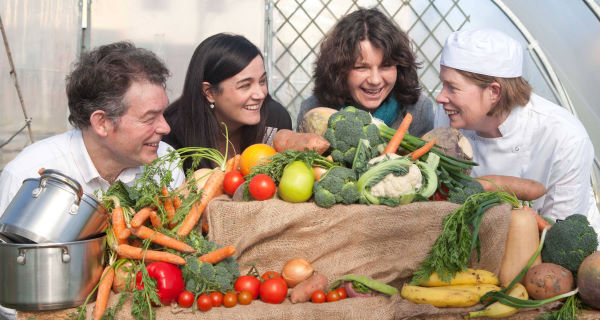
Next Saturday, two 1,000 litre pots will be fired up on Cork City’s Grand Parade to cook a free vegetarian curry for 5,000 people.
Using perfectly edible vegetables otherwise earmarked as waste, the event is part of the new Cork Food Policy Council’s first proper public engagement and is designed to highlight the extraordinary volumes of food waste each year in Ireland and around the world.
The council is a partnership seeking to establish a sustainable, healthy food strategy for Cork with representatives on the steering group from the community, the food retail sector, farming, fishing, restaurant/ catering, education, environmental and health sectors and the local authorities and is chaired by Colin Sage, senior lecturer in Environmental Geography, in UCC.
“The Cork Food Policy Council brings together people with different interests across the breadth of the food system,” says Sage.
“It was formed because many of us are of the view that the food system is not working in a socially efficient way. Certainly, it is regarded as a highly sophisticated machine producing high-quality food and offering it at the lowest possible price but if you go beyond that, you have a system with problems.
“For example, ill health would be one of those problems: 60% of Irish adults are overweight or obese and you don’t have to believe this is a failure on the part of the consumer, that they are solely responsible, an idea that would be put across by something like Operation Transformation, that it is entirely the consumer’s fault.
“In fact, this is a feature of a food system that delivers large volumes of food containing large amounts of sugar, salt and saturated fat, essentially, highly processed food.
“The system is set up to push large amounts of food, to sell the highest volume possible through promotions, two-for-one, and this is resulting in first of all, large volumes of food waste and, secondly, large amounts of food unnecessarily consumed.
“If you consider the average consumption of calories is about 2,800 a day when we can probably metabolise about 2,000 calories a day so the extra 800 goes on as body fat,” says Sage.
While there are many interest groups tied up in the council, the Feed the City initiative is very much about promoting the work of one new body, Bia Food Bank.
In 1967, American John Von Hengel was walking down a street in Phoenix, Arizona when he spotted a Mexican woman pulling waste food from a bin. He stopped her and instead walked into the shop and asked the owner if he could take any waste food for distribution to those most in need. And thus he began the international Food Bank movement, with a national network across the US by 1975.
In 1985, Frenchman Bernard Dandrelle established the first European food bank.
Von Hengel died in 2005 and his gravestone epitaph reads: ‘The poor we shall always have with us but why the hungry?’ Five years after his death, the UN released figures confirming 2010 was the first year that over 1bn people around the world went hungry while 1.3bn tons of food was disposed of as waste.
The Irish version, Bia Food Bank, is being spearheaded by Eoin McCuirc, a CSO manager who is also a director of the Cork Simon Community and who over the years, had been involved in other charitable initiatives working with the poor and homeless when he came across a Dublin-based food bank Crosscare which inspired him to dream up a national version.
“At first I thought this is great, why not do it in Cork,” says McCuirc.
“But I saw there was a national need and when you factor in economies of scale, you can take in all of the donations if you have a national infrastructure,” he says.
Bia has raised €100,000 in funding and is looking to raise another €150,000 to operate. It has already secured a base in a large refrigerated warehousing complex in Little Island with any food manufacturer, wholesaler or retailer donating waste food delivering it there to be later distributed by Bia to various charities. “We act as a broker,” says McCuirc.
“It allows charities serving the community such as Vincent de Paul or Simon to concentrate on other work than sourcing food. We are saying to the food industry, ‘give us all your surplus food, we will take good care of it and ensure it goes to someone who needs it, not a person, but always a charity that knows the need and we guarantee it won’t be sold,” he says.
“There are 5,000 families being supported by Vincent de Paul in Cork and, nationally, 21% of children go to bed hungry at night. And the charities’ budgets are constantly being reduced so we are saying, ‘here’s this food, now use the money you save to counter the effects of those budget cuts.’
“The food bank will not solve all the problems but it is worth creating and ensuring that nobody goes hungry in our city and nothing is wasted,” he says.
corkfoodpolicycouncil.com biafoodbank.ie
CONNECT WITH US TODAY



Be the first to know the latest news and updates

















