Inside The Centre: The Life of J. Robert Oppenheimer
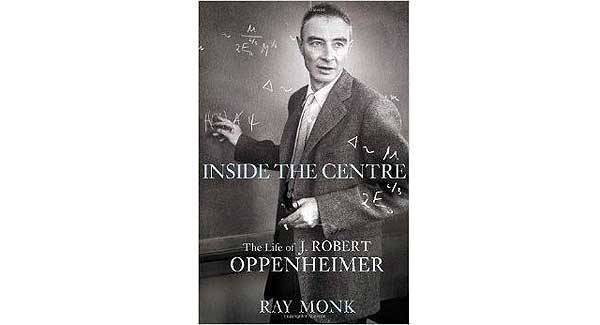
Ray Monk Vintage, £12.99 paperback.

Inside The Centre: The Life of J. Robert Oppenheimer

J. Robert Oppenheimer, as head of the Los Alamos Laboratory in New Mexico — the Manhattan Project — oversaw the Allies’ successful effort to beat the Nazis in developing the first atomic bomb in World War 2. Dig deeper, though, and Oppenheimer’s is a strange life; exotic and incomprehensible, like the subatomic world he studied.

A remarkable intelligence, and a leading figure in physics in the 1930s and 1940s, he was also a fragile personality — he had an unconventional upbringing, including a desire to downplay his Jewish heritage — and was ill-equipped emotionally to deal with accusations of disloyalty during the communist ‘red scare’ witch-hunts conducted by Senator Joe McCarthy in the 1950s.

Though incredibly intuitive about quantum mechanics, and responsible for the United States’s strong position in these sciences before the war, the man’s own orbit was curiously limited.

Born privileged, to New York Jewish merchants, he was only partially accepted by the ‘in crowd’ when anti-Semitism was on the rise; nor did he make it easy on himself to be accepted, as he shifted from group of friends to group of friends, compartmentalising them and discarding them.

In later life, he was attracted to other men’s wives, leading to professional friction: a promising working relationship with chemist, Linus Pauling, was ceased as a result of his approaches to Pauling’s wife, Ana. He was prone to mathematical gaffes in the papers he published, smearing his own reputation as surely as he smeared his personal life with inappropriate advances and long-running affairs.

This is a dry biography, as dry as the Mesas in the American Southwest where this strange city boy sought to find himself after various crises in his life; there are glimpses of colour, as blooms in the desert, but they are few and far between. There are many questions posed by this biography, but few are answered in a life full of loose ends.

This is mostly down to Oppenheimer himself. Monk — who has previously written biographies of Bertrand Russell and Ludwig Wittgenstein — is methodical, detail-focused and thorough. Oppenheimer’s flaws should be obvious to one so brilliant, but they remained, and become frustrating to read about.

Monk concludes that Oppenheimer was a committed supporter of the Communist Party of the USA in the 1930s, but there was no evidence of him ever having betrayed his country.

Later in life, though politically isolated for his communist connections, Oppenheimer was to play a role in the arguments between right-wing militarists and left-wing intellectuals about nuclear proliferation; in spite of having earlier gone on the record condemning the left-wing activities of one of his students, Bernard Peters.

Would he have been as great if he also had not been lucky? Lucky to have been at Cambridge in 1926, while Paul Dirac and Ralph Fowler were making their great theoretical breakthroughs in quantum mechanics? Lucky to have been able to correspond with Niels Bohr and Erwin Schrˆdinger, when they were at the height of their powers?

It’s hard to say; but Oppenheimer’s obsession with the scientific discipline he helped to found, and his ability to synthesise prodigious amounts of new material, made him whole for a time; and his greatness at the frontier of knowledge shines through, in spite of his many flaws.

More in this section

Cookie Policy Privacy Policy Brand Safety FAQ Help Contact Us Terms and Conditions

© Examiner Echo Group Limited













