Meta tales from academe
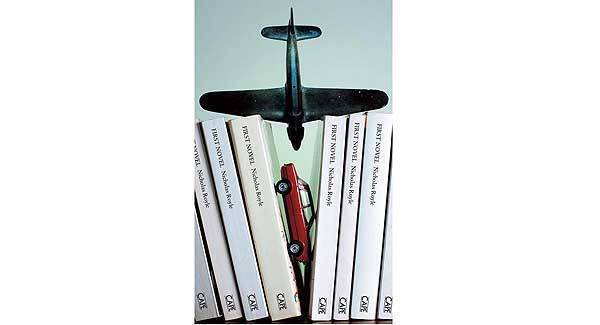
This just might be the exceptional book which should be judged by its cover. Consisting of a shelf of books, each bears the title First Novel and the author, Nicholas Royle, with various signs of spine wear. Two of the books tilt away from each other into a V where a dinky car and toy plane are shoved.
It represents a lot of what is going on in the book where the central character, Paul Kinder, a novelist and creative writing lecturer, is obsessed with first novels of real-life novelists.
Every particularity of literary taste is nuanced to the nth degree, for instance in his collection of first novels he has a section reserved for those published by Picador with white background and black print on the spines.
Magazine articles on writers’ writing dens are examined microscopically to the extent that the preferred chairs of writers are analysed more than their written words which are only mentioned in passing.
This fetishising of the world of literature is a particularly knowing and modern extension of the idea that the medium is the message. It slyly suggests that in the way we now absorb the world we can know all we need to know about the writer from the spine colour of a first novel and the preferred chair (there is one digression on which writers prefer castors — this group includes Colm Toibín and Martin Amis, apparently).
Sex is also fetishised here. When Paul Kinder is not obsessing about the minutiae of the literary world he is he obsessing about where sex happens — in cars parked as close as possible to airport runways. For the uninitiated, dogging is the jargon word du jour. Whether he’s talking about books or sex there is a remoteness to his contemplations.
“I would take out the odd volume and smell the pages and gently press the pads of my fingers against the covers, as once I might have touched a woman.”
All of these details are hinted at by the cover. If it were left to Paul Kinder to review this book written about him by Nicholas Royle he might refer to the fact that Royle has six previous novels and lectures in creative writing at Manchester Metropolitan University.
Kinder might also refer to the fact that the jacket photograph of Royle appears to have been developed through a sheet of stained gauze.
These are the kind of observations that permeate this clinically written and knowing modern novel. Sometimes the attention to detail gives the book a creepy and edgy quality as the raw emotional experiences of the characters are left to fight to assert their place in a sea of microscopic details.
You really have to roll with this book or it could just read like a detached exercise in literary self-regard. Even going along with it to a large extent one aspect that proves grating is the frequent device of saying, either ‘he will’ or ‘he won’t’, either ‘she did’ or ’she didn’t’, and so on.
For those who prefer a more directly told human story they will find this to be a more halting kind of read as scenes from lives are coldly curated.
Described as a mystery it is certainly an interesting read and it would make an interesting addition to the syllabus of any university creative writing course, either in Manchester or not in Manchester.















