Waning Obama presidency loses sparkle
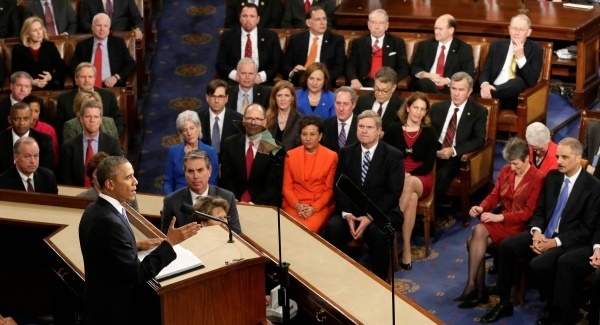
Now, if Barack Obama is still remoulding the planet, he’s doing it in baby steps.
Hemmed in by Republicans, slowed by personal missteps and leaking inspiration after five rough years, the US president has embraced incrementalism.
Obama did unfurl a punchy, optimistic State of the Union address this week, billing the fight against income disparity as the defining project of the age.
But there was no multi-billion dollar programme or a “moonshot”-style challenge for 21st century Americans.
Instead, Obama offered modest, targeted plans using the power of his office to bypass Congress, which has let its own reforming muscle wither.
Once, Obama vowed to slow the oceans’ rise and to mend Washington’s “broken politics.”
Now, he plots a way over the political mire — with “ladders” to give everyone a leg up on retirement savings, a decent wage, education and health care.
“What we are seeing is a different Barack Obama,” said William Rosenberg, a professor of political science at Drexel University, Philadelphia.
Obama powered into office on a wave of expectation and had the luck to follow a deeply unpopular predecessor in George W. Bush.
He exploited Democratic control of Congress to pile up the kind of legislative record that few recent presidents could boast — banning torture, saving the auto industry and passing big health care and Wall Street reforms.
But now, with power in Washington divided, the hope and change that defined him is largely in the past.
One example: Obama has spent years waxing lyrical on the need for immigration reform. But on Tuesday he trod carefully on the issue — his one potential second term domestic legacy win — lest he spook conservatives agonising whether to sign up.
On the other potential big ticket item — a nuclear deal with Iran — Obama was more firm, promising to veto any new sanctions he says could kill diplomacy.
But the new Obama is neither a seeker of consensus nor a political pit bull fighting Republican lawmakers to exhaustion.
Instead, he bills himself as an independent, activist president, using regulation and fiat to bend the political climate his way.
He will raise the minimum wage for federal workers even if Congress won’t do it for everyone. He will regulate power plants to cut harmful emissions if he can’t pass meaningful climate change bills.
And he will call on CEOs not to discriminate against the long-term unemployed even as Republicans will block job stimulus plans.
But the power a president can wield alone is finite — more tinkering than transformation.
And at times this week there was a sense of a White House assigning work to keep itself busy with three years still to go — for example Obama’s charge to vice president Joe Biden to launch a review of work training programmes.
Presidents are often frustrated by America’s adversarial centres of power, a political system that auto-corrects after sharp changes of direction and power that ebbs with the two-term clock.
But Obama’s eclipse has been more marked, such was his historic promise as the first African American president.
It is tempting to wonder what the Obama of 2008 would think of the programme he rolled out this week.
Candidate Obama saw himself as a transformative president, more Ronald Reagan than Bill Clinton — who Obama aides privately criticised for an incremental approach.
At least Obama appeared fresh — more lively than the listless leader who limped off to Hawaii after a brutal 2013.
He came across as a president determined to make the best of his remaining time.
Obama seems to have made a calculation that while he lacks power to pass tax reform or bring peace to Syria, he must concentrate influence where it is most effective.
One senior aide, however, argued vehemently hours before the State of the Union speech against claims Obama was now just working at the margins.
Try telling a poor student that got into college that their chance was not a big deal, the official said, slamming conventional media wisdom in Washington.
While they lack sparkle, moves like raising take home pay, and widening access to health care and education can make a difference, said Maureen Conway, of the Aspen Institute.
“I think they do have a tangible impact, they get at basic family economic issues. They are fundamental to the way people live their lives every day.”
But the president must be careful ahead of mid-term elections in November.
Pushing executive power too far will spur Republican charges of a power grab and discomfort vulnerable Democrats in mid-term elections.
But if Obama holds back, Washington pundits will be ready to brand him a lame duck.
The economy is better, even if not everyone’s feeling it yet. With Congress unlikely to deal on most issues, Obama must keep expectations low, without putting people into a funk. If they’re not already there, that is.
Polls show people are pessimistic about the country’s direction and the economy. Seventy percent think unemployment will stay the same or get worse in the next year.
As for Obama, “both his supporters and his opponents are worried that he has lost his enthusiasm and his energy for the political contest,” says Calvin Jillson, a presidential scholar at Southern Methodist University in Dallas.
Jillson points to Obama’s own comments in a recent interview that he’s “overexposed” and that it’s natural for people to want something new “after six, seven years of me being on the national stage.”
Obama had an awful 2013: His top legislative priorities went nowhere, Edward Snowden’s revelations about government spying caused an uproar, the launch of his health-care plan was plagued with problems and a budget dispute led to the first government shutdown in nearly two decades. Looking forward, he faces the prospect of diminishing power: his party is expected to lose ground in the mid-term congressional elections and public focus increasingly will turn to the contest to select his successor.

CONNECT WITH US TODAY



Be the first to know the latest news and updates

















