A Tender tale of Romeo and Juliet
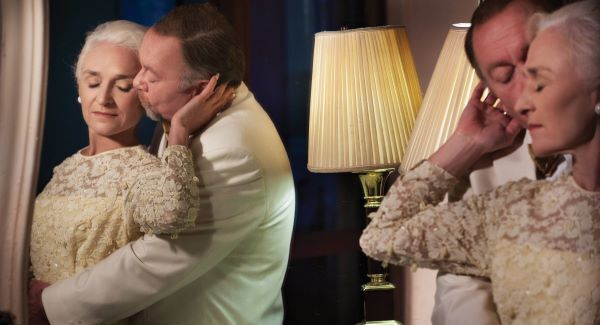
IT’S Thursday afternoon and Olwen Fouere and Owen Roe have just gotten out of bed. “We were pretending to have sex,” says Fouere, reassuringly emphasising the “pretending”.

A Tender tale of Romeo and Juliet

“We didn’t take anything off, but we did have moments where we’d say, this would happen, that would happen.” She laughs as Roe chimes in: “We got into bed and started improvising.” Don’t we all?

The pair are rehearsing A Tender Thing and the scene is not in the script. It was an exercise prompted by the play’s director, Selina Cartmell. If the aim was at building a convincing relationship as an on-stage couple, it’s either worked or simply added to what they have already established. Roe and Fouere are easy with each other, and, there’s an element of divilment in them. They joke and swap tales of rehearsals with ease, as if they were students out of earshot of their teacher on breaktime.

‘We laugh a lot,” says Roe.

“We are comfortably physically together,” Foeure adds.

“That’s crucial, especially for this one,” Roe goes on. “There are a lot of moments where you’ve got to trust the other person. There are dark moments in this. It is a celebration of love, but the relationship must be true, so you’ve got ups and downs, conflict and misfortune.”

In A Tender Thing, playwright Ben Power re-imagines Romeo and Juliet as a couple in their 70s. But here’s the ingenious thing: he achieves this largely as a cut-and-paste job, slicing up the original and putting the rearranged lines into the mouths of his now aged lovers. It’s an intellectual exercise, but, for the actors, it’s a case of reaching for the emotional truth made possible by the play’s hard-won and crafty coherence.

“You tend to forget where things came from.” says Fouere. “When I read the play first I had a very physical response to it. That’s the only way I can describe it. It somehow gets underneath... it totally bypassed the intellectual exercise for me. That’s its beauty, it has this eternal moment feel to it.”

Nonetheless, says Roe, “it’s brilliant. It’s very clever what Ben has done.” But Roe too goes back to the emotion that lifts it beyond mere cleverness. “It was a very personal thing for Ben too. Selina was talking to him and she says he became very emotional talking about why he wrote it, talking about his own parents.”

Both Roe and Fouere come to this show on the back of Irish Theatre Award-nominated performances. Fouere for her virtuoso showing in her reworking of Finnegans Wake for the stage, riverrun, and Roe for his King Lear, in a version directed by Cartmell.

Both, indeed, have a long relationship with the director, stretching over several shows each in the last decade, including a version of Samuel Beckett’s Catastrophe in 2006, in which they both appeared. “I had a real strong sense of her,” says Fouere, of her first encounter with the British-born director. “A strong feeling that she would be really interesting to work with. I saw her first show [Titus Andronicus in 2003] and it had the hair standing on the back of my neck. Selina is completely tireless and absolutely relentless in the pursuit of things,” she says. “She never gives up. She will get you to do it every which way, but something always comes out of it.”

Culturally, we are not often exposed to expressions of passionate love by septuagenarians. To that end, A Tender Thing redresses the balance. In some ways, too, the depth of emotion in Shakespeare’s lines do sound more convincing when spoken from experience, as here, rather than the throes of youthful ardour, as in the original.

“It’s definitely more convincing for Juliet,” Fouere leaps in. “I find her really irritating in Shakespeare’s text. Here, she’s much more interesting. Because she is a woman who has experienced all that passion, that life, lots of other things. Maybe I’m being unfair, maybe it’s how she’s been interpreted, but I’ve seen her so often directed to be not quite as feisty as she could be.”

Though both Roe and Fouere play characters a generation older than themselves, they can draw from experience in constructing their characters. Roe is no stranger to long-term love. He has been married 30 years this year, to actor and writer Michelle Forbes. “We met the first day of acting school,” he says. “Very soon after we started going out. And the rest is ancient history. It has its ups and downs like all relationships, but we’ve always worked at it. We’ve always felt it was worth sorting out any problems because we’re friends as well, we still make each other laugh. I think that’s crucial.”

Roe also thinks of his own parents while playing the role. “Romeo is completely devoted to her. And I’ve seen that in my father,” he says. “He’s very much in the back of my head when I’m doing this. He had that romantic sense about him towards my mother. What the two seem to have is great friendship which is what’s needed to sustain a relationship. In the younger Romeo, it is sheer romance, now it’s a real friendship and love.”

Fouere, too, finds herself drawing on personal experience, though perhaps not her parents. “My father’s first love was Brittany,” she laughs, before recalling an aunt and uncle who, at 80, would still hold hands walking down the street. “I’ve witnessed more of that kind of love not in English-speaking countries,” she says. “It’s more current, that sensual, sexual love is more current, in my experience, in places like France or Spain. But, as Brien Friel said, the Irish are the Mediterraneans of the north, when they let go of their repressions.”

* A Tender Thing opens at the Project Arts Centre on Jan 27. Previews from Jan 23. www.projectartscentre.ie

x

More in this section

Cookie Policy Privacy Policy Brand Safety FAQ Help Contact Us Terms and Conditions

© Examiner Echo Group Limited













