A Wilde way to celebrate the Everyman
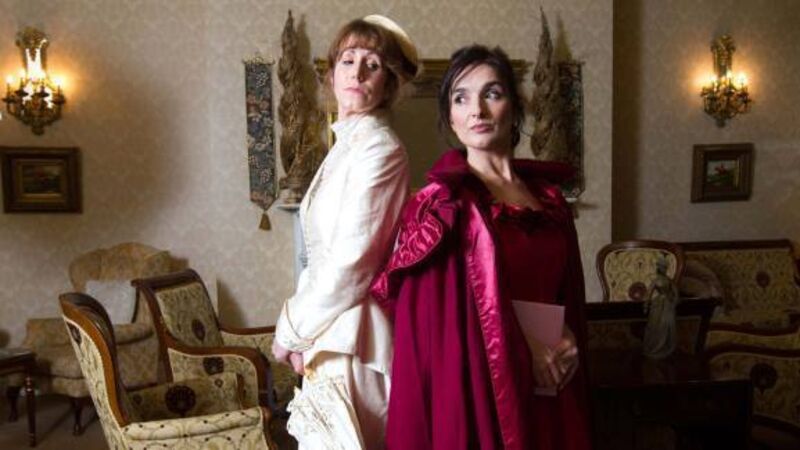
Twomey is revisiting his favourite Wilde play: he directed it 12 years ago. The 1895 comedy-drama is about blackmail and political corruption, and is an astute study of the upper echelons of London society. Some of the actors from the 2002 production are returning, including Conor Dwane, as Lord Chiltern. Shirley McCarthy, who played the ingénue, Mabel Chiltern, back then, is now playing the blackmailer and femme fatale, Mrs Cheveley. Ian McGuirk is playing Lord Goring. Design is by Jim Queally.
The play “has assumed a tremendous topicality,” says Twomey. “You have the political corruption in it and the blackmail. There is this undercurrent running through it, with state secrets being sold for money. It’s extraordinarily relevant to today’s world.”
While The Importance of Being Earnest is regarded as Wilde’s best play, Twomey is drawn to the greater depth in An Ideal Husband. He notes the influence of Norwegian playwright, Henrik Ibsen, on Wilde. “Ibsen was very much sympathetic towards women. Wilde was also sympathetic, and the suffragette movement was on the way. But, at the same time, Wilde was very honest about London society, so you have the character of Lady Markby, who was a typical Victorian woman at the top bracket of society. It’s a great comedy role, played by Ronnie O’Shaughnessy. Lady Markby has no time for any changes in society. She’s married to a politician, but can’t stand politics. Wilde has her digging at politicians and the government, reflecting his own views. Then, there’s Mrs Cheveley, who is one tough lady. And you have Mabel, who’s a modern young miss and is not going to turn out like the older women.”
The opulence of the set and costumes, while suitably celebratory for the Everyman’s landmark birthday, poses its own challenges in these straitened times. “There’s a cast of 13, but they need about two dozen costumes, because the opening scene is a soirée, followed by the next morning, with the characters in their day-time costumes,” says Twomey.
Mary Newman, who made the costumes for the Everyman’s production of Lady Windermere’s Fan three years ago, is mixing and matching the costumes from that production to reduce costs. Finding Victorian furniture was a problem, so Queally designed a minimalist set with just the essential pieces of furniture.
Going to the theatre on opening night is not the big social occasion that it used to be. Wilde wrote An Ideal Husband as a four-act play, interspersed with 30-minute intervals and drinks all round. But Twomey hopes this opening night will revive that sense of occasion.
The Everyman was the brainchild of director, John O’Shea. (Dan Donovan and Seân Ó Tuama were also involved). “There were a lot of amateur theatre groups operating in Cork at the time, all drawing from the same pool of actors. John had the brilliant idea of combining the groups and forming the Everyman Theatre Company to produce a season of plays. The first building for the company was the CCYMS hall, in Castle Street. Some fantastic shows were done there. Then, in 1972, when the company needed to expand, it went into the Fr Matthew Hall and became the Everyman Play House. I was in plays there. The first play I did with the Everyman was Luther, directed by John. I played a cardinal in it.”
Twomey’s debut as director for the Everyman was Arthur Miller’s seminal play, Death of a Salesman. “I had a fabulous cast. Dan Donovan played the lead role of Willy Loman, while the late Lorna Daly played his wife. That play transferred to the Cork Opera House, the only Everyman play to do so. It created a bit of a sensation.”
Towards the end of the 1980s, “the priests who owned the Fr Matthew Hall were extending the annual Feis at the venue. With the period of the Feis expanding, it was cutting into our season of plays. When the Palace Cinema came up for sale, the Everyman bought it. A deposit was put down on the building, as a result of fund-raising and various individuals who gave wonderful sponsorship at the time.”
Funded by the Arts Council and Cork City Council, the Everyman developed a separate administrative structure, which allows the Everyman Palace to originate co-productions and residencies, and operate both as an associate and host venue for visiting companies.
Twomey says that John B Keane’s first play, Sive, in which he starred as the singing tinker, Carthalawn, was a much-needed injection to the Irish theatre scene. “That was in 1959. At the time, Irish theatre was in the doldrums, going nowhere. It sprang to life with Sive (which was rejected by the Abbey Theatre). It was sold out in Cork. John B Keane was responsible for reviving Irish theatre. After him came the likes of Brian Friel. I was fortunate to have a lot of dealings with John B Keane and adored him, and am a huge fan of his work.”
Twomey will present his talk, ‘John B and Me,’ to the Cork Literary and Scientific Society, in February, at the Crawford Art Gallery. He says that John B was as adept as satirist Wilde at capturing a sector of society: Wilde portrayed London’s salons; Keane portrayed the priest-ridden world of rural Ireland from the 1950s onwards. Both writers have provided the Everyman Theatre Company with great plays over its half-century.
*
CONNECT WITH US TODAY



Be the first to know the latest news and updates