What the economists predicted for 2013
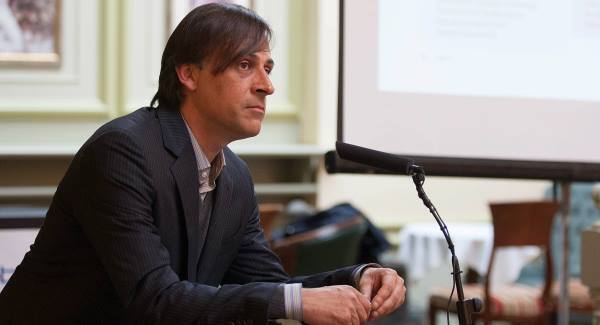
Two years ago, at the second Kilkenomics festival, I asked economists and commentators where Ireland would be in two yearsâ time. Ever the jokers, more than one of them replied literally: â50 miles west of Walesâ.
Those I questioned included Argentinaâs youngest-ever finance minister, Martin Lousteau, investment banker Vikas Nath, co-author of Economics For Dummies Peter Antonioni, economist Constantin Gurdgiev, broadcaster and film-maker Max Kaiser, and economist David McWilliams.
All had pessimistic outlooks. It appeared that Ireland was staring into the financial abyss. A default on our sovereign debt looked inevitable, and dropping out of the euro and devaluing some form of neo-punt looked like the logical, if terrifying, path for the country to follow.
The most pessimistic talked of riots on the streets and empty ATMs. McWilliams, Antonioni and Keiser all said that a default was inevitable.
Keiser was emphatic.
âDefault is inevitable, but everything will be more obvious in two yearsâ time. It depends on the global situation, as they (global economies) are all interconnected,â he said.
Antonioni foresaw Ireland coming out of a tough recession on its own currency.
âIreland will be coming out of a pretty tough recession. If they go according to the script, Ireland will probably be back on its own currency. If things donât go according to the script, (Ireland) will be on its own currency alongside the euro.â
McWilliams was accurate in predicting that the economy would still be in trouble.
âThe economy will be a little bit weaker. There will be a little stagnation. House prices will be more or less where they are â maybe 10% lower.â
McWilliams said that the policy being followed, austerity, meant that the economy could not recover and he said that there was âno doubt,â that Ireland would have defaulted.
In the last two years, much has happened.
Ireland has technically defaulted, through re-negotiation of promissory notes, but not in the manner that most people had anticipated.
The most accurate and optimistic forecast was made by Nath.
âPersonally, I donât see any default. If there is a euro, then Ireland will be a part of the euro. The economy is dynamic, the country has potential. It can come out of this without having to de-value or default,â he said.
Oddly, Nathâs assessment of why Ireland wouldnât default has very little to do with economic fundamentals, and more to do with our national personality.
âMuch like David McWilliams, I am sceptical about traditional, macro-economic data and models. Instead, I like to look at the character and societal make-up of the people in a country. To me, the Irish have always been a well-educated, hard-working and inventive people, with a lot of pride, who have suffered a lot in their history, but have always bounced back.
âAn Argentine or a Russian might have walked away from his obligations, but it is unlikely that someone from Ireland will. You are honourable people,â he said. Two years after his prediction, Nath admitted that he had been lucky but pointed out that, as an investment banker, betting on emerging markets for 20 years, he has developed a ânoseâ.
He remains optimistic about Ireland, too, and believes that Irelandâs recovery will soon gain in both strength and speed.
But what happened to all of those predicting a new punt?
âWell, I donât regret my answer. What I did was underestimate, as many of us did, the degree to which political capital would be thrown in to defend the euro,â said Antonioni, when asked to consider his prediction.
Antonioni said that predicting the future in economics is as difficult as in everyday life.
âEconomic forecasts are especially tricky, because they are contingent, so if âwild cardâ events take place, they can have the effect of making all predictions about that system out,â he said.
Nath warned against sensationalism and economists looking for press coverage. âThe problem arises when they try to grab headlines and focus on sound-bytes. âMy recommendation is that whenever you get a forecast, be rigorous in asking âwhy?â
McWilliams said the danger was that they might twist the data to fit their prediction, instead of admitting that they are wrong.
âNever fall in love with your own prediction,â he wisely added.
* The Kilkenomics festival will take place from Nov 7-10, in Kilkenny.
It will feature a range of economists, comedians and analysts, who will all hold forth on the health of the Irish and world economies.
* www.kilkenomics.com














