Pinter's Betrayal gets to the heart of the matter
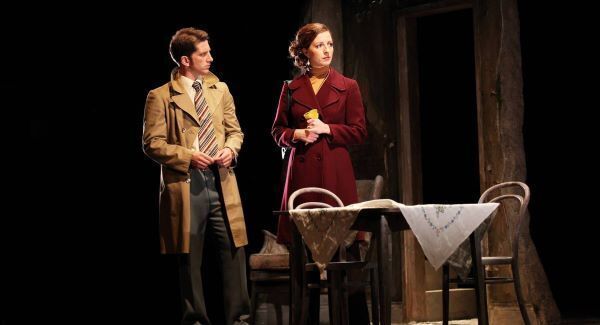
About a seven-year affair between a married man, Jerry, and a married woman, Emma, the play was inspired by Pinter’s relationship with BBC television presenter, Joan Bakewell.
The two are betraying their spouses, but Jerry is also betraying his friend, Robert, who is Emma’s husband. Robert, a publisher, also has affairs, while Jerry, a literary agent, is married to the unseen Judith, who might also be cheating.
The play’s use of reverse chronology is clever and revealing. The first scene takes place after the affair has ended, in 1977. The final scene ends when the affair begins, in 1968.
In between, working backwards, there are seven scenes. As director, Michael Cabot, of London Classic Theatre, says the play is an interesting exercise that is “almost like an investigation.” The structure is akin to a snake shedding its skin, he says.
Cabot, a Pinter fan, says Betrayal is the English playwright’s “most personal and most accessible play. There’s no sense of being distanced from it. The audience, once it gets its head around the structure, engages with the play straight away. Pinter knows the subject matter intimately. It’s a much more emotionally connected play than a lot of his other work.”
Layers of emotional baggage are stripped away as the play works back to the genesis of the affair. While the play is about deception and the ruthlessness of a clandestine relationship, Cabot is not judging Jerry and Emma.
“In their own way, they could be said to be selfish. But I’m not sure about calling them amoral. I try to look on them in quite a kindly way.
“If you start judging the characters, you stop being objective. As soon as you start to feel that people are doing something bad, you create a distance.
“I’m encouraging the cast to understand why the characters behave as they do,” Cabot says.
“Actors have to find some connection with the characters they’re playing.”
Cabot’s approach is to see Jerry and Emma’s affair “as a relationship in its own right. I went into rehearsals wanting to make sure that we treated Jerry and Emma’s relationship with as much truth and weight as we did Robert and Emma’s marriage. The reason Jerry and Emma get together is because there is probably something lacking in their marriages.”
But Pinter doesn’t provide his characters with reasons for their actions. Emma and Robert’s marriage seems to be relatively happy. Are the adulterers amusing themselves, living lives full of intrigue, satisfying their desires? “I think there’s a degree of that. But there’s a moment, late in the play and early in the chronology, when Emma asks Jerry if he has ever thought of changing his life. She’s really asking him if he’d consider a future with her. At that moment, that is a possibility for Emma,” Cabot says.
However, Jerry says it’s impossible. “There’s an element of Jerry that is quite comfortable being in a certain territory that isn’t too demanding.”
Cabot says that behind Pinter’s economical language, where no word is extraneous to events, there are hidden depths. The first scene is a meeting between Jerry and Emma, after the affair has ended.
Emma, who at this point is having an affair with an author, tells Jerry that Robert has been betraying her with other women for years.
She says she told her husband about Jerry. In the second scene, Jerry meets Robert to talk about the affair. Robert discloses that he had learned about the affair four years previously.
“There is so much in these two scenes to dig into. They were the scenes that I spent the most time discussing with the cast. As the play moves backwards in time, it was as if each discussion got a little bit lighter.
“When we rehearsed the final scene (set in 1968), when the affair begins, we did very little talking. It just kind of worked because, at that stage, there was very little to tell, other than the fact that Jerry ran into Emma at a wedding. They have an instinct about each other; a kind of spark. Jerry gets drunk and, for the very first time, he confesses to Emma how he feels about her. Everything is very simple at that point. The complications come with time.”
The structure of the play begs the question as to whether Jerry and Emma would have behaved as they did if they had known as much as they know when the play kicks off.
“One of the things I’ve taken from this play is that people are very much pattern-led. They make the same decisions and mistakes, again and again. We’re very much creatures of instinct. Even if you know the consequences, it doesn’t change behaviour.”
Cabot says it’s like asking a smoker or a heavy drinker whether they would have had that first cigarette or drink if they had known the damage it would do.
Most people, he says, wouldn’t change their behaviour, even with the benefit of hindsight.
“There is a moment, at the very end of the play, where Emma could walk away, after Jerry drunkenly kisses her. She could pretend it didn’t happen and see it as a terrible mistake. But Jerry’s hand finds hers and he pulls her back. There’s an inevitability about it.”
Drink, says Cabot, “is a great facilitator at the beginning of Jerry and Emma’s relationship. Alcohol features quite strongly in this play.” Despite the characters’ sophisticated milieu, they are at the behest of their baser instincts. Call it lust or love, but Jerry and Emma’s affair has implications for their spouses and their unseen children. Cabot allows the audience to form its own judgement.
* Betrayal runs at Cork’s Everyman Theatre from Oct 14-19.
CONNECT WITH US TODAY



Be the first to know the latest news and updates

















