Astronomy Ireland gearing up for Ireland's biggest telescope festival
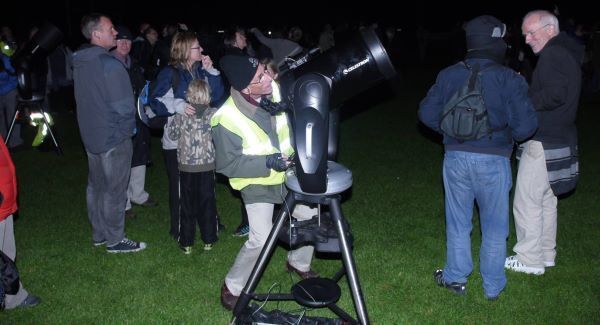
This annual Astronomy Ireland fundraiser is an evening of celestial enlightenment: powerful telescopes will chart the ‘heavens’, with a barbecue as refreshment. “We even have a trick up our sleeve to beat the Irish weather, should the need arise,” says Astronomy Ireland director, David Moore. “We will still have demonstrations, guest speakers and the barbecue on the night, regardless of the weather. However, if the sky is overcast, a separate, telescope-only event will be organised for the following weekend, where people will still get to see the wonders of the universe.” Ireland’s best-known astronomer, David will present a ‘guided tour’ of the universe, starting with Earth and our solar system, moving out to the stars in the Milky Way, distant galaxies, and the edge of the universe.
As this year will be the best to see the northern lights, keynote speaker, Dave Gradwell, will discuss solar storms and how they trigger aurora displays. “The sun varies in activity every 11 years, but this, latest cycle has proved difficult to predict. His talk will explain the solar cycle, why this one has bucked the recent trend, and what influence a strong solar maximum could have on our day-to-day lives,” says Dr Brian Espey, from TCD, who will discuss light pollution.
Astronomy Ireland is the largest national astronomy club in the world relative to population. Founded in 1990, it had grown to 13,000 members in 2011, on a platform of promoting astronomy, space interest and education, through talks, lectures and star-gazing sessions.
“The advent of the internet and social media has helped enormously, both in terms of communication and accessing information. Nowadays, if a star explodes, it’s out there in an hour, whereas, 20 years ago, we relied on posting information to members.
“We now have 20,000 on our mailing list, which is really quite remarkable, and further underlines why we are the largest astronomy club in the world, relative to population.”
Astronomy Ireland’s education programme, for primary and secondary schools, social clubs, youth clubs and community meetings, has been another of the organisation’s notable successes — and part of a greater plan for the years ahead.
“Science plays a such an important and fundamental part in our lives, and the aim of this initiative is to promote astronomy and to help build a science culture for Ireland. This is part of the huge future for Astronomy Ireland, and an obvious area for us, given that 40% of our members are under 18,” says David.
Telescope technology has enabled anyone with an interest in astronomy to access information from the comfort of their own home, creating a community of users —‘citizen scientists’. The Gloria Project, the first free and open-access network of robotic telescopes, is an environment where users can research and analyse data that other users have acquired. “There has been a strong Irish involvement in the establishment of the Gloria Project, and anyone who wants to use a telescope can get involved,” he says. “There are projects such as studying super novae, exploding stars that have helped us to determine how old the universe is.
“There are also hundreds of thousands of asteroids going around the sun that haven’t been accurately catalogued. With this kind of telescope network, that is a project that you could undertake as a citizen scientist.”
* Astronomy Ireland Star-B-Q, Aug 31. See www.astronomy.ie
“One of the best ways to start is by using a pair of binoculars,” says David Moore, of the essential kit for aspiring astronomers. “Those with long lenses are particularly good, and cost upwards of €25.”
Common combinations are 7x35 or 8x50 — the first figure being the magnification, the second the aperture. “Astronomy happens in the dark, so larger apertures — those big front lenses — are best for collecting more light to see fainter things.”
When it comes to telescopes, a simple rule applies — ‘try before you buy’. Visit your local astronomy club, or go to a reputable dealer, and test the options. “People coming to our Star-B-Q will have the chance to see all sorts of telescopes,” David says. “It’s the place to ask questions and see them in action.”
Telescopes have plummeted in price in recent years, and are within the range of most pockets.
“Twenty years ago, the cost was equivalent to a week’s wages. Nowadays, it’s more like a day’s pay.”
A serious astronomy enthusiast should expect to pay upwards of €500, but starter models can be much cheaper.















