Gingers happy to ‘see red’ at festival
Ms Primmer was subjected to ‘gingerism’ — the bullying of people with red hair. In the UK, gingerism is real.
Also in 2007, a family from Newcastle was forced to move house twice due to bullying caused by their children’s red hair.
Tabloid favourite, Chris Evans, regularly has his name splashed across the front pages of Britain’s (ahem) ‘red tops’ beside the terms ‘ginga’ and ‘carrot-top’, while singer Mick Hucknall has described ‘gingerism’ as being akin to racism.
In November 2008 Facebook pulled a fan page for a ‘Kick a Ginger’ group, which aimed to establish a ‘national kick a ginger day’. The page had 5,000 likes.
Most redheads have been derided for their hair.
Historically, redheads have been singled out as untrustworthy and/or oversexed.
In the Middle Ages, red-heads were believed to have an insatiable, animalistic sex drive. James Joyce wrote that red-haired women “buck like goats”. In art, Mary Magdalene is often depicted as red-haired and, of course, the greatest traitor, Judas, was a redhead.
In truth, the reason redheads have a hard time is probably simple numbers.
Across the world, the ‘fear and bean rua’ account for only 1% of the population and are a minority (if not a race).
Just 10% of Ireland’s population has red hair (but, shhh, don’t tell the Americans).
The pop of ginger tops is Scotland, where 15% of the population is redheaded, the highest proportion in the world.
There are theories as to why red-heads are more common in northern Europe than elsewhere. One suggests that redheads survived better in the less sunny climes of the north, where their pale skin absorbed enough vitamin D from the sun.
As professor of genetics at University College Dublin, Geraldine Butler says the variables in getting red-hair are complex.
“If one parent is a redhead, then he or she will pass a mutant ‘redhead’ gene to their children,” she says.
“If they get a normal gene from the other parent, they won’t be red-heads.
“If both parents have one normal and one mutant gene, they won’t have red hair themselves. But they randomly pass on either the normal or the mutated gene to their children.
“So, therefore, there is a 25% chance that the child will inherit both mutant forms and will have red hair.
“You need to inherit two mutated genes, one from each parent, in order to have red hair. This explains why red hair is rare and also explains why people without red hair can have redheaded children.”
Although Professor Butler says that “the chance of inheriting two mutated genes is getting lower, because people are mingling more”, rumours of the redhead’s demise are greatly exaggerated.
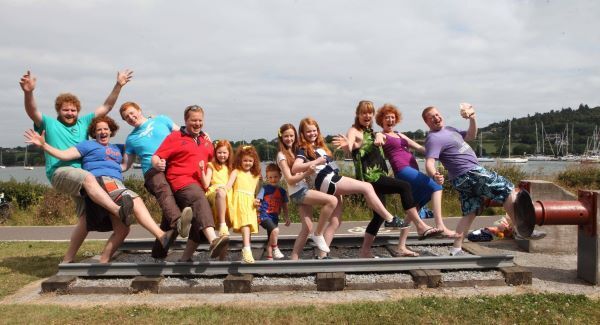
That’s good news for Joleen and Denis Cronin, who, this weekend, are celebrating the fourth annual Irish Redhead Convention in Crosshaven, Co Cork.
The event was dreamt up by the siblings, both proud redheads, when a friendly joke in their family’s bar sparked off an idea.
“It was coming up to my brother’s 26th birthday,” says Joleen. “And we were sitting in the family pub, when we asked Denis what he wanted to do for his birthday.
“Someone said ‘ah, sure, we’ll have a party and we’ll only invite people with red hair’. That got us and our friends thinking about red-haired themed events, like carrot-tossing, orange lawn bowling and freckle counting.
“It just became sillier as the night went on.”
Silly it may have been, but, as owners of a pub, the Cronin’s were well used to running events and, within weeks, the redheaded dream became a reality.
Since its inception, the convention has raised €7,500 for the Irish Cancer Society.
Recently, National Geographic ran a feature saying that redheads were declining, but it seems unlikely that they will be extinct by 2100, as some news rooms have seemed eager to suggest.
Who knows? If things go well among the 2,000 redheads expected to descend on Crosshaven this weekend, there might be a few more little red noggins knocking around at next year’s redhead festival.
www.redheadconvention.com















