Welcome to the home of the future
This restlessness for change in such a trite, superficial feature it made me wonder yet again about things likely to alter our homes more profoundly in the next 20-30 years. Futurology far from gazing into a crystal ball, uses the sciences to plot probable developments in all areas of our lives.
One of the most inspiring and energetic voices in futurology with a proven track record in accurate prediction, including technology and the environment, Dr Ian Pearson, is trusted by businesses and corporations to help steer the waters ahead. He suggested text messaging as a leading voice in the Network Development team at BT in 1991. With a background in science, engineering and trends, he’s optimistic about our domestic environmental changes.
“Well, you can forget the hassle of the car for starters. Self-driving cars or ‘pods’ will just be ordered up to the door, as and when you need them.”
I laughed nervously at this idea, but he goes on, “actually, in some US States, the scheme is under license and operational as part of the public transport system.” (But with drivers at this point). Could this happen in Ireland within 20 years? “Certainly — and it will make a garage and parking space redundant, plus pushing down the cost of essential infrastructure like roads.”
What about rural areas? “Well,” Dr Pearson maintains, “the car might take longer to get to your door, but once in place it will still be within a matter of minutes as opposed to one minute in the city. I’m just an engineer making logical deductions for tomorrow based on things we can already see happening.”
Indoors, one of logical extensions of today’s home will be the growing presence of the “casual screens”. These are not just fixed screens built into appliances and positions, but a projected, augmented reality seen through visors that we’ll pop on as naturally as glasses or slippers. Every surface of the house from the front of the fridge to tabletops and walls can carry a visual.
As well as using imagery for music, TV and film, we can beam up the form of a favourite friend to chat with in real time, right beside us on the sofa. The casual screen could also be used to change pictures displayed on the walls, and to redecorate surfaces at a whim. “Two to three years ago,” Ian explains, “the Travel-Lodge chain used screens to project lovely views inside the hotel, to raise their budget surroundings to a five star. Using this technology we could sit on a Caribbean beach in our living-room or look at a gorgeous view through a virtual window.” Could this progress to brain implants to interface with all this?
“Oh most certainly, in 40 years, without a doubt. All this technology will be affordable for everyone.”
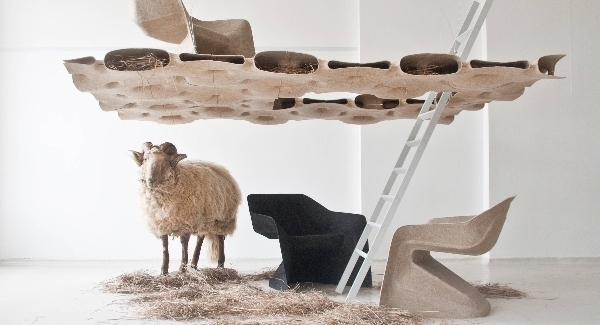
Dr Pearson is certain of increased use of a new super carbon all around our homes, called Graphene. Among its many talents, Graphene can cheaply purify water and is as strong as steel. It can be used to make everything from knives to furniture, so along with the environmental champions such as hemp, wool and wood, you can look forward to revolutionary materials joining standard inclusions all around the house.
What about 3D printing? Having seen shoes printed in plastic, I wondered if we could print out our own furniture or even clothes from designs bought online? Dr Pearson is circumspect. “The printers are expensive, and it’s really only plastic. I can see dedicated companies printing out pieces and parts rather than having to order them in. What it does mean is freeing up our creativity. If you can imagine it and use a computer, it can be realised easily, a great development for our artistic sensibilities.”
Will there be robots? “Robotics have already arrived but the Japanese market is driving this trend much further, introducing home companions for the elderly for example.” Could we all soon have a virtual butler to answer the door and fix the tea?
“The cost for robotics,” Dr Pearson adds puckishly, “is falling dramatically.”
In terms of power, gas and electricity will be the norm, according to Dr Pearson.
“Gas is still cheap and plentiful.” Certainly the increasing push by gas companies here to install stand alone gas tanks for LPG for rural homes, seems to support his prediction, that it could soon be gas for all. He is not a fan of active solar energy at home in its present form. Apart from what he terms the ‘horrible aesthetics’, he points out that in order to make a domestic water or photovoltaic (electricity) system, the toxic, CO2 chemical processes run counterproductive to the object of the exercise. The design and manufacture needs, according to Dr Pearson “serious review”.
Currently the majority of new Irish builds slide past Part ‘L ‘of the Building Regulations on sustainable energy using a raft of solar panels on the roof. Pearson goes on to point out that the UK’s Royal Institution of Chartered Surveyors (RICS) have released a statement on solar’s cost effectiveness for the consumer saying the payback time for solar panels ranges from 100-165 years.
Still, the future for Ireland is bright according to Dr Pearson, a proud graduate of Queen’s University Belfast.
“We will think ourselves out of this energy mess we’re in at the moment, and don’t forget the economy is increasing by 2.5%-3.0% annually even with the recession. Things are not as bleak as people imagine and the march of technology is a good thing.”
* Dr Ian Pearson is a Chartered Fellow of the British Computer Society, the World Academy of Art and Science, the Royal Society of Arts, the Institute of Nanotechnology and the World Innovation Foundation. His work can be found at www.Futurizon.com or by googling his extensive opus of popular blogs, books and articles followed worldwide.
CONNECT WITH US TODAY



Be the first to know the latest news and updates

















