Pope Pius XII still can’t shake off the claims that he was Hitler’s Pope
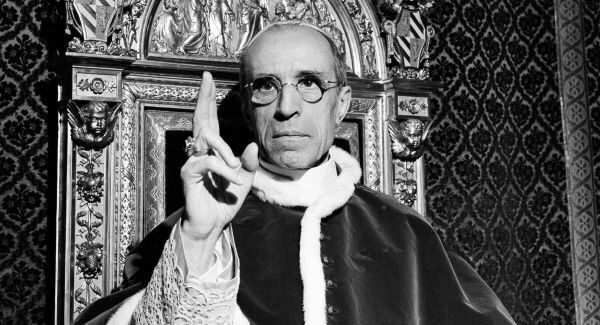
The situations were very different as were the numbers of victims of different evil regimes. Of Jorge Mario Bergoglio it is claimed that, when he was provincial of the Jesuits in Argentina, he failed to openly condemn the military junta who ruled Argentina with brutality from 1976 to 1983. Of Eugenio Pacelli, it is claimed that as pope, he failed to speak out against Hitler and the Nazi regime. Specifically, Pius XII is accused of failing to unequivocally condemn the Holocaust.
If the two men have their accusers, they also have their defenders. Sergio Rubin, author of The Jesuit (a biography of Bergoglio), said much of the criticism of Bergoglio was misplaced. Under Bergoglio’s leadership, Argentina’s bishops issued a collective apology in Oct 2012 for the Church’s failure to protect its followers.
Argentina’s 1980 Nobel Peace Prize winner, Adolfo Perez Esquivel, himself a victim of the dictatorship, insists that Bergoglio is stainless. “There were bishops who were accomplices, but not Bergoglio,” he says. “There is no link relating him to the dictatorship.”
Another Jesuit, Fr Robert Graham, a US historian, is among the staunchest of Pacelli’s defenders. And now comes a new book, The Pope’s Jews, from the prolific pen of Gordon Thomas, author of Pontiff (1983), about the attempted assassination of Pope John Paul II.
Subtitled ‘The Vatican’s secret plan to save Jews from the Nazis”, it is already the subject of plans for a feature-length TV documentary by Allen Jewhurst, who has produced documentaries for the BBC’s Panorama programme.
In fact, the book is structured like a film script, with a lot of cross-cutting between scenes and individuals. This gives the narrative a lot of pace and colour. But while the author at the outset lists teams of researchers in various locations, the book has no footnotes or endnotes.
Overall, the author paints a compelling picture of the bravery of Jews in the Rome ghetto, and the manner and extent to which Pius XII worked to save them and Allied prisoners of war. A key figure in all of this was the Kerry-born Monsignor Hugh O’Flaherty, dubbed “the Vatican pimpernel” (which is also the title of Brian Fleming’s 2008 biography of the priest).
However, the central criticism levelled at Pius XII — that he failed to openly and directly challenge Hitler and the Nazis — is not refuted by Thomas. On the contrary, he accepts that the pope took a deliberate decision not to publicly confront and condemn fascism.
“Pacelli had decided that, horrific though the persecution was, there must be no public denunciation by the Church. To do so would, he believed, destroy an effective strategy he had devised to protect the Jews and give them an opportunity to escape the Nazi tyranny... The strategy was silence. Any form of denunciation in the name of the Vatican would inevitably provoke further reprisals against the Jews.”
As the Irish ambassador to the Holy See pointed out in a confidential communiqué in May 1964 to the Department of External Affairs (as it was then known), Pius XII did not issue an encyclical “before the end of the war and during the actual period when persecution of the Jews by Hitler was rampant” in “condemnation of national-socialism”.
The ambassador added that Pius had his “own good reasons” for not issuing an encyclical, but this failure remains a major stain on his reputation, and his “good reasons” have not acted as a shield against his critics.
In spite of this, Thomas is convinced there are still documents in the Vatican’s secret archives that will rescue Pius XII’s reputation. He points out that it may well be 2020 before this wartime documentation will appear.
The controversy over Pacelli’s role was dramatically reopened in Feb 1963, with the first production in Berlin of Rolf Hochhuth’s play The Deputy. In a preface in the published edition of the play, Dr Albert Schweitzer wrote: “Not only is it an indictment of an historical personality who placed upon himself the great responsibility of silence; it is also a solemn warning to our culture admonishing us to forego our acceptance of inhumanity which leaves us unconcerned.”
It is now widely accepted that the Pius XII portrayed by Hochhuth in The Deputy was a gross and cruel caricature. Nevertheless his reluctance to follow the example of his predecessor, Pius XI, who published the encyclical Mit Brennender Sorge (“With Burning Anxiety”) in 1937 branding Nazism as fundamentally anti-Christian, has enormously damaged his record.
Gordon Thomas also pays due tribute to the role of Monsignor O’Flaherty, who worked in the Congregation of the Holy Office (now the Congregation for the Doctrine of the Faith, which was headed by Cardinal Joseph Ratzinger before his election as Pope Benedict XVI). One of his network of helpers was the singer Delia Murphy whose husband, Thomas Kiernan, was the Irish Ambassador to the Holy See during the Second World War.
Interestingly there is nothing on the record to reflect O’Flaherty’s view of Pius XII, other than acknowledging that he operated with the Pope’s support.
But in Fleming’s biography, the singer Veronica Dunne, who was in Rome at the time, recalled that O’Flaherty was “quite disillusioned” with the politics in the Vatican. “On more than one occasion, he said to her that politics there were worse than elsewhere”.
Is this why O’Flaherty was never rewarded with an Irish Diocese? Why was he never made a bishop?
Buy this book














