Right to life — but not for the mother
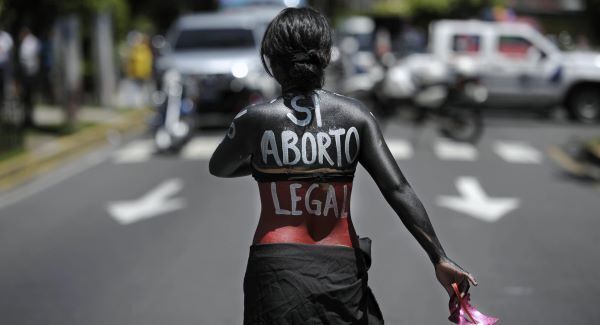
IF Savita Halappanavar had been pregnant and in difficulty in El Salvador, doctors would have been legally obliged to leave her die.

Right to life — but not for the mother

In this small Central American nation, abortion is more grievous a crime than ‘ordinary’ murder. There are 49 women serving sentences for interrupting pregnancy, charged with “aggravated homicide”, which has a maximum sentence of 50 years. Any doctor deemed to have interfered with the life of the unborn will be sentenced to 12 years in prison, a risk that resulted in 13 women dying last year, denied life-saving medical intervention. If a woman travels abroad for a termination, she faces a possible two-year sentence on her return, as an ‘accomplice’ to the crime.

However, wealthy Salvadoran women travel abroad for terminations, or can request medical intervention in private clinics at home, where doctors ask no questions.

The imprisoned invariably are from impoverished rural backgrounds or marginal urban neighbourhoods. The legislation dates back to 1997, when Church pressure led to a prohibition on abortion in all circumstances, even when the health of the mother was at grave risk.

“The Spanish inquisition was easier on women than the Salvadoran government today,” said Monica Roa, a lawyer with Women’s Link Worldwide.

In the past month, El Salvador’s stringent abortion laws have been tested, as Beatriz X, a 22-year-old woman, five months pregnant, would most likely have died had she completed her pregnancy. Three sonograms confirmed that the foetus was missing large parts of the brain and skull, due to anencephaly. The baby would survive, at most, for a few days.

Beatriz suffers from lupus, which weakens the kidneys. During a previous pregnancy, she spent 40 days in intensive care. In mid-April, after five months of waiting, Beatriz recorded a video appeal to President Mauricio Funes. “I want to live, I want to be with my baby boy and my husband,” said the distraught woman from her hospital bed. “I’d like them to interrupt the pregnancy now... I would like people to respect my decision.”

The video was widely disseminated, prompting a campaign on both sides of the debate. José Luis Escobar, archbishop of San Salvador, said that mother and child could be saved. “I really wonder if interrupting the pregnancy is the best thing for her. With quality care, she can remain healthy and her child will be born.”

The medical team treating Beatriz, composed of 15 experts, determined that the foetus was bound to die and the mother faced a ‘grave’ risk of suffering the same fate. The Inter American Court of Justice ruled that El Salvador was in breach of human rights standards by denying Beatriz urgent medical attention. The government, a centre-left administration, feared a bruising battle with the Church, which might affect its chances of re-election next year. Days passed and the issue went before the supreme court. The subsequent ruling, by four votes to one, ordered Beatriz to complete her pregnancy, stating that “the rights of the mother cannot be given priority over those of the foetus, regarded as a human being with full rights at the moment of conception”. The judges’ statement included a veiled threat to the worried doctors; “they are strictly obliged to carry out their work with reference to the constitutional mandate” but also added that the decision to “intervene medically” to save Beatriz would be left in their hands.

The dangerous stalemate prompted the Spanish government to offer asylum, while support groups collected money to pay for her ticket and the cost of the operation. But Beatriz’s weakened condition, and the lateness of the initiative, left her unable to take up the offer. A team of UN health experts described Beatriz’s ordeal as “cruel, inhumane and degrading” piling on the pressure.

On June 3, health minister, Maria Isabel Rodriguez, supported a one-off permission for immediate medical treatment that would have no judicial consequence for doctors or patient.

On June 4, after 27 weeks, medical staff delivered a baby girl which, as expected, survived only for a few hours. Beatriz remains hospitalised, due to her weak condition, but, earlier this week, sent another message to the government.

“I am sad, because the baby died, but I don’t want anyone else to suffer like I have.” The doctors treating Beatriz have said they fear that without legislation “another Beatriz” is bound to happen.

The irony of El Salvador’s draconian regime is that research produced by the World Health Organisation concluded that stiff laws do not affect rates of abortion. On the contrary, they increase the number of dangerous interventions that kill women, with an annual, global death toll of 40,000.

“It is difficult to defend a right which no-one wants to have to use,” said Monica Roa, a lawyer working to repeal strict abortion legislation in Latin America, “but we must ensure that women enjoy a minimum of protection, so that no-one dies because an abortion is denied.”

Roa, a Colombian activist, filed a successful lawsuit in her own country, persuading judges that abortion was a fundamental right in three circumstances. Since then, shots have been fired at her office and she has state bodyguards watching her home round the clock.

In October 2004, Cristina Quintanilla, a Salvadoran woman from an isolated village, gave birth, bleeding profusely. When she arrived at the nearest health clinic, doctors declared the baby dead and called the police, accusing her of murder.

Quintanilla was chained to her hospital bed for three days, and questioned by police while still under anaesthetic. Her 18th birthday was the previous day and she already had a two-year-old boy. Quintanilla was escorted from hospital bed to jail cell, and sentenced to 30 years behind bars. “I had lost my child and, the next thing I knew, I was in jail,” she said.

In the past 10 years, 129 Salvadoran women have been accused of murder by termination of pregnancy, of which 49 were sentenced to lengthy prison terms. Quintanilla was ‘lucky’ in that her sentence was commuted after four years, but she missed out on critical stages of her child’s development, including his first day at school. “The state won’t give me that back,” she said.

Many women accused of interrupting pregnancies say they didn’t even know they were pregnant, with one woman sent to jail after arriving at a clinic, just two months pregnant.

At a recent pro-life rally in Dublin, John McAreavey reportedly said that the legalisation of abortion in other countries had “unleashed a terrible sadness across their societies”, but El Salvador’s implacable laws, and Ireland’s equivocations, have, arguably, unleashed a much greater sadness, with no end in sight.

The Catholic Bishops of Ireland stated this week that “no individual has the right to destroy life and no state has the right to undermine the right to life”, echoing the sentiments of Salvadoran clergy. As Irish politicians prepare to legislate on behalf of pregnant women who require abortion, the death of Ms Halappanavar, and the miraculous survival of Beatriz, should be at the centre of their reflections, if the cycle of sadness and death is to be overcome.

More in this section

Cookie Policy Privacy Policy Brand Safety FAQ Help Contact Us Terms and Conditions

© Examiner Echo Group Limited













