Autocenter for the people
FALSE OPTIMISM, at the Crawford Art Gallery in Cork, is an exhibition by artists working in Berlin.
The exhibition is a partnership between Peter Murray, director of the Crawford, and Joep van Liefland and Maik Shierloh, of the Autocenter, Berlin.
The Autocenter is an independent space, founded in 2001 in Berlin city centre. Irish artists have flocked to Berlin for its vibrant art scene and affordable rent on living and studio spaces. Many have shown at the Autocenter.
“Berlin is a centre for artists from all over the world,” says Murray. “You’re as likely to find artists from South Korea, the United States or Ireland. In total, there are 15 artists in this exhibition, four of whom are Irish.”
Declan Clarke is one of the Irish artists living in Berlin. ‘False Optimism’ includes the premier of his silent, black-and-white video film, ‘We Are Not Like Them’ (2013), which has 1950s references. It shows Clarke travelling to four European, post-industrial cities. The architectural legacy is central to the work.
A second Clarke film looks at Richard Burton’s role in the film, The Spy Who Came in From the Cold, based on the book by John le Carré.
“This is full of all these nice resonances, because it was filmed in Smithfield, Dublin,” says Murray, “and not in Berlin. For the making of this film, they recreated Checkpoint Charlie in Dublin in the 1960s. Many artists are now interested in the archaeology of contemporary art. Contemporary artists seem to be delving into the past more than ever before.”
Van Liefland also has a piece in the exhibition. ‘Untitled 9 (My Name is Nobody)’ is a large, framed grid of VHS tapes treated with paint and framed. “He’s turned what used to be the cutting edge of modern technology, 15 or 20 years ago, into a museum piece,” says Murray.
“You hardly see a video recorder anywhere for sale, anymore. It’s a meditation on how things contemporary become historical almost immediately.”
Painter Tatjane Doll’s large canvases depict Lucky Luke, the popular, Belgium comic-strip hero, in otherworldly silhouettes. Doll employs unorthodox methods.
Il-Jin Atem Choi and Becker Schmitz have transformed a room with post-it notes in their piece, ‘Brennstoffzelle’. The walls, ceiling, and floors have been stickered with these small, yellow squares — 40,000 of them.
Atem Choi has three, large drawings in the exhibition. Simplicity is the key: lines drawn in black marker create optical illusions of depth.
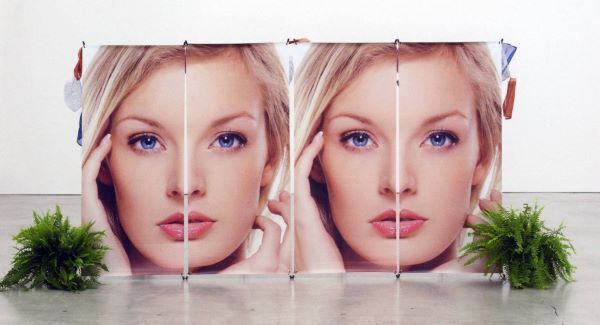
Timur Si-Qin is an American artist of Mongolian heritage. His work deals with the clashes of these cultures. On one side of ‘Ancestral Prayer’, giant pictures of a white, blonde, pretty lady are presented like an advertising billboard. On the reverse, traditional prayer flags are strung through the metal supports of the billboard. Si-Qin’s other work, ‘Lynx Effect’ (2012), is a stack of bottles of Lynx shower gel run through with an antique sword.
Peggy Franck’s ‘Drawing From a Store of Thought’ (2012) is a giant screen of orange/pink plastic on an aluminium frame, which gives a new view of the gallery’s 18th-century paintings as visitors move through the space.
Franck is a Dutch artist concerned with recycled materials, mainly industrial plastics. ‘A Household Without Responsibilities’ (2013) is a sculpture of found objects resting in a bathtub.
‘Absolute Vitality’ is a stand pulled from a trade fair by American artist duo, AIDS-3D. This is the name of a legitimate company. The name is spelt in large, mirrored letters against the backdrop of green plants. There is a cheesy feel to the display, which is a commentary on modern society.
Kitty Kraus has made an installation for ‘False Optimism’. In a darkened space on the top floor, Kraus has a series of light sculptures, which throw patterns around the room. Kraus works with materials of a fragile nature, often with the intention of destruction. These installations are made of ‘auto destruct’ pieces in which Kraus will use a strong wattage that will explode within the work after a couple of days. This untitled work has been put together without that threat, and there is a serene atmosphere within the installation.
“Some of the art in this exhibition in like arte povera,” says Murray. “It’s only an electric lightbulb, or squares of glass, or the post-its. These are things you can buy in any hardware store. There are art objects that can be made very simply from objects that are almost discardable.”
*False Optimism runs until June 1.

CONNECT WITH US TODAY



Be the first to know the latest news and updates

















