Letting your young child use the iPad? A smart move?
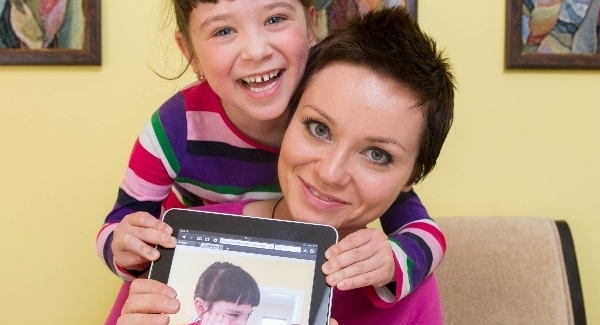
Daria Adamska has learned the hard way not to let her six-year-old play on the iPad at home.

Letting your young child use the iPad?  A smart move?

The Co Cavan-based mother-of-two had got into the habit of giving little Michelle their iPad to occupy her on long-haul flights back to Adamska’s native Russia.

“However, we found that if she was allowed to use it for more than an hour she was always in a foul mood, very irritable and uncooperative and hyperactive. Also, she wouldn’t go for a nap afterwards.

“We learned the hard way that we had to set limits,” says the 30-year-old Russian native.

Adamska’s not the only parent to come face to face with the dark side of smart technology — in one particularly extreme case a four-year-old girl in England had to undergo psychiatric treatment after being diagnosed as Britain’s youngest iPad addict.

Adamska knows all about the drawbacks of computer technology — she runs an online hosiery business, DressMyLegs.ie from her home in Bailieborough — so she decided to ban Michelle from the iPad at home and also set limits on the time her spent playing laptop games.

“We really limit her access to the computer games. They have to be age appropriate and there has to be a learning aspect to them and we only let her on for about an hour a few times a week — not every day.”

However, she points out, as the internet is an integral part of modern life, she can’t ban it completely.

“Like anything else, moderation is the key. I’d be very cautious about allowing Michelle access to smart technology.

“Now if we say a half hour on the laptop we stick to it and we put an alarm clock beside it so that she knows when her time is up. ”

Larry Rosen, a professor of psychology at California State University, warns that the impact of smart technology on young children has not yet been comprehensively studied.

In his book, iDisorder: Understanding Our Obsession with Technology and Overcoming its Hold on Us, Rosen says parents should be more careful about the amount of “stimulating” technology their kids are exposed to on a regular basis.

Dr Kate Byrne, a child and adolescent psychologist says, “People shouldn’t be too complacent about the long-term effects on kids because we don’t know what they will be.”

While there are many positive elements to smart technology it can be used as a learning tool, to carry out research and for enjoyment — it has a downside, she believes.

“There’s a fear that if kids use too many forms of electronic media they won’t use their imaginations as much as if they were reading a story.”

Byrne also worries about the impact on focus of the constant pop-up advertisements, and the over-stimulation, which leaves children tired and cranky.

She believes Adamska’s approach is correct.

“Overexposure to anything is not good. I think it could be damaging to let children play endlessly with technology.

“I’d also be concerned about the impact it has on their imagination and their communication skills, because smart technology gets in the way of ordinary communication.”

It also impacts on the amount of exercise they take, she warns, adding that there is a lack of parental awareness about smart technology.

“It simply has not been around long enough for us to see the long-term effects and I’d caution parent to be sensible.”

It’s damaging to let children do too much of anything — so why should smart technology be any different, asks child and adolescent psychologist Dr Patrick Ryan, at University of Limerick.

All things in moderation, he believes: if you let children use touch-screen equipment for hours on end, he warns, they not only miss the opportunity to engage in other childhood activities — interacting with family, playing with friends, helping with chores, or even just talking to mum and dad.

“Parents give it to them because children just love modern technology,” says, Ryan, author of the teen parenting book, You Can’t Make Me.

Parents also allow it because it keeps children quiet, but he warns, “If it becomes a habit and the child becomes conditioned to having it on demand, the parent ends up giving in because to break their expectations causes temper tantrums.”

Over-use, or use in an unregulated, unsupervised way has been shown by research in the USA to affect literacy and numeracy skills and the children miss out on learning the rules of social interaction, he warns.

“Be sensible and practical — if you’re on a two and a half hour flight and the child is on the DS for an hour, that’s fine. It’s when it happens every day that there can be problems.”

More in this section

Cookie Policy Privacy Policy Brand Safety FAQ Help Contact Us Terms and Conditions

© Examiner Echo Group Limited













