How safe is the land of the free?
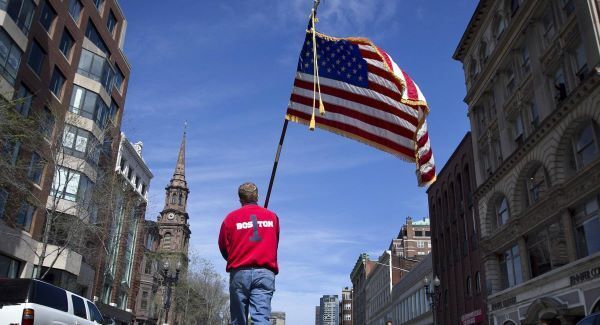
The order of magnitude speaks for itself: three dead in Boston, nearly 3,000 in New York City. Still, in the aftermath of the Boston tragedy, it is impossible not to ask the same questions that came on the heels of 9/11: just how safe are Americans in their homes, in their workplaces, on their streets, and at their celebrations? And just how safe can they be?
At time of typing, the two brothers, ethnic Chechens from Russia, suspected of bombing the Boston Marathon seem to have been motivated by a radical brand of Islam but are not connected to any Muslim terrorist groups. Dzhokhar Tsarnaev has been charged with crimes which could bring the death penalty.
Tsarnaev, aged 19, was charged in his hospital room, where he is in a serious condition with a gunshot wound to the throat.
His older brother, Tamerlan, aged 26, died after a gun battle with police.
“Have you ever read The Turner Diaries?” one counter-terror adviser to the Obama administration asked provocatively when questioned about the case. The reference was to a racist diatribe that partly inspired Timothy McVeigh’s bombing of the federal building in Oklahoma City 18 years ago. But the adviser would not elaborate.
The bombs used in Boston were improvised explosive devices, IEDs, made from everyday pressure cookers filled with easily fabricated explosives as well as nails and ball bearings to act as shrapnel.
But one thing seems clear: the primary danger facing the United States today is no longer a 9/11-type attack resulting in thousands of casualties but rather smaller-scale violence, whether foreign or domestic in origin. “Are we safer than after 9/11? Absolutely. Are we absolutely safe? No,” says a veteran official whose career in counter-terrorism goes back decades. “And you’re never going to be. That’s the challenge.”
To understand the threats the US faces, it makes sense to begin with al Qaeda. Osama bin Laden is no more, but his successor, Ayman al-Zawahiri, is still at large. One of the organisation’s most dangerous operatives, Adnan Shukrijumah remains a major worry for the US, where he was brought up and knows his way around.
The Arab Spring that erupted in early 2011 disrupted or destroyed critical intelligence relationships that Washington had cultivated for years in the Middle East with dictators like Egypt’s Hosni Mubarak, Tunisia’s Zine al-Abidine Ben Ali, Libya’s Muammar Gaddafi, and, yes, even Syria’s Bashar al-Assad. All were focused on fighting the threat of Sunni jihadi terrorism. Now those intelligence networks are weak or non-existent.
Daniel Benjamin, who was the State Department’s coordinator for counter-terrorism until last year, insists that “right now there is no greater threat to the United States from that region than there was before those revolutions.” Some of those in the counter-terrorist trenches would beg to differ, however. The veteran official, who declined to be identified, says that “the expansion of al Qaeda affiliates is just incredible”.
In the past 12 months alone, the State Department has added two new organisations to its list of terrorist groups, al-Nusra in Syria and Ansar Dine in Mali.
The biggest worry now — and Benjamin shares it — is in Syria.
The Quilliam Foundation, an anti-radical think tank in London, has tracked an even more ominous trend: the effective alliance of Syria’s al-Nusra and Iraq’s branch of al Qaeda, which increasingly operate as a single and effective organisation-fighting the Syrian regime on one front, the Iraqi government on the other. US Defence Secretary Chuck Hagel announced this week that up to 200 troops will be sent to neighbouring Jordan to “prepare for a number of scenarios”. In the past such deployments in other parts of the world often have been used as a screen for expanded covert operations.
Meanwhile, Obama’s secretive drone war may seem remote, but killing suspected terrorists can sometimes create dangers even as it terminates enemies.
In early 2010, the police chief of a major American city said that he had started to worry about those drones and their possible consequences for security in the United States. By this point drones were already Obama’s weapon of choice in the struggle against al Qaeda. The president’s goal was to shrink America’s footprint in the wars of 9/11 while continuing the fight against the most dangerous bad guys. Soon after his inauguration, he began to step up the covert CIA programme. At the time he accepted the Nobel Peace Prize in December 2009, he had authorised more drone strikes than George W Bush had approved during his entire presidency. (There were only nine strikes conducted in Pakistan between 2004 and 2007. In 2010 there were 111.)
By his third year in office, Obama had approved the killings of twice as many suspected terrorists as had ever been imprisoned at Guantánamo Bay.
There was little doubt that the programme was effective as a tactic; drone strikes routinely killed “high-value targets” on the CIA’s hitlist. The Washington Post quoted a CIA official relaying the boast of the CIA’s counter-terrorism chief: “We’re killing these sons of bitches faster than they can grow them.”
Yet at the same time, drone attacks had become another pretext for terrorists to plot against American targets. Which is what worried the above-mentioned police chief.
A glaring example was the case of Najibullah Zazi, a 24-year-old Afghan-American obsessed with the US drone war, which he claimed was indiscriminately targeting innocent civilians in Pakistan and Afghanistan. In 2008 he travelled to Pakistan and trained at an al Qaeda camp. In 2009, along with two friends from Flushing, Queens, he plotted suicide bombings at New York’s two major railway stations, Grand Central and Penn Station. Fortunately they were thwarted by foreign intelligence collection and good old-fashioned police work. But had they succeeded, the bombings would likely have been the deadliest attacks on the homeland since 9/11.
“We’re seeing that blowback,” retired Marine Gen James Cartwright, Obama’s former vice chairman of the joint chiefs of staff, recently told the Chicago Council on Foreign Relations. “If you’re trying to kill your way to a solution, no matter how precise you are, you’re going to upset people even if they’re not targeted.”
The most insidious plan for revenge by al Qaeda came out of its affiliate in Yemen as the drones turned their sights on the radicals there in 2010. With direction from the charismatic American-born propagandist Anwar al-Awlaki, the AQ acolytes made ambitious bids to carry out attacks. They persuaded a young Nigerian to fly to Detroit with explosive underwear and blow up a plane, but all he did was burn his genitals. The Yemen crew sent bombs by international courier service to Chicago, but the packages were intercepted.
Yet the furore in the politically divided United States was so great, and the panic of the international community so obvious, that the failures were, in their own way, successful. And al Qaeda in Yemen started to lower its sights still further. With the publication of a slick online magazine called Inspire, it sought to spread the open-source technology of terror in English to anyone who might be interested, even if they ignored or detested the al Qaeda ideology.
10 issues of Inspire are now available on the web. One of the first, famously, taught you how to “build a bomb in the kitchen of your mom”. That infernal device was much like the ones made from pressure cookers that blew up in Boston.
In 2011, Awlaki and the magazine’s editor were blown away in a drone attack, but the publication goes on. Right-wing nuts can use it; so can Black Bloc anarchists and, for that matter, conventional criminals and extortionists. All may have their own reasons for creating mayhem, but they also serve the general cause of disruption.
These sorts of lone wolves — whether inspired by al Qaeda or a domestic agenda — are in many ways the toughest cases for law enforcement.
Of course, Obama himself has encouraged the public to move on from 9/11. Since coming into office, he has pushed the idea that terrorism ought to be de-emphasised in public discourse.
Yet, as Obama knows, the core objective of terrorists is not to conquer territory but to conquer the psyche of average citizens.
To the extent that Americans can show restraint and go on with their lives in the face of tragedies like the one in Boston, terrorism — whatever form it comes in — will never succeed.
* Christopher Dickey is the Paris bureau chief and Middle East editor for Newsweek and The Daily Beast. Daniel Klaidman is a national political correspondent for Newsweek and The Daily Beast. Eli Lake is the senior national-security correspondent for Newsweek and The Daily Beast.
* (c) 2013 Newsweek/Daily Beast Company LLC. All rights reserved.















