Bringing high-flying thrills to the masses
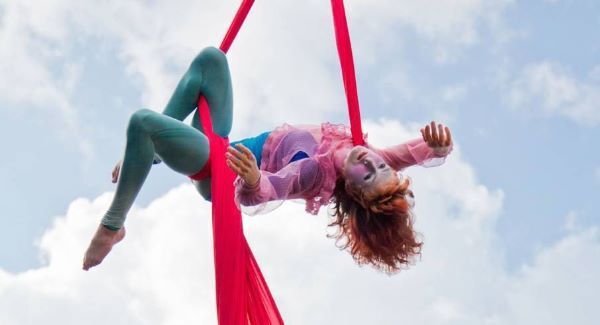
With insurance and development barriers hindering their progress, husband and wife team Jym Daly and Chantal McCormick took their Fidget Feet company to London to upskill.
The Donegal-based couple then returned to Ireland and produced a flurry of work that excited audiences and inspired the next generation. One such group that has benefited from the training opportunities they provided were Paper Dolls.
“I met the rest of the girls who would go on to form Paper Dolls at Fidget Feet work shops,” Emily Aoibheann remembers. “We quickly realised that doing a two week workshop every couple of months was not going to bring us to a level where we could really explore the art form. So we took it upon ourselves to sort out a space where things could happen.”
Paper Dolls secured a training space at the Complex in Smithfield, Dublin, and put on a self-titled show at the Absolout Fringe in the city in 2011.
“We went straight from there to enrol in a year-long aerial and acrobatics training course at Belfast Circus School.”
When they returned to Dublin, the Complex had been closed, so they found a new home at axis: Ballymun. The centre’s director, Mark O’Brien allowed them workshop their Constellations show, which would eventually win top prize at this years Dublin Fringe Festival, if they gave workshops to the local community. “Teaching is part of the ethos we inherited as part of our relationship with Fidget Feet,” Aoibheann says.
Paper Dolls recently launched a two hour conditioning and technique class over seven weeks, which allowed people with no experience of aerial to pull up a rope and give it a go. Students were taught the fundamental vocabulary of aerial and began to learn the relationship between themselves and the apparatus.
“It’s so much easier to grasp once you have that foundation of body awareness under your belt. It’s how we were taught. We had to be able to do certain things before we were rewarded with learning a trick.”
Small steps can bring you to great places. So the earlier weeks were spent getting the body used to the movement and the equipment. “You spend around a half an hour doing stretches and exercises, hauling your body weight onto things,” says Richard Weld-Moore, a 36-year-old graphic designer from Dublin, who took the course as a way to combat a minor fear of heights.
“Then they taught us a few basic climbs, how to mount the rope, leg raises and trapeze work. After the first few weeks your arms are in bits and there were certain moves, like the pike or turning yourself into a ball that I found impossible to do alone. But as the course develops you develop the body strength.”
Fiona Mooney, 20, is taking the class as she is to tour around the US with a circus as part of her J1 trip. “We did different stretches every week,” she says. “I used to consider myself the weakest thing ever. Now I go into my little sister’s room and get her to poke my new muscles..”
This semester, the people who completed the foundational course will go on to do a beginners repertoire one, using a variety of different apparatus — rope, silks, hoop and trapeze, as well as playing around with tricks.
“During a recent workshop I learned the ‘gladiator’ where I got to wrap my feet around the trapeze and go backwards hanging upside down,” says Mooney.
It’s fundamentally a really engaging work out for people who are adventurous and who like a challenge. “You begin to realise the capacity of your own body,” Aoibheann says. “You learn to negotiate uncomfortable feelings; your pain threshold increases and people who stick with it are strong as oxes. And you are working your brain. The technique aspect, the logic, puts your brain to work.”
Aoibheann is aware of a project in a women’s circus in Melbourne that has done a lot of work with victims domestic violence or who had body dysmorphia issues, who used the aerial training to reclaim their own sense of ‘bodilyness’. There are also studies done on the role circus can play in peoples recovery from addiction.
“This unique mixture between adrenalin and adventure and physical and mental application means there is so much potential for a social circus aspect to emerge in Dublin as well,” Aoibheann says. “The problem lies in where the money is going to come from.”
Dress code at the classes is couple of pairs of tights, tracksuit bottoms and tops and high-waisted shorts.
“You do a lot of work around your midriff once you start doing the repertoire stuff and equipment can be abrasive. You will be bruised, bumped and burned. We try and avoid those things by layering clothing and protecting the skin. But it is a bit rough and ready.”
Those wanting to experience Paper Dolls for themselves can attend a shibari workshop in Cork on Apr 6-7. “Shibari is a technique of bodily suspension using hemp and jute rope,” Aoibheann says.
The workshops will cover the basic principles of shibari knot-tying and a little about the tradition before moving on to basic harness building and partial self-suspension.
“The way the guys teach is very good,” says Weld-Moore about the course. “They obviously have a passion for this stuff and want to see it done well. When someone is that into doing what they are doing, it’s quite an inspiring and you really want to learn from them. I was only going to do it for a few weeks but it’s infectious now I’ve signed up for more and more.”
* Paper Dolls are doing a weekend of shibari workshops in Circus Factory Cork this weekend, and there are new aerial classes commencing in Dublin this week. Contact learnwithpaperdolls@gmail.com















