Distilling the essence of life made pure
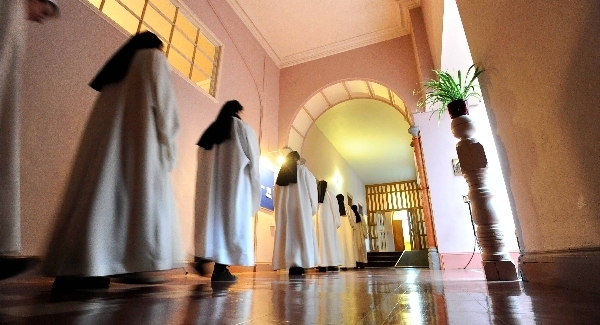
Awaiting the arrival of Abbess Sr Mary Fahy in the kitchen, I’m lamenting the colour of the walls (flesh), and thinking how the human heart finds its home in some very peculiar places.
There are 1,800 Cistercian monastic nuns worldwide. “A strange rare breed,” is how Sr Lily, a farmer with a gift for epigram, puts it later.
Those who reside here, in the only Cistercian monastery for women in Ireland, have chosen to live enclosed lives of “Ora et Labor” — work and prayer.
I’ve come for two nights to discover what this oddly binary life is all about.
While I’m here I will observe the Rule of Benedict — a guide for Christian community-living that has stood the test of time for 1,500 years, or at least the part of it that pertains to “Praying the Hours”; an eight-times-daily practice of shared prayer, in which the sisters have engaged with unerring punctuality, every day since their community was founded here in 1932.
But first I must meet the abbess.
“Right now, I don’t know who’s the braver,” she smiles, walking towards me, “whether it’s you for coming, or me for having you.”
“I’m thinking of Vigils at 4am. I think it’s me,” I say, standing.
We sit. Sr Marie, in the nicest possible manner, does not skirt around the matter of my journalistic intentions. I establish them, then bite the bullet and establish my prayer habits (none) and faith (vague). She remains buoyant.
Nor does she whistle past the graveyard on the matter of the recent Church sex-abuse scandals.
“Personally, I expect the negative criticism that’s been levelled against the Church in recent years.” she says. “I have a sense that the entire church is in shock at the tragedy of child sex abuse. It’s a tragedy because people who should have shown the compassion and love of Christ used opportunities to feed their own compulsions. They damaged children irreparably.
“Here, we all carry the pain and the shame; we have a day of prayer once a week in the abbey, on Fridays, for the healing of abuse-victims. We own it, with great sadness and humility. It’s a reality which we can’t walk away from.”
There is a break in her composure. “It’s the extent of it,” she says, looking slightly concussed.
She talks just as candidly about God. Speaking about him as if powered inside by a steady little faith-hope-and-love-generating dynamo, she says she left her former life as a missionary nurse because she wanted to make “a more radical commitment to God, to become intimate with Him, to discover what it means to be fully human and to persevere in a life of prayer.”
I ask her to describe the basic structure of their lives at St Mary’s.
“We’re a self-sustaining community,” she says, “and we try to be ecologically aware. Work provides an important balance in our life of prayer. We generate our own income from farming, and two other businesses — Eucharistic bread-making, and a greetings-cards enterprise. We also run a small guest-house and have a vegetable garden. And of course, our older sisters get the old-age pension. What’s left of what we earn, we give to the poor.”
Without any funding from the Catholic Church or the State, it is a necessarily frugal life; the monastery is graceful outside but basic within. It is not cold but neither is it warm — light and heating switches, I find, are no sooner turned on than it seems they’re turned off again — and the food would not move anyone to conversion.
“It’s a life of silence and solitude,” she says “but we’re work colleagues, so the rule of silence is observed sensibly; we have to talk on a day-to-day basis, in order to function.”
Sr Michelle, 44, a former sociology teacher, is Procurator of the Abbey, responsible for household administration.
She likes the silence. “The Rule of Benedict is a very workable guide,” she says. “Silence helps community life. You can’t interact all the time. When it comes to conflict and irritation — it happens, we’re human — there’s a place for talking but there’s a place for silence too. I find silence is a place I can retreat to and afterwards, resume community life.”
As a teenager, the climate in Sr Michelle’s home was not religious. “I became a kind of closet Catholic,” she smiles, “sneaking off to church… reading the Mystics. But after leaving home, I became more and more drawn to the Rule of Benedict and contemplative life.” Her life continued circling nearer and nearer to its centre: God. She came to St Mary’s from England aged 25.
Her family, though not devout, were tolerant. “Mum comes every year once or twice to visit,” she says. “It’s lovely. We pack a picnic and walk the dogs within the enclosure. She loves coming here.”
She asks me about motherhood. It is hard to resist confiding in Cistercian nuns; those steady little dynamos generate other things besides faith, hope and love — such as common-sense, intellectual curiosity and humour, but mainly, nuclear-power empathy.
I describe the basic nature of motherhood as I experience it.
“So the love you have for your children means you’re emotionally vulnerable,” she says. “We’re vulnerable too.”
How?
“We’re human beings,” she says, “with families and baggage and hurt. In many ways, it’s like family life here; we care about each other and we live very closely with each other. But the love I have for God helps me transcend the difficult things about this life, like the love you have for your children helps you transcend the difficult things about being a mum. It helps me be as charitable — as graceful — as I can to the people I live with.”
“Sounds like a life’s work.”
“Being a mother is a life’s work.”
I tell Sr Michelle I’ve promised my daughter to ask about home-comforts. “Specifically, she wants to know if you’re allowed to wear cosy pyjamas.”
She smiles. “Well… privacy can be an issue here… the dormitory’s thinly partitioned and we share washing facilities… but please tell her we are allowed to wear cosy pyjamas.”
What about time-off, television, internet-use, home visits?
These are occasional, if not rare. “We have one day a month, where you’re exempt from attending prayers and you’re free to go anywhere within the enclosure. It’s called a Hermit Day.”
“Not getting up at 4am must be heaven.”
“It is.”
At four in the morning, the sisters assemble in the Abbey for sung prayer. It’s an otherworldly dawn chorus, but getting up at 3.50am hurts. From where I sit at the back with gritty eyes and pillow creases, the praying looks intense; the sisters look serene but they have a concentrated, expectant expression. It reminds me of my sons’ faces when Robin van Percie takes possession of the ball.
The schedule is rigorous: Vigils (4.10am), Lauds (7.45am), Mass (8.10am) Terce (9.45am), Sext (12.40pm), None (3.45pm), Vespers (6pm) and Compline (7.55pm). Yet this is only one aspect of their life of prayer; in the hours between Vigils and Lauds, for example, the sisters engage in Lectio Divina — a practice of slow scriptural reading and meditative prayer.
At Vigils, I wonder how the two new postulants — not yet wearing white cowls — are adapting to the rhythm of life here, and try not to stare at them.
Both postulants joined this year. A third of the nuns are above retirement age. Since 2000, 16 sisters have died. The community is smaller than it used to be — in 1960, there were 49 sisters, today there are 36 — but six women are now in formation here (on the path to becoming nuns), which is far more than might be expected; only nine women entered religious orders in all of Ireland in 2006.
I ask Sr Lily, who farms the 200-acre enclosure whether she thinks monastic life has an enduring appeal. We’re pitching silage to 69 dry cattle in the immaculate farmyard.
“Aye well,” she says, “it has for me. I joined in 1982 and when I came to visit first I thought, ‘no one’s putting me in any nun’s habit’.”
She hands me rubber gloves. “I was a youth and community worker in Belfast,” she continues, “in the ’70s; good at dodging bullets. I wanted to take what was here back with me to Belfast and sprinkle it up there — you know — like salt. But three months later I’d handed in my notice.”
“God called me here,” she says, climbing into the tractor and starting it up, “I like the balance of life. Being a monastic farmer suits me. The singing can be a penance, mind, if you’re standing next to someone who’s singing out of tune.”
It’s as well Sr Lily is hardy; five acres of their land are allocated as a wildlife habitat, and there are 40 acres of woodland, but most of the 200 acres is tillage; wheat, barley, potatoes, fodder-beet and 27 acres of Miscanthus, an energy-crop.
She checks her watch just before the bell to Sext sounds. We climb down off the tractor.
Ten minutes later the sisters have resumed their positions inside the Abbey. They commence singing. I look at the Abbess, and Sisters Lily and Michelle. Then I look at the Infirmary Nurse, Sr Mary — a diminutive nun with a smile like a lucky windfall — and my thoughts wander.
I think about where I might have left my laptop charger… the drive home… and that my hands still smell of silage. I think about their paradoxical lives; binary but whole, simple but obscure. And then I think it would be good if someone could find a way to distil the essence of life here. I think it would be good if someone could distil it, then bottle it and get the Pope to drink it.

CONNECT WITH US TODAY



Be the first to know the latest news and updates

















