Making music to enhance the moving image
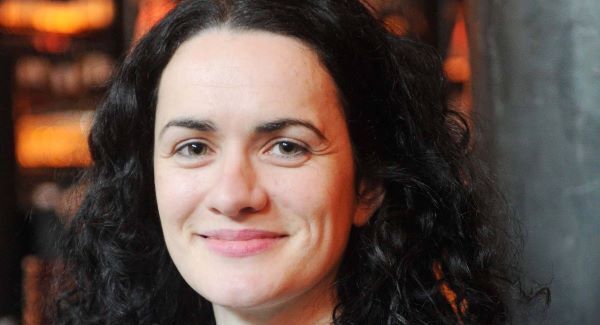
A highlight will be The Passion of Joan of Arc, with a commissioned live score by Cork composer, Irene Buckley.
Following its recent, sold-out performance at Glasgow Cathedral during the Glasgow Film Festival, this cine-concert is played in tandem with the iconic 1928 film directed by Carl Theodor Dreyer. The venue is St Fin Barre’s Cathedral.
Buckley has used the text and the structure of requiem mass to create an evocative work scored for soprano, Molly Lynch, and church organ, played by James McVinnie. McVinnie, who performed at the royal wedding of Prince William and Kate Middleton at Westminster Abbey, will play the imposing pipe organ at St Fin Barre’s Cathedral. The composition includes electronic music.
Renée Falconetti plays the young Joan of Arc, who died for God, and for France, aged 19. Falconetti’s depiction of the martyr is regarded as one of the great film performances, with rumours that the actress was treated harshly to guarantee her sometimes pained-looking performance. The screenplay is based on the trial records; Joan, burned at the stake for witchcraft, depends on her faith to endure the torment.
For Buckley, being asked by artistic director of the Cork French Film Festival, Paul Callanan, to compose the score was a dream come true. “It was quite an ambitious undertaking. I’ve always had the idea that I’d like to write a mass, because I sang in choirs, such as the UCC choir. I’ve sung lots of masses and requiems over the years, so I’m familiar with the text and the meaning. It’s great to be able to apply something I’m familiar with to a film score.”
Though Buckley has written music for documentaries and short films, and is keen to compose more music for film, she says this commission “is unusual, in that it’s not like a conventional film score. First of all, there’s the length of it, which comes in at an hour and 20 minutes of continuous music, with only a few seconds of silence.”
Also, because there is no dialogue in the film, Buckley had an opportunity to showcase her music. “The music is not just there in the background to accompany the film. I’m conscious of creating a whole piece that works by itself. It’s an unusual opportunity to have my music heard completely.”
Buckley says that she didn’t have to change her aesthetic for the commission. “I’m conscious of the era of Joan of Arc, which was the 15th century. I’ve studied medieval and Renaissance music at college. While there are elements of medieval music in the score, the main sound is ambient electronic.
“Most people would imagine electronic music to be quite harsh and contemporary, but it’s not at all. It’s actually a very warm and enveloping sound. It almost sounds orchestral, rather than electronic. There are strings, as well, but they’re not live and I’ve pre-recorded the electronic music.”
Apart from the recording, Buckley isn’t fazed by the unpredictability of the live performance. “We just have to synch up everything at the beginning. The soprano and organist have stop watches. We all press ‘go’ at the same time. There is no conductor. Everything is written in the score and timed,” she says. Buckley felt it would be appropriate to compose a requiem mass. “It’s the mass of the dead. You could say it’s sombre, but, for me, different parts of the mass symbolise various themes in the film. At the beginning, the ‘Kyrie Eleison’ is performed. It symbolises Joan’s purity. The ‘Agnus Dei’ symbolises Joan’s strength. Also, there’s the ‘In Paradisum’ that symbolises her salvation. The ‘Libera Me,’ an organ piece, conveys Joan’s despair and her spirit being broken. There are other pieces as well.
“The ‘Requiem Aeternam’ depicts Joan’s sense of wonder that she gave up her life for her country and for her faith. There are moments of lightness, too. I try to reflect that with a piece called the ‘Sanctus.’ This occurs when Joan receives the sacrament. She was, first of all, refused, but when she was given the body of Christ, she was so relieved. You can see the lightness in Joan’s face at this moment. She is full of joy and acceptance of what is happening to her. Her faith is so strong that she is willing to accept death and meet God.”
Coming from a musical family that includes the singer, Annette Buckley, Irene says that, growing up, her musical influences were traditional Irishc.
However, Buckley trained as a classical composer, and has just started to write the music for an opera based on ‘The Lament of Art Ó Laoighaire.’ Buckley was in New York recently, where she performed at the Irish Arts Centre. She has also had her work performed at Carnegie Hall.
But, for the moment, her sights are set on St Fin Barre’s Cathedral, for what promises to be a memorable performance.
* www.corkfrenchfilmfestival.com














