Inspirational painting resonates down the years
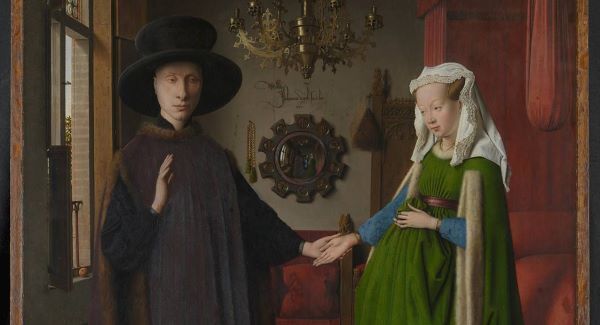
Painted in 1434 The Arnolfini Portrait still influences contemporary painters and writers. Peter Murray on a new history of the masterpiece

Inspirational painting resonates down the years

Girl in a Green Gown

Carola Hicks

Vintage Books, £16.99

Of all the paintings in the National Gallery in London, only a handful exercise a degree of fascination that has remained undiminished over the centuries. And of this handful, probably the most important is a small panel, painted in 1434 by the Flemish artist Jan Van Eyck, depicting a man and woman holding hands in a bedroom.

Titled The Arnolfini Portrait, after the merchant family in Bruges who were its original owners, on any given day this exquisite painting will be surrounded by art lovers, not a few of whom have come specifically to see this work. Although associated with a family whose name appears in the archives of the city of Bruges, the identity of the couple is not known for certain, nor is it clear why the double portrait was painted.

Long before it entered the National Gallery in 1842, The Arnolfini Portrait was recognised as a masterpiece, an icon of the northern European Renaissance. Painted in oil, rather than in fresco, and domestic in scale, it was always intended to be seen by just one person, or a small group of people, rather than a large crowd in a town hall or a thronged cathedral.

Although an extraordinary work of art, the subject matter of the painting is not remarkable. Van Eyck depicts a young man and woman, both elegantly dressed, holding hands. They stand on the polished floorboards of a room of relatively modest size and adornment, attended by a small dog who looks out at the viewer of the painting, as if deciding whether or not to bark.

Behind the couple can be seen a carved Gothic chair and a four-poster bed, hung with red velvet curtains.

This last piece of furniture appears not to have been neglected, for the woman, resplendent in a voluminous green fur-lined dress, is pregnant. Her left hand rests on the large bump, while her slender right hand is extended, to be lightly clasped by an equally white and delicate hand, that of her husband. The husband stands, dressed in no less sumptuous clothing, and wearing a large hat.

From the ceiling is suspended a Gothic candelabra of intricate metalwork, while between the couple, on the wall behind, a mirror reflects the room and its occupants, and includes a tiny detail of the artist himself, reflected in the convex glass. Above the mirror, on the wall, is the inscription “Johannes Van Eyck fuit sic” or “Jan Van Eyck made it here”.

Like almost everything in the painting, the inscription is enigmatic, hinting that the painting may even in some way be a self-portrait.

However, historians have identified an Italian merchant, one Giovanni di Nicolao Arnolfini, who was married twice and who lived in Bruges. The instinctive assumption, that Arnolfini commissioned the painting to celebrate his marriage, is diminished by the fact that the woman in the painting is clearly pregnant.

By today’s standards, with weddings routinely enlivened by the offspring of earlier trials and errors, this is not unusual, but in 15th century Flanders it would have been unusual to have depicted a bride so clearly pregnant, in a marriage portrait. It is more likely the painting was commissioned to celebrate approaching parenthood. But given that this is a work painted in late medieval Europe, it is also reasonable to conjecture that it could have been commissioned by a grieving Arnolfini, to commemorate his first wife Constanza Trenta, who perhaps died in childbirth.

The suggestion of a religious subtext is prompted by the rosary beads that hang from the wall beside the circular mirror, and the notion that the painting is connected with childbirth is strengthened by the presence of a small carved figure, on the back of a chair, of St Margaret, the patron saint of childbearing.

To place The Arnolfini Portrait in context, it would have been on Van Eyck’s easel at a time when the Dominican and Franciscan friaries at Sligo, Quin and Askeaton were recently founded. The great castles at Blarney and Bunratty also date from this period, while the room depicted by Van Eyck is not dissimilar to those in the 15th century Ormonde House in Carrick-on-Suir.

In Italy, in this period, the rediscovery of classical art and architecture was in full swing, but in northern Europe, and in Ireland, late medieval Gothic art and architecture remained in vogue. Like London, the wealthy trading city of Bruges would have been somewhere in between. But Van Eyck was closer to the Gothic north than to the classical revival that was transforming Florence, Urbino or Padua.

With its thin, pale-skinned couple, who stand surrounded by the simple, but expensive, fabrics and furniture, The Arnolfini Portrait celebrates the Gothic north, rather than the Mediterranean south, and yet the painting portrays a successful merchant prince from Italy, and his keen-eyed wife, also Italian, who regards her husband with a curious expression, combining submissiveness and mastery.

The Arnolfini Wedding retains a fascination for succeeding generations not least because it is an allegory about the transience of human life. This has made it an apt subject for study by the art historian Carola Hicks, who worked on this book while terminally-ill with cancer, but who died before she could complete what was to be her last work.

In a tribute that echoes the painting itself, The Girl in a Green Gown was completed and made ready for publication by her husband Gary Hicks. However, the tone of the book is far from mournful. With its lively introduction by that enchanting bo-peep of the contemporary art world, Greyson Perry, this impressive work of art historical scholarship is in every way as engaging as its subject.

Hicks gives a well-written account of Van Eyck’s life and work, she describes the painting and its possible meanings in detail, and gives also an account of those who have owned this work of art.

For remarkably, among the many thousands of late medieval panel paintings that have survived, the successive owners of The Arnolfini Portrait have all been identified, from the year it was first created. Hicks does more than most art historians in bringing to life an iconic work of art; linking it to the careers of museum directors such as Kenneth Clark and Martin Davies, and of art historians such as William Weale and Erwin Panovsky.

During World War II, when the entire collection of the National Gallery was removed to Wales, to be secretly stored in the Manod slate quarry at Blaenau Ffestiniog, The Arnolfini Portrait was not only preserved from the Blitz in London, but was also cleaned and conserved, in caverns deep beneath the mountains of Snowdonia. After the war, it returned to London, in better condition than when it had left, and with its popularity undiminished.

Even in recent years, the painting continues to be quietly controversial, provoking discussion and debate on issues such as marriage and feminism. Hicks details how the portrait has inspired artists through the centuries, not least the architect William Burges, designer of St Fin Barre’s Cathedral in Cork, who in 1867 meticulously recreated the circular mirror in The Arnolfini Portrait, but also, in the early 20th century, William Orpen, whose famous The Mirror, painted in 1900, is one of his greatest works.

In recent years, Van Eyck’s masterpiece has continued to inspire artists and writers, such as Mark Leckey, Ciaran Carson and Pauline McLynn. A visit to the National Gallery in London, to see the original painting, will be greatly enhanced by reading this book.

To buy this book click here.

More in this section

Cookie Policy Privacy Policy Brand Safety FAQ Help Contact Us Terms and Conditions

© Examiner Echo Group Limited













