Danes have it sussed for design
A simple moulded Grass vase from Normman Copenhagen. Restrained, honest, practical, it has instantly won a place right in the centre of the table where it now holds angular catkin branches in a sturdy embrace.
With the fanfare of Swedish design, it’s easy to forget the enduring place the Danes have in modern design. Their artistic community has government support unrivalled the world over. One fifth of their economy is devoted to the furniture industry alone. Design successes include the familiar names of Carl Hansen, Copenhagen, Kjærholm Production, One Collection, and the Republic of Fritz Hansen.
The Danish Modernist School played a major role in delivering the iconic shapes that endure in our surroundings today’s home and office.
Many of us would recognise a piece of vintage G-plan or a 1970s Danish office chair at a glance. However, there’s more to the Danes than their talent for killer curves in bent-plywood.
Danish society cherishes a tradition, something of a cosy cult, termed ‘hygge’. The term originated in Norway and was raised as a spiritual defence against the long, dark winters of the far north. Writers struggle to describe what hygge means in English.
It’s not a bald material style, but a way of living, indoors and out, a sense of welcome, comfort and shelter in which things only play a part. It’s born from the soul of intimacy, contentment and the egalitarian spirit of oneness, something treasured in Danish society.
I remember being taken by ferry for a day by my Swedish employer to her coastal Danish home. Thick wool socks were wordlessly pulled onto my feet at the door step. I was guided to an armchair thick with throws, my backside sliding naturally into the dip worn by decades of descending family bottoms.
A mug of coffee, its surface softly littered with fragrant cinnamon was nestled in my cupped hands. No-one spoke English, and I had eight words of Danish. It was magical. Last year Denmark came number one in the UN survey of global happiness.
With the slavering hunger stirred up by a marketplace of more must-have ‘stuff’, it’s cheering to remember how the spirit of place comes from a genuine sense of welcome and peace. Candlelight, the heady perfume of home baking, the lilting scent and sight of fresh flowers, laughter and the softly slipping focus after a few gløggs (warm wine).
Hygge celebrates an essential, straightforward happiness can be found at home in everyday things.
If you would like your home to have more hyggerlig (invested with hyyge) it has to be first and foremost a place you and yours feel safe, happy and comfortable in.
Take a more soulful less studied approach when assembling those surroundings.
Ordinary things from an enveloping old sofa to your son’s first wobbling efforts at pottery valiantly supporting a listing candle can be celebrated for their quiet, personal place.
Think about comfort and conviviality encircling and buoying you up rather than vouching for consumer goods only really intended to impress.
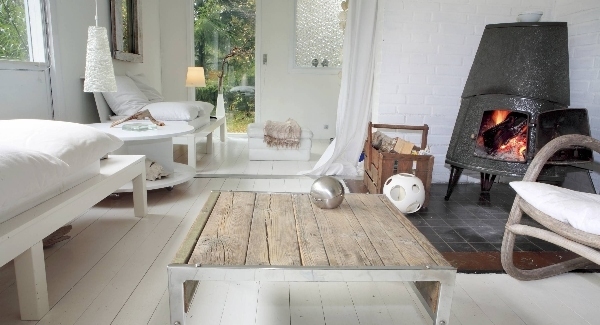
The Danes love white walls, and all white interiors are not uncommon, their starkness in the stiff, cool Scandinavian light of winter mitigated by bright throws, knits and contemporary artwork.
This is an inexpensive look to try and you can warm up the white a shade or two towards grey or gold undertones if you find it too snowy and chill. White is the backdrop chosen for most art gallery walls and the lion’s share of interior designers selling us searing colour secretly inhabit white spaces. Everything set in front of white sings and is lifted by the uninterrupted deflection of light off walls and even floors.
Husmanskost, the Danish term for good home cooking, has its acknowledged popular queen in Trina Hahnermann, dubbed ‘Denmark’s Delia’. If you haven’t snuffed the air for a spelt and rye roll, or explored the wonder of inflating a piece of dry herring back as mid-winter fare, treat yourself.
Danish food is delightfully healthy too. Hahnermann’s latest book, The Nordic Diet, published by Quadrille (€18.75), promises weight loss, but given that this lithe Viking, fifty-something spins around Copenhagen exclusively by bike, a total lifestyle change may be in order for success. Glem ikke hyggen (Have a nice day).
Bolster cushions are wonderful for lounging on a bed or creating some interest and comfort on a boring couch. Here’s a simple approach. If you vary from given sizes, just add 5cm to the diameter of your circles from the width of your fabric.
WHAT YOU NEED:
* Bolster pad 45cm long by 17cm (diameter)
* Chosen fabric to make a 50cm by 70cm rectangle and two 22cm circles (diameter)
* Thread to tack
* Pins
* Matching thread for finishing
* Sewing machine if you have one
Instructions:
1. Fold the main piece in half, right sides facing to make a tube
2. Pin and then tack the raw edges together 2.5cm from the edge
3. Machine stitch over the tacking for 5cm at each end
4. Fold open and press seam allowance
5. Add circular ends by putting right sides facing at each end, pinning and tacking with 2.5cm allowance to the raw edges.
6. Remove tacking and turn inside out
7. Insert bolster pad
8. Slip stitch neatly to close your cushion.
Danish furniture design has been copied worldwide, but in used-furniture outlets look for Danish and Danish-inspired pieces from the ’50s, ‘60s and ’70s.
Look for chairs with an airy, open frame in supporting hammocks, or edgy geometrics of pale and reddish woodwork.
Leather, hide, bent plywood and even plastic can be included. Also, sideboards and desks with hardwood veneers, sporting low, long, sweeping profiles, with handles recessed into the piece.
Also, office-style chairs in dining sets married to splay-legged, spindly tables without fussy, intrusive detail.
There are all sorts of throwaways you can spot in older waiting rooms and corporate reception areas.
We can’t all pop over to London to splash out on an authentic bit of Arne Jacobsen, but you might be surprised when, and where, other, quiet classics can appear.
The blush-red depth of teak and rosewood is highly favoured by the Danes and moulded plywood in fluid forms is popular even today.
Some maker’s plates are screwed to the underside of the pieces, or your might find a paper label still in place.
Older readers may well have Danish glories put away in the garage or spare room, as simply too ‘old fashioned.’ Think again.
Personality should be written large on a good Danish piece and some mid-century classics are fully reproduced or closely copied. Look online at cat-walk pieces from the vintage years to train your eye, from designers including:
* Arne Jacobsen (Egg chair).
* Børge Mogensen (Spanish chair).
* Hans Wegner (Wishbone chair).
* Verner Panton (Panton stacking chair).

CONNECT WITH US TODAY



Be the first to know the latest news and updates

















