A wave of emotion
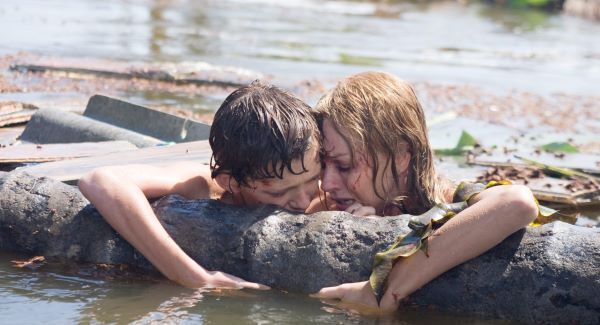
THE Impossible is in Irish cinemas this weekend. Starring Naomi Watts and Ewan McGregor, it is the most successful film in Spanish history, the harrowing story of a real family who survived the Indian Ocean tsunami of Dec 2004, which killed 230,000 people.
Though The Impossible alters the ethnicity of the protagonists — the onscreen family are British instead of Spanish — it tells the true story of Maria Belon, her husband Enrique, and their three sons. Maria, a doctor, was involved in the screenplay, and she was by the side of director Juan Antonio Bayona while the film was being shot in the actual locations in Thailand.
Though the film lurches strangely toward the horror genre, the narrative becomes searing and emotionally intense once the giant wave hits, and Bayona depicts the tsunami’s elemental force with fierce imagination.
The aftermath, when the family is split apart, its members uncertain of one another’s fates, is also inflected with an agonising realism by the performances of Watts, McGregor, and young Tom Holland, who plays the couple’s eldest son Lucas.
“I told Bayona to be extremely real,” says Belon. “I told him that we had to put the audience under the wave.
“And I can say he has done an incredible job, because everybody who sees it is as shocked as we were. Everyone comes out from the theatre saying ‘Wow. I am alive’.”
Belon — who suffered life-threatening injuries in Thailand — says her memories of her submersion in the wave remain vivid. “I remember this experience of eight years ago better than I remember what I did last week,” she says. “It’s extremely clear in my mind. Every moment under the water — my thoughts, my feelings — it was a slow-motion moment.”
Though Belon and her family lived to tell the tale, her attitude to life has been transformed. “I could say I was born two times,” she says. “The first time I was born from my mother, and the second time I was born from that wave. It changed me.
“Yes, I have the same body and I have the same character, but I am another person. We are all other people. It’s very difficult for me to explain. It’s as if, before the wave, I was blind to what living was for. After the wave, in those tough situations, you could see so clearly what life is for. So it has completely changed my life.”
Belon says she no longer makes plans, but lives in the present moment. “If anyone asks me what I will do tomorrow, I just laugh and say ‘I have no idea’,” she says. “Of course, I try to organise my life, but always I look at it like this: ‘Okay, I know it’s a lie, but I’ll try to go on with this lie.’ I don’t look for security at all. I just look for life.
“Western culture relies always on the idea of control,” she says. “We want to control everything. We want to control our money, our jobs. We want to make securities for our home. It’s very difficult for me to understand this way of living now.”
Her children, youngsters in 2004, have been similarly affected by their survival.
“Well, my kids are extremely brave,” she says. “They just want to eat all of life. They never say ‘no’ to good experiences. Actually, both Lucas and Thomas left home at 15. They said, ‘Mama, we want to travel around the world.’ I said ‘Go on, go on.’ Some people might ask us ‘do you protect yourselves more since the tsunami?’ Actually, we protect ourselves much less. There is nothing that can protect your life. Death is coming for you wherever you’re hiding. So you’re better not to hide. But, yeah, my three kids are incredibly brave in their lives.”
For the film shoot, Belon and her family returned for the first time to the Thailand resort. “The whole family were very happy to be back there, visiting people in the villages, hugging them, and saying thank you to all the people in the hospital,” she says. “We were very grateful for the experience.
“It’s still very much in people’s hearts there,” Belon says. “I tell you, the people who were under the sea, we can immediately recognise each other by looking in each other’s eyes. We have something in common. People would hug you and say ‘weren’t you under the sea?’ And we would say, ‘yes, we were’. But there is still a lot of pain among people and that will remain for a long time.”
Despite its box office success, The Impossible has been accused of under-representing the suffering of the Thai people during the tsunami.
This criticism has infuriated Belon.
“There is criticism of it being about a Spanish/British family and not about the Thai people,” she says. “They have said that the director is racist for choosing a tourist family. I think they are racist, because they don’t get that the people are the same under the wave.
“The other day, in London, a Thai woman came to me and hugged me in an incredible way. She was screaming on my shoulder for ten minutes.
“Finally, I asked her what was going on and she said, ‘Thank you so much for telling the story of the tsunami. I lost my sister in Thailand and this film is done so wonderfully and is so respectful. It tells the story of everyone who died there, so well.’ And I was shocked and I told her that I was so grateful that she had said that.
“This movie is about people,” Belon says. “It’s not about whites or Thais or Chinese or British. It’s about people under the wave. It’s about the horrible experience we endured. Some of the Thai people survived.
Some of the Westerners survived. But it is not about the colour of skin.”
Belon says that while the film depicts an extraordinary and deadly natural disaster, the emotions it triggers are universal ones: fear, love, courage, and hope.
“I truly believe that life is going from one tsunami to another tsunami,” says Belon. “So if we survive, we have something to learn, something to give to each other. I think when people watch the movie they feel, ‘okay, I wasn’t in the tsunami, but I’ve been in another kind of wave or I will be in another kind of wave’.”
Ultimately, Belon says, the movie is for the many scores of thousands of people who didn’t survive. “The purpose is to tell their story,” she says. “Our story is an excuse to tell their story.”
* The Impossible is in cinemas nationwide
CONNECT WITH US TODAY



Be the first to know the latest news and updates









