Facing up to Irish humour
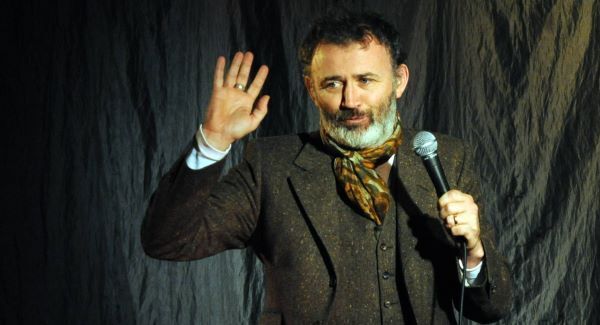
TOMMY TIERNAN is in the middle of a never-ending jaunt around Ireland’s constituencies. Every few weeks he tackles a different county. He’s gigging in West Cork at the moment, and says he has a love of trucking around the island.
“Apart from a wonderful way of living,” he says, “one of the things I get a kick out of is finding out the tolerance people have for being slagged, and also then the reputation of one county in another county.
“For example, we did the World Tour of South Tipperary and I was talking about Louth, and I may as well have been talking about Cambodia. Louth means nothing to the people in South Tipperary. Nothing. It doesn’t exist. It’s like you’re talking about Laois.
“But if you’re in Tipperary and you start talking about Limerick or Kerry, that’s a different kettle of fish. You can drive the length and breadth of the country in an afternoon, but Louth is still unknown territory for the people of South Tipp.
“I also found it weird that Donegal is universal. In South Tipp, they can understand and they can laugh at Donegal. In Kerry, talking about Monaghan is meaningless. It doesn’t register with them at all.
“As far as Kerry people are concerned Monaghan has no presence. That kind of stuff is really interesting to me — which counties are almost non-existent.
“You know when you’re in school, there’s always one fella in the class who doesn’t register with you at all. You see him at the debs and you go, ‘Who is he?’. You’ve been in the same class as him for 15 years, but he means nothing to you. You never passed a ball to him. You never got directions off him. You never engaged him at all. That kind of stuff — I love it.”
Tiernan started out in showbusiness as an actor. He joined the Galway Youth Theatre shortly after moving to Galway in 1988, and later became a founder member of a comedy group called Flying Pigs.
“We were all actors in the 1990s,” he says laughing. “I was an actor for a little while in the guerrilla theatre movement of Galway in the late ’80s, early ’90s. It was underfunded, under-attended and under-prepared, but great craic.”
He crops up on the cast list of one of Tom MacIntyre’s plays from the period, A Fine Day for a Hunt, which was produced by Punchbag Theatre Company at their venue in the Spanish Arch, Galway, in 1992.
“Tom kind of handed it over to a bunch of young bucks,” says Tiernan. “I think we made a hames of it; I think we made a real mess of his work. He was very generous to give us the opportunity to do that.”
Tiernan started stand-up comedy in 1995, with a couple of gigs late that year at the King’s Head in Galway (where lately he has test-driven new material before bringing it on the road), which he fashioned into 20 minutes of material for a try-out at Dublin’s Comedy Cellar in January, 1996. Things moved quickly from there.
In the summer of 1996 he won the prestigious Channel 4 competition So You Think You’re Funny? and in 1998, the Perrier Award at the Edinburgh Fringe. Since then, he’s headlined the Montreal Just for Laughs Festival, has appeared on the Late Show with David Letterman and is still hugely popular with Irish audiences.
Although he’s appeared in acting roles on screen over the years, including a turn as a depressed priest in the last episode of Father Ted, the only straight role he’s playing these days is as husband to his wife, Yvonne. “That’s enough,” he says. He makes a distinction between the two crafts — acting and stand-up.
“I remember somebody said a stand-up comedian is an actor pretending to be a stand-up comedian. The more you do it the more you develop a default way of thinking that is geared towards a subversive, comedic way of looking at the world. That muscle or reflex gets stronger the more you do stand-up.
“There is a huge sense of role-playing in it — you put on a mask. Moving from theatre to stand-up, I much preferred the total control and being able to free-wheel my way through whatever inclinations I had rather than being trapped within the discipline of a theatrical role where you have to hit certain beats and you have to stay within character and it’s all very controlled.
“Stand-up is more frenetic and you can go wherever you want, whenever you want. The only rule is that it stays unpredictable and funny. It’s a very instinctual thing. Theatre is very disciplined. I found stand-up very freeing compared to it.”
Not many people could do a 20-minute set on Down’s syndrome people without offending, as he did as part of a tour in 2007, segueing into his next routine with the line, “That part of the show is over. We can relax — now I’m going to talk about the handicapped”.
He can be very funny in his descriptions, once describing a bass player in a free jazz session as sounding “like someone who was trying to remember a tune”, but his great art is his storytelling — he has a particular facility with language and for weaving spells with the Irish syntax.
“I don’t think that English is the language that our DNA is set up for,” he says. “I think Irish would suit us a lot more. Irish is a way of thinking and there’s a phraseology to it that would suit us better. When Irish people come to English, it’s not a perfect fit. I think it’s a constant source of invention.
“For us to be speaking English, we’re thinking on our feet the whole time. We’re a bit like people at a border security trying to be allowed into another country, that’s probably where our sense of invention comes with the English language. It doesn’t really suit us. We’re always looking for a better way of saying things. That’s probably why it delights us so much because we play with it.
“The English aren’t great at it to be honest. They’ve an awful boring way of speaking their own language. It’d put you to sleep. I used to do a joke about it: one of the reasons I cursed so much was not because I’m uncouth, it’s because I’m Irish. The English language doesn’t suit my soul. Sometimes I think the English language is like a brick wall between you and me and the word ‘fuck’ is my chisel. There is that sense of a muscular engagement with it.
“We’re not at home in English. Maybe our conversation is the better for it — that sense of restlessness within the language.”
Luckily for his fans, Tiernan’s own sense of restlessness looks set to keep him on the road for a long time to come.
* Tommy Tiernan’s World Tour of Cork is in Skibbereen tonight; Clonakilty, tomorrow ; Fermoy, Thursday, Dec 6; Bantry, Friday, Dec 7; and Dunmanway, Saturday, Dec 8. He also performs at Vicar St, Dublin: Jan 3-26 and at Cork Opera House, Feb 21-23.
CONNECT WITH US TODAY



Be the first to know the latest news and updates

















