Movie reviews: The Campaign
But what happens when the mobsters send the future you back to be bumped off? This is the dilemma Joe faces when his older self, played by Bruce Willis, turns up in front of his gun. Worse, Joe lets Older Joe escape, and Older Joe is a man with a mission — to track down the mob kingpin who has commissioned his killing, and thus ensure that he and his wife get to enjoy their old age. Writer-director Rian Johnson plays fast and loose with the ‘rules’ of time travel in Looper (one of the characters advises another not to think too hard about the consequences of defying space-time, lest his head begins to hurt — and it’s solid advice), but even if the story is riddled with plot holes, this is still terrific fun. Gordon-Levitt makes for a persuasive hit man who is addled by his drug addiction but conscience-stricken at the prospect of killing babies in order to reshape the future, whilst Willis plays his grizzled killer with a wink and a nod to his previous outing as a time-traveller in Twelve Monkeys (1995), a movie from which Looper begs, borrows and steals its best concepts. Despite all the sci-fi dressing, however, Looper is a good old-fashioned noir. Wonderful stuff.
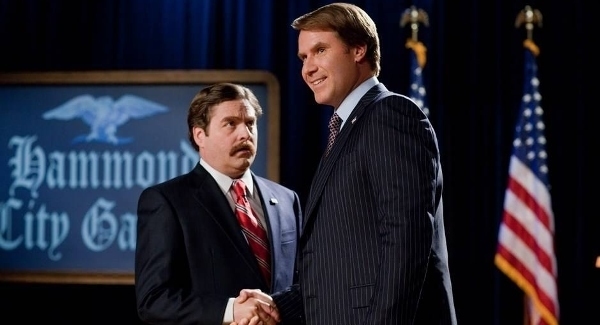
The Campaign (15A) opens to coincide with the last couple of months of the US presidential campaign, as corrupt Congressman Cam Brady (Will Ferrell) finds his North Carolina seat under threat from newcomer Marty Huggins (Zach Galifianakis). Their parties are never mentioned, but it’s clear that the womanising, sticky-fingered, morally bankrupt Cam is intended to represent the Republicans, while squeaky-clean idealist Marty is a Democrat. Not that it matters: once the election gets underway, both sides resort to increasingly dirty tricks to sabotage the other side, with Cam’s campaign being run by the hapless Jason Sudeikis, and Marty’s overseen by the sinister Dylan McDermott, who is secretly working for a corporate cabal. The humour here is too broad and blunt to qualify as satire, and director Jay Roach has no more profound a message to offer than a suggestion that we should never trust any politician, ever. That said, the various scenarios and the tit-for-tat escalation of hostilities — candidates shot during hunting trips, ‘baby-punch-gate’, the worst ever on-air recitation of the Our Father — provide enough belly laughs to keep proceedings ticking over until the inevitably schmaltzy ending, and Ferrell and Galifianakis make for enjoyably ridiculous political clowns.
A much more subtle political message arrives courtesy of Barbara (12A), which is set in East Germany during the 1980s. Written and directed by Christian Petzold, it stars Nina Hoss as the eponymous heroine, a doctor who has been exiled from East Berlin to a hospital in the provinces, there to serve out her penance for an unspecified crime. Rejecting the overtures from her colleague Andre (Ronald Zehrfeld), a self-confessed stooge for the state, Barbara sets out plotting her escape from East Germany — but can she untangle herself from the demands placed upon her by the vulnerable, pregnant teenage patient Stella (Jasna Fritzi Bauer)? Bearing all the hallmarks of a spy movie, Barbara is a languidly paced character study of one woman battling against insurmountable odds. Despite a fine portrayal of grace under pressure, Hoss never really allows us access to Barbara’s emotions or to share in her fear, and the audience is left unengaged by her plight. Petzold has made a beautifully crafted film, but it’s one to be admired rather than loved.
Holy Motors (16s) is probably the most unique cinematic experience you’ll have this year, as the camera follows ‘Monsieur Oscar’ (Denis Lavant) from one experience to another as he segues between a number of personas — killer, corporate director, concerned father, lunatic hunchback, and more — in his white stretch limo. Written and directed by Leos Carax, the story is a flamboyant but self-indulgent exercise in surrealism.
CONNECT WITH US TODAY



Be the first to know the latest news and updates

















