Bagging a real bargain
The first woman in the queue has been here since 7am, hoping to buy two pairs of leather boots. Her friend wants to buy a Louis Vuitton handbag. Others in the queue remain silent for fear of being gazumped once inside.
“It’ll be a free-for-all in there in a minute. I’d give up my dinner for a handbag,” says one lady.
Inside, the staff are being briefed by manager Elaine Corkery. It’s the ‘Handbags’ and ‘Textbooks’ window sale, which always attracts lots of attention. The bags, which are now on display on the shop counter include look-a-like D&G (€70), Fendi (€25) and Louis Vuitton (€20-€50) handbags. Nestled amongst them is a hidden gem — an original red leather Hermes Birkin bag (€150; retail prices range from €1,000-€10,000), complete with gold padlock.
At 10am, the doors are opened and the ladies (and two men) rush inside, smoothly swiping their bags of choice off the shop counter. The lucky few hang onto multiple handbags as they browse the rest of the shop. A baby is left in his buggy in the middle of the shop floor while his mother rummages through the book sale. By 10.07am all the handbags are gone, the trestle table has been knocked over, and the shop till is pinging as cash is handed over.
“All I wanted was a Radley bag, I’d have paid anything,” says one happy customer. Annie and Anntho Tshimanga from the Congo are delighted with their bags bearing Guess and Chanel (€9.50) labels. Eva Lastovkova is on holidays from the Czech Republic and secured a Louis Vuitton bag.
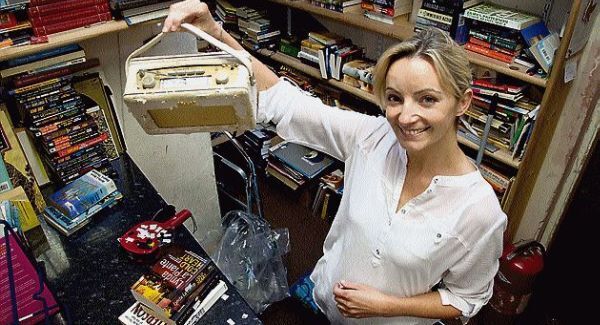
Jamie Cullinan has snapped up a red Coast woman’s winter coat (€65) on behalf of his boss. Currently on holidays, she had previously spotted it in the window, and asked him to buy it for her on the day of the sale. Chris Ensor from New Zealand had just finished his night shift when he popped in and bought a vintage blood pressure tester in a green leather case (€35) as a surprise for his medic girlfriend.
Martha O’Brien emerges swinging the Hermes Birkin bag in a brown paper carrier bag. She joined the queue five minutes before the shop opened, and simply got lucky.
“A lady had the bag and I asked her was she taking it and she wasn’t, so I got it. I recognised it when I saw it in the window and I rang the shop a few days ago to see when it would be on sale. I have a similar black one at home,” says O’Brien.
The large book department is equally busy. Due to begin studying bio-chemistry in UCC in October, Wayne Coleman popped in to buy a college text book for €12.50 instead of buying it new for €100. “I was lucky enough that our lecturer put his booklist up early. I saw some second years and post-graduates in the queue too,” he says.
Another lady loads up carrier bags with a vast range of psychology course books, all greatly reduced. “This is extreme, but we do get a certain amount of it every day,” says Corkery, who organises a themed-window sale every three weeks.
“Fifteen years ago, there were people who would’ve been ashamed of their life to be seen walking through the door. There would’ve been an element of snobbery. But one of the positive things that the Celtic Tiger brought to this industry is that it became a bit of a giggle to go in and find the unusual, vintage stuff. It’s become a destination store,” she says.
Over the course of the day, the whole world passes through the shop, buying an eclectic range of products: a candle-making kit, gold cuff links, curtains, towels, men’s coats, candle holders, board games and baby clothes. A smart-suited man browses the clothing rails, while a journalist pops in on his lunch-break to buy a book. An elderly woman buys dolls for her grand-daughter and a wife buys a leather watch strap for her husband. A tall model-type drifts around the shop before finally discarding a green-leather handbag. Regular customers chat to staff members as they make their purchases.
To put customers at their ease, Corkery insists that the charity shop must look and feel like any other shop. “You don’t want people coming in here feeling a humiliation element to it. It needs to be a pleasant experience and that’s why we put money into the fixtures and fittings, use sizing cubes, and don’t re-use old hangers. It has to be as close to a normal retail store as anywhere else. No-body wants to be made feel that it’s anything to do with being poor,” she says.
Even though the economic downturn has not greatly affected profit (in fact, there was a 3% increase in ICS shop profit this year), the staff have had adapt to the changing needs of their customers.
“The need was never greater and there are more and more people who need to dress their family and dress themselves. People are far more selective about what they buy now and the impulse buy is definitely a thing of the past. People are coming in with a specific thing that they need to buy, be it a winter jacket or updating their child’s wardrobe. We’ve adjusted our pricing in order to help people with that,” says Corkery, who manages 40 volunteers and three part-time staff.
“We keep our children’s clothes at a very low price and that means that a mother can then pick up something for herself for a few euro too. There are enough low-end products in here for anyone to afford,” she says.
By 3pm, there is a temporary lull. A young man drops in a bag full of good quality ironed clothes, and it is immediately brought to the store rooms upstairs. Anything unsuitable or un-wearable is sold to Liberties Recycling, a textile recycling facility and charity in Dublin.
Pat, a volunteer in the book department, re-arranges books in the window for next month’s window sale. Boasting a selection of local and national history books, including books by Frank O’Connor, WB Yeats and Maurice O’Sullivan, the attractive window display has been garnering inquiries throughout the day. However, staff have a strict policy of no pricing being available until the day of the sale.
“I’ve had people come in and ask how much it would be to buy the whole window,” says Pat.
“But the staff maintains the integrity of the window sale by refusing all offers until the door opens on the day. It’s the only way you can get people to trust you.
“You see men standing outside looking at the books and you know they have a big knowledge of books. When they come in and ask, you know you’ve got a plum in the window,” says Pat, who uses the internet and other sources to decide on pricing for rare books.
The ICS relies on public donations and van collections. However, they now have to compete with cash-for-clothes shops, and bogus collectors who sell the clothes for export to the Eastern European market. “Our van drivers have been working with us for quite a long time and people know who they are and are inclined to keep their stuff specifically for us. That’s largely down to the links that most families would have at this stage with cancer, unfortunately. But people can sometimes be hoodwinked, too,” says Corkery.
“People are just incredibly generous. We’ve come across literally everything from a needle to an anchor. Over the years we’ve had fantastic antiques, old sets of china that have become very collectible, and one lady regularly donates up to 15 Armani outfits at a time.
“We’re very lucky. We have goodwill in three ways: the donors, the volunteers and the customers. Without any of the three, you’re going nowhere.”
* The next window sale is on Oct 5 at 10am. www.cancer.ie

CONNECT WITH US TODAY



Be the first to know the latest news and updates









