Our past speaks through these beautiful buildings
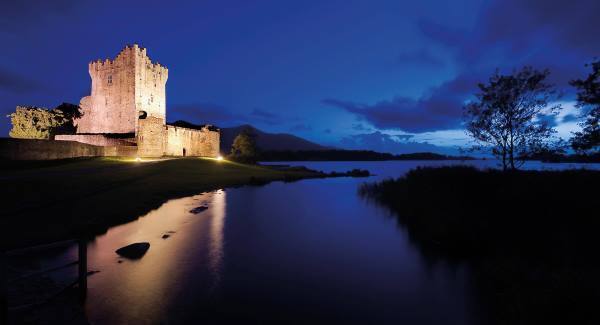
The history of these islands and their peoples can be read through their castles, ruined or restored, finds Mary Leland

Our past speaks through these beautiful buildings

Castles of Britain and Ireland

Rodney Castleden

Quercus, £15

AS THE doomed King Duncan announces as he approaches Glamis in Macbeth: “This castle hath a pleasant seat.” The king’s approval seems still appropriate for the turrets massed around the 14th-century core of the tower house in which Shakespeare’s Scottish play is set. Rodney Castleden spreads his architectural net very widely in this trawl through England, Scotland, Wales and Ireland, and Glamis is probably one of the most famous castles in English literature. It is also said to be one of the most haunted, and no wonder, given its 16th-century chatelaine Lady Jane was so hated by James V of Scotland as a prominent member of the Douglas family that he contrived her conviction as a witch and had her burned at the stake in Edinburgh in 1537.

It might be thought that the fictitious murder of King Duncan set a precedent for such deeds of malevolence at Glamis (poetic license ignored the fact is that he did not die there at all but on the battlefield). All the same there was a history of violent nastiness at the castle, probably beginning with the death of King Malcolm II there in the 11th century. After that its fortunes rose and fell and rose again through the years until the Earls of Strathmore produced Elizabeth Bowes Lyon, England’s most recent Queen Mother. One of the finest private houses in Britain it now stands daunting yet graceful as a fine example of the Scottish baronial style, thanks to its remodelling in the early 19th century.

While Scotland’s allocation is predictably massive in scale and often ominously gaunt not every location in Castleden’s anthology has such a dramatic history or appearance nor is every location a castle at all. The Tower of London is an understandable entry, and Ely Cathedral did begin as a Benedictine abbey; Battle Abbey makes sense, but Bath Cathedral is definitely not a castle. There are a lot of abbeys: ‘The great age of castles coincided closely with the great age of cathedrals and abbeys’, writes Castleden in his introduction, and its true that ecclesiastical buildings became places of both refuge and residence when towns came under attack. This would have been true especially of monastic settlements, resident communities in fortified, enclosed or defensive structures. To be reminded of so many of these great or beautiful buildings is a pleasure although Castleden’s generous criteria and editorial brevity impose an uneasy simplification of history. Offering his collection as tangible reminders of a turbulent past, his atmospheric images justify his point that castles and abbeys represent ‘a major link to the complex events of the past and are powerful touchstones to the imagination.’

Which brings us back to Shakespeare and his imaginative use of Glamis. What would he have made of Dunluce, near Coleraine, whose defensive walls stand stark on its cliff as if to proclaim its many centuries of endurance? Those years ended with Oliver Cromwell, when the Royalist Earl of Antrim was arrested by Parliamentarian soldiers in 1642 and the 16th century stronghold of Sorley Boy McDonnell was at last left to moulder on its headland. As with the other chapters Castleden gives his short account of the castle’s career from its strategic origins as a defensive site perhaps two millennia ago. The first stone building arose here for Richard de Burgh in the 13th century; then came the McQuillans and their somewhat tenacious relative Sorley Boy who recognised the value of its commanding position in terms of his own holdings in Scotland and who, after various comings (his) and goings (his enemies) was recognised as Constable of Dunluce in 1586. From his career sprang the Earls of Antrim and the upgrading of Dunluce as a residence of some elegance, particularly during the time here of Catherine, wife of the Royalist earl Randal McDonnell.

Just as colourful and eventful a story is contained within the walls of Ross Castle in Killarney, built by the O Donoghues in the 15th century and dominated still today by its great keep and curtain walls.The O Donoghues were ousted in favour of the MacCarthys; it was the secretive marriage of Florence MacCarthy Reagh to Ellen, daughter of the Earl of Clancarty at Ross Castle which condemned them both to an almost life-long separation and in his case to many years in the Tower of London at the pleasure of Queen Elizabeth I. Some say he was better off in the tower, Ellen being notoriously bad-tempered. Time and Cromwell together have had their way with Ross Castle and its territory which was eventually sold to the Kerry landowner Lord Valentine Browne; the castle now stands, according to the chapter here, as, “in effect, a very large-scale garden feature.”

Something of the same might be said of the Rock of Cashel, surprisingly included here as Cashel Castle in order to fit into the author’s scheme. Although this marvellous “multiple ruin” holds its commanding eminence on the landscape from many viewpoints, it is also seen almost intimately from the gardens of Cashel Palace Hotel, as if the lawns and borders extended to this naturally adjacent collection of buildings. As a 5th century fortress its inclusion can be justified in residential terms, although its fame now relies on the antiquity and beauty of its great ecclesiastical remnants. Timoleague Abbey however had a resident community: founded by MacCarthy Reagh of Carbery in 1240 it may stand on what was originally a pagan site and certainly its location at the edge of the tide is redolent of antiquity. Later, however, ‘… the friars who lived there did not lead austere lives. They had a penchant for the finer things in life, and were prosperous thanks to their trade with Spanish wine merchants.’

Several pages are devoted to Blarney Castle — the MacCarthys again — and other Irish entries include Trim, Bunratty, Malahide and Corcomroe Abbey. At Corcomroe Castleden points out an item which often can be ignored, given the remote location under the Burren hills in Co Clare: it contains one of the very few surviving images of a medieval Irish king in the effigy of King Conor na Siudaine O Brien. While providing terse accounts of the origins, owners and histories of each entry Castleden also offers a striking assertion of the extraordinary buildings of these islands created for defensive or religious purposes rather than as family accommodation. Conwy in Wales, for example, is a massively battlemented structure on the edge of the Conwy estuary; Caerphilly has the appearance of a small walled town; other rebels threatened the northern borders which is why so many of these entries are from Northumberland (eight), the English list beginning with Lindisfarne and carrying on through Bamburgh to Durham and Yorkshire (eight again) until the milder plains of Kent and Wiltshire are reached. But even then the towers had to be built against (or by) incomers from the sea; later fortifications sprang from the inner turmoil of a country at war with itself, their legacy a wealth of picturesque ruins or of pleasant survivors of two thousand years of construction, dismemberment and reconstruction.

More in this section

Cookie Policy Privacy Policy Brand Safety FAQ Help Contact Us Terms and Conditions

© Examiner Echo Group Limited













