Fighting a losing battle
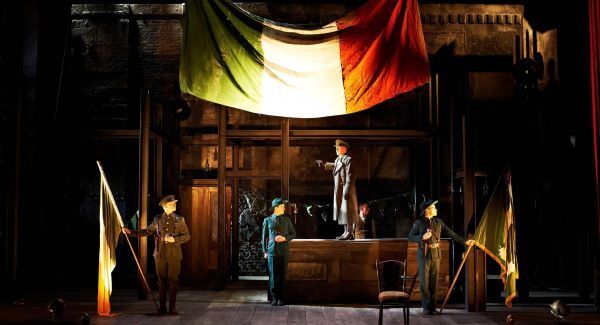
PRESENTED by the Abbey Theatre, Sean O’Casey’s The Plough and the Stars begins its run at the O’Reilly Theatre on Great Denmark Street in Dublin this week. The main stage of the Abbey is being renovated, but the play will return there on Sept 15, before touring the UK and Ireland. The last time The Plough and the Stars moved to an outside theatre was after the fire of 1951, which gutted the original Abbey.
With the hundredth anniversary of the 1916 Rising looming, narratives of the War of Independence will be revisited by historians and commentators. O’Casey’s tale of rebellion, suffering, love and loyalty is a good place to start.
Set in the Dublin tenements, and culminating in its final acts in the 1916 Rising, the play sees the events through the eyes of a young couple, the Clitheroes. Nora Clitheroe longs to protect her family and move from the tenements; her husband, Jack, is a member of the Irish Citizen Army.
When a letter arrives for Jack, promoting him to commandant, she surreptitiously burns it. Furious when he finds out, and inflamed by the nationalistic fervour that engulfs the city, he leaves her to take part in the fighting.
In act three, Jack reappears with one of the dying rebels, but does not heed Nora’s pleas to leave the fight. Nora goes into labour, but the baby is stillborn, and when she hears that Jack is dead she descends into madness as the final, futile acts of the rebellion play out across the city.
Nora is at the heart of the play; she doesn’t want her family to be involved in the fight, but cannot escape the ramifications of the battle on her life and, finally, on her sanity. It is the nature of war that non-combatants pay as heavy a price as the soldiers; the ‘collateral damage’ of modern times.
Rather than relieve poverty and social deprivation, the Rising will make the plight of the working classes much worse, in the short term, at least.
Nora is played by Kelly Campbell, who says the contradiction between the need for violence to overthrow a colonial power and an abhorrence of the devastating effects of war is what makes the play so engaging.
“To me, Nora presents Casey’s humanist feelings about war and violence,” she says. “Hers is an emotional response; to send her love out to war is inhuman and against her nature, and she is the only one in the play making that argument. She doesn’t necessarily believe that violence is wrong, but her priority is to build a family with Jack and get out of the slums. She believes that this is where his heart should be and that there is no point in going off to fight a war if that family unit isn’t yet right.”
While Campbell empathises with Nora, she recognises the complex and conflicting desires the play conveys. “The idea of waging war is against my nature, but I recognise that, as a people, we needed political independence,” she says. “Since time immemorial, nations have been born in bloodshed. But with Nora’s character, O’Casey shows us the price that such independence will require, in the end. Even as she desperately struggles to hold on, the Rising will destroy everything she holds dear and leave her with nothing. It can be hard to play madness; you have to stand on the precipice yourself, in some ways, but she is a fascinating character to play.”
Campbell says the events of 1916 still have huge resonance. “I think the Rising and the events that preceded it are integral to where we are today,” she says. “Ultimately, it brought us freedom, but it also led indirectly to the Civil War, where we tore ourselves apart. It is also a reminder of how young a nation we are, and maybe we still need to come to peace with those events. One of the most fascinating things for me is that it feels personally relevant. My great, great, great aunt fought in the Civil War and was interned in Kilmainham, where her name was etched on the cell door.
“I walk down O’Connell Street everyday and I see the bullet holes in the GPO. The history of the Rising can still be seen in the streets of the city.”
Given the regularity with which The Plough and the Stars is staged, could it not be argued that the play’s message has long since been digested? “I think the events of 1916 need to be reinterpreted and understood by each successive generation,” says Campbell. “We have to go back to go forward. Wayne, at 33, is a young director and is looking at it with the fresh eyes of a new generation. It is a very vibrant and forceful production. At the end of the day, of course, O’Casey was a masterful playwright and we are not washing over it with a modern interpretation; we want to serve his original purpose and tell the story he set out to write. The arguments he presents about violence and honour, about not necessarily following the crowd and examining your own conscience, are as valid today as they ever were.”
* The Irish and UK tour of The Plough and the Stars will take in the Grand Opera House in Belfast, An Grianán in Letterkenny, Cambridge Arts Centre, Birmingham Repertory Theatre, Theatre Royal in Bath, Siamsa Tíre in Tralee and The Lime Tree in Limerick. Booking, and further information, on www.abbeytheatre.ie and (01) 87 87 222.
The Plough and The Stars has not always been judged benignly by the citizens of Dublin. The third of O’Casey’s Dublin trilogy — it followed The Shadow of a Gunman (1923) and Juno and the Paycock (1924) — it was first shown in the Abbey in 1926. Riots ensued in Dublin, as the audience objected to the presence of a prostitute on stage and to the less than flattering portrait of the Rising itself. Yeats intervened, accusing the rioters of shaming themselves, and the dispute rumbled on in the press. When the Abbey rejected O’Casey’s next play, The Silver Tassie, O’Casey (inset) moved it to London, the first and ultimately irreparable fracture in his relationship with the theatre.
Since then, O’Casey’s work has remained a perennial favourite at the Abbey, as full-time archivist Mairéad Delaney points out: “There have been well over 50 productions of the play at the Abbey and, along with the Playboy of the Western World, it is the most popular piece in the repertoire. It has also toured extensively. There is quite a big archive of material and one of the most exciting finds we’ve made is the original prompt script for the 1926 production, with O’Casey’s hand-written notes in the margins.
“The fire in 1951 began backstage... and spread quickly, although firemen broke down the doors to rescue what they could. The play was moved that night to the Peacock theatre with the help of donated props from other Dublin theatres, and the new and enlarged Abbey would not re-open until 1966. There is one direct link between the current production and that night; an iconic photograph shows a member of the Dublin Fire Brigade rescuing a pram from the fire — the same pram is still used as a prop today.”















