The mother of all madcap ideas
EVER since he picked up a stick and used it as a tool, mankind has persistently tried to improve his lot. Necessity as they say is the mother of invention, but not all her children are always that clever.
Cu Vi ParolasEsperanton?
When Ludwig Lazarus Zamenhof published his Unua Libro on July 26th 1887 he signed it Doktoro Esperanto. The name stuck and the language, Esperanto, was born. Zamenhof’s idea was to create an easily learned language that people could use as a second language. Calculating the number of speakers and fluency is difficult, so estimates range from 10,000 to two million. Zamenhof’s goal was to create an international language that would help to cultivate world harmony and although it hasn’t quite achieved that, it is a recognised language. Google recently added it to its translation feature.
Stuck on the Sofa
Thomas Edison was undoubtedly the greatest inventor in history. Responsible for the light bulb as well as a plethora of other useful gadgets, the American was a ceaseless creator. But even genius hits a wall on occasion and in Edison’s case it was made of concrete. In 1898 he started the Edison Portland Cement Company with a view to producing concrete houses to be decked out with furniture made of the same grey substance. Although some houses were indeed built using his technique, the company was never financially viable and eventually it closed down.
Smelly-Tele
Attempts at bringing odours to our noses through the big screen have been made since before the invention of talkies. The most famous attempt thus far has been Smell-o-vision which was devised by Swiss national Hans Laube. In collaboration with film director Michael Todd Jr, Laube brought out Scent of Mystery in 1960. During the movie, 30 scents including whiffs of smoke and garlic, were pumped into the cinema at key moments in the film. Audiences thought the idea stank and it soon disappeared into the ether.
(Not) For the birds
In 1977, American Leo Voelker patented the Bird Trap and Cat Feeder, an elaborate contraption which looked like a bird table but was, as the name suggests, a trap. The idea was to (literally) kill two birds with the one stone by trapping the birds and letting them fall down a shoot where they would be presumably gobbled up by hungry cats. It didn’t fly.
Fork off, I’m eating
The fork alarm was invented by psychologist Nicole M Dubus and Susan Springfield. It was, as you’ve probably guessed, a fork with a timer which provided “a cue to a user after an elapsed period of time for indicating that another bite of food … may be taken”. Patented in 1995, the idea was to slow eaters down in an effort to reduce obesity. That the consumption of burgers, chips and fried chicken rarely involves the use of forks might have had something to do with its commercial failure.
THE HAND THAT ROCKS ...
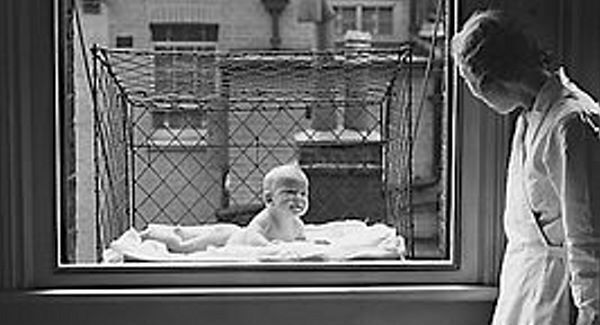
Invented by American Emma Read and patented in 1923, the wire baby cage was hung outside the windows of houses and apartment blocks in an effort to maximise space inside and to allow the child get air. The invention was something of a hit in London where it was distributed to members of the Chelsea Baby Club in the 1930s. Had it endured, we suspect Michael Jackson may have been a fan.
Coo-Boom!
At the start of their involvement in World War Two, the American army initiated Project Pigeon. The project leader, Burrhus Frederic Skinner, believed he could harness pigeons’ pecking to steer missiles towards their targets. The idea involved dividing a missile’s nose cone into three compartments and strapping a pigeon into each one. As a bomb dived towards the ground, each pigeon would see the target on a screen and by pecking at the image, activate a guidance system that would keep the bomb on target until impact. The project was stopped in 1944.
Coffin Boffin
In 1868 inventor, Franz Vestor came up with what he called the ‘Improved Burial-Case’. The coffin, which was never produced, was marketed as allaying people’s fears of being buried alive and included a trap door and a bell, the handle of which was wrapped around the unfortunate corpse’s body should it feel the need to start living again.
Let’s go for a…fly?
The earliest attempts at making flying cars date from the early 20th century when Glenn Curtiss designed the three-winged Curtiss Autoplane.
It failed to fly but it did inspire others such as Henry Ford to look into mass production. In 1926 Ford unveiled his Ford Flying Flivver but the project was abandoned two years later when a test pilot died during a trial. Others have tried and failed since then but the dream/potential nightmare lives on, and in April of this year the International Flying Car Association was established to “help advance the emerging flying car industry”.
Smile like you mean it
A train company in Japan has introduced a smile scanning system for their employees. Every morning when they get to work the workers of the Keihin Electric Express Railway Company are made to smile into a computer screen. If the computer detects any hint of grumpiness, it advises the employee on improving their beam. A case of ‘grin and bear it’.
CONNECT WITH US TODAY



Be the first to know the latest news and updates









