Vision of the future
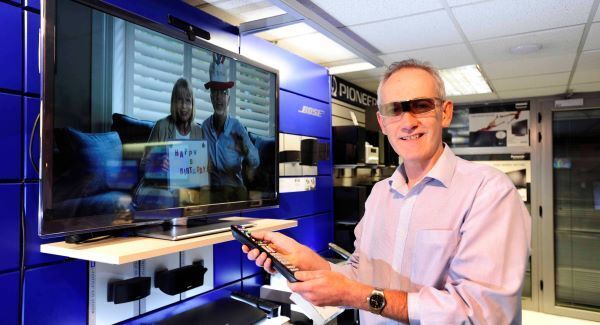
THIS year will be remembered in TV circles for the ‘big 3’ — the Euro 2012 soccer tournament; the Olympic Games in London; and the European digital switchover. In Ireland, the digital Saorview signal was switched on last year, impacting sales of Saorview-approved TVs and set-top boxes.
The Olympics will introduce another dimension in TV viewing — Super Hi-Vision. BBC are erecting three, 50-foot, outdoor screens broadcasting super hi-vision (also known as UHDTV — ultra high-def TV), producing images 16 times as sharp as standard high definition. Because of the cost of cameras and screens, it is unlikely this technology will reach the living room before 2020.
The talking point in TV showrooms is ‘smart TV’, says Jim Tobin, senior manager at O’Callaghan Digital Sound and Vision, and The Sony Centre, in Cork.
“Anecdotally, and what I’ve seen over the last 12 months, is that Samsung have become the real drivers of ‘smart TV’ — even though Sony were the first on the market, Samsung really pushed and promoted it,” says Jim.
“Sony also conducted an online survey of customers who had bought a TV, and were surprised to discover that when it came to the deciding factors why people bought a certain TV, picture quality was the number-one priority, ‘smart TV’ didn’t make it into the top ten and 3D didn’t even make the top 15. Yet this is what we’ve been hammering home for the last number of years — ‘smart, smart and smart’,” says Jim.
“There are cases of people going into shops assuming that if they purchase a ‘smart TV’ they can do away with the computer. It’s simply not true. That’s to do with video-streaming, using a computer as an interface.
“If you are into downloading movies, and video-streaming from the computer to the TV — separate to YouTube, which is relatively poor quality — you are not going to be happy to watch a 13-15 inch window on a large television screen and running a cable off the computer. You are burning out the computer as well. That’s where TVs will come into it. That’s where I see the future for it.”
For fluid operation of a ‘smart TV’, Sony recommends a minimum of a 4-6MByte/sec download — a Byte is eight bits, which equates to 32-48 megabits per second. Most service providers sell their download speeds in megabits (Mb) rather than megaBytes (MB).
“That is fine for the major city dwellers, where high-speed services are available, but not for those who live in the rural areas,” says Jim.
In Samsung’s home territory, South Korea, KTT (Korean Telecom) are making noises that their broadband system — one of the best in the world — is creaking as the country’s population has taken to ‘smart TV’, mainly for video-streaming. “They have high-definition screens and are downloading high-def movies which are five times the standard file size, and the telecom system simply can’t cope — and that’s on services which offer download speeds of at least 100Mbits per second,” he says.
“What we find in all of our stores is a massive interest in ‘smart TVs’. It’s a talking point for many customers. However, when we demonstrate what it is and what it does and what it can do, it often falls short of their expectations of what they are looking for in a ‘smart TV’. We also find it is the younger generation who are into the ‘smart TV’ concept more than the older generation, only because they are more tech-savvy.
“We are now into the fourth generation — for nerds, let’s say version 1.4 — of ‘smart TVs’ and the manufacturers are not going to halt development, in fact they are going to continually enhance the offering,” says Jim.
There are set-top boxes like AppleTV and the latest Sony internet player with Google TV, which will connect the internet to the TV set. And the latest technologies are already seeing TVs incorporating elements of the microcomputer — in the US, Sony sell a Google-TV, incorporating a full-size keypad.
“Skype cameras offering better resolution will also be a definite addition. The rationale of the manufacturers is that when people have a ‘smart’ television with good connectivity, they would prefer to have a Skype chat in the living room around the TV, as opposed to everybody huddling around a computer,” Jim says.
The elephant in the room with ‘smart TV’ and technology is the rumoured Apple iTV (as opposed to their set-top box). Jim says the industry is rife with rumours about the next big thing from Apple.
“Speculation persists that Apple iTV are in talks with high-end German manufacturer, Loewe, even though the German company denied it in May. Loewe are a relatively specialised, but really high-quality manufacturer,” says Jim.
But if Apple enter into production of televisions, it could be the rock on which they perish. “Almost every manufacturer of televisions — with the exception of Samsung — and we are talking Sony, Panasonic, and others, are losing money on every TV produced in the last seven years. The Japan Times reported on Sony, predicting “… sluggish sales of TV sets. Sony looks set to notch its eighth consecutive year of losses.”
Will the Olympics boost the sales of TVs? “There are three television ‘events’ this year: Euro 2012, The Olympics and Saorview — and the Saorview little dot that is now appearing in the bottom corner of the screen means we are getting more enquiries about that than the Olympics,” says Jim. “Nobody in Ireland is going to rush out and buy a TV for the Olympics. It may add a slight advantage, but only because the Olympics are occurring in the same time zone.” He says manufacturers would have had a better hit from Euro 2012.
The drivers for purchasers are picture quality, and reliability, with most manufacturers offering five-year warranties. Eco-friendly power-saving devices are a newer selling point for manufacturers, with sets using OLED (organic light-emitting diodes).
Plasma and LCD/LED are at the end of their life cycle, and Panasonic and Sony are in partnership developing OLED, while Sony are making inroads with their new Crystal LED, but Jim says this could take five years to get to market. “Now that we are in GAA season, and with RTÉ broadcasting games on high-def through Saorview, we are seeing a rise in sales, even from the older customer base.”
Sky and UPC (currently being rolled out) offer ‘on demand’ shows to their cable and satellite customers, through their existing networks outside of the internet, so the indications are that the options for viewers are growing.
“It sums up for me where ‘smart TV’ is. Primarily, it’s for video-streaming and I would think that UPC and Sky have the edge over NetFlix,” says Jim. “The one area which has escaped attention, until recently, is the replacement factor. Traditionally, people would only replace their TV when it packed up. However, now, with new features, a top-end TV will be close to outdated in five years’ time — it may still work and function perfectly — but consumers will have an historic unit compared to what will be on the shop floor. Sony are reducing their range of TVs, because they reckon the LCD/LED/plasma are at the end of the road, what will they come up with next … apart from the touchscreen remote control ... well, watch this space.”
HDMI (high-definition multimedia interface) is the first industry-supported, uncompressed, all-digital audio/video interface. HDMI provides an interface between any audio/video source, such as a set-top box, DVD player, and A/V receiver, and an audio and/or video monitor, such as a digital television (DTV).
HDMI supports standard, enhanced, or high-definition video, plus multi-channel digital audio on a single cable. It transmits all ATSC HDTV standards and supports eight-channel digital audio, with bandwidth to spare to accommodate future enhancements and requirements.
Sony commissioned a survey last year to discover what compels buyers to invest in a new TV. The global research revealed that 3D wasn’t driving sales; indeed, it ranked a lowly 18th out of 20 reasons to buy a new flatscreen.
“We were shocked to find out 3D is not so important,” said Hiroshi Sakamoto, deputy senior general manager of Sony’s Home Entertainment group. As a result, the brand has changed its communications strategy, restoring an emphasis on picture quality (still ranked as the most decisive reason to buy one TV over another).

CONNECT WITH US TODAY



Be the first to know the latest news and updates

















