Arguments: the overlooked key to healthy, lasting relationships
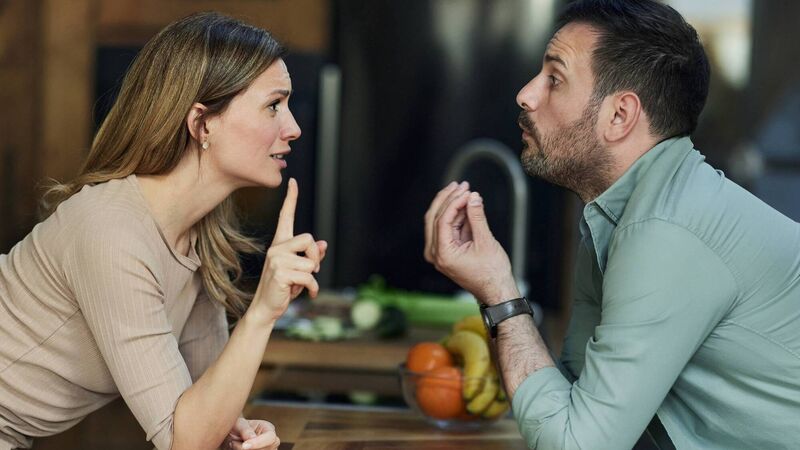
Arguing is usually seen as a sign that a relationship is on the rocks. However, the psychotherapist and lecturer of systemic psychotherapy at University College Dublin, Deirdre Hayes, ( www.deirdrehayes.ie) says a certain amount of squabbling is to be expected.
“When you live alongside someone, you’ll inevitably have arguments because you’re not the same as they are and don’t see the world exactly as they do.” According to US research from 2022, common flashpoints for modern-day couples include spats about family, ranging from tensions with in-laws to disagreements over how to raise children; tiffs about the division of household chores; and disputes about finances.

These findings align with a 2016 Irish survey, which found that 1,000 people reported having an average of six arguments with their other half each month - 23% were about finances, 23% about chores and 39% about family.
While it may sound as if couples have a lot to quarrel about, such quarrels aren’t necessarily detrimental. Hayes believes they can energise relationships.
“Imagine how boring it would be if you agreed on everything and your partner responded to every suggestion with ‘grand’ or ‘fine by me’,” she says. “You wouldn’t grow as a person or as a couple.” Yet she acknowledges that not everyone knows how to argue constructively and gives the example of a couple who described their rows as “Armageddon”.
“They would both be so wounded that they would retreat into silence for days afterwards,” she says. “Together we worked out ways for them to argue more efficiently.”
In 2018, American social scientist Joseph Grenny interviewed 1,000 adults and found that couples who mastered the art of arguing were ten times more likely to report a happy relationship than those who avoided conflict.
So what techniques help us bicker better?
One is recognising when things are getting heated and taking time out. “The psychologists Dr John Gottman and his wife Dr Julie Schwartz Gottman write about how arguing causes our heart rate to rise,” says Hayes. “When it reaches a certain point, our prefrontal cortex – the part of the brain that manages thinking, emotions and behaviours – shuts down. Nothing good comes of arguing in that state. We’ll have a far more rational discussion if we allow the body to calm down.”
She advises couples to make the letter T with their hands to signal for time out. During that time out, she warns them against “ruminating over what you’re going to say when you’re back in the ring with your partner. Focus on calming yourself instead by doing something like going for a walk. Then come together in a quiet space for a more constructive conversation, ideally not the same room where you had your initial argument.”
Another technique is demonstrating that you have heard the other person. Rather than one person giving their point of view followed by the other, Hayes recommends “taking a moment to summarise what you have heard the other person say before you give your perspective to allow for greater understanding”.
Developing awareness of ourselves and any repetitive patterns of behaviour can also be helpful. She gives the example of a couple treated by renowned American psychotherapist Esther Perel.
“The husband retreated to his bedroom whenever his wife voiced even the slightest criticism. Together, they figured out that his wife’s criticisms reminded him of putdowns he used to receive from his strict parents. Once he and his wife realised this, they developed a code. He would say ‘Ow’ when he felt hurt, and she would try to respond with kindness.”
How you phrase things is all-important in arguments. “I heard you say… is a far gentler way of putting something than You said…,” says Hayes. “By making ‘I’ statements and focusing on how something made you feel, you’re being less accusatory and are less likely to trigger a [negative] reaction.”
The Gottmans refer to the damaging behaviours couples should avoid as the Four Horsemen of the Apocalypse - criticism, defensiveness, contempt and stonewalling.
- : When a complaint turns into a personal attack. For example, ‘I’ve been slaving in the kitchen while you’ve been watching TV. You don’t care about me.” In this instance, she suggests using “the hamburger method where you start with something kind, such as: ‘I know how busy you’ve been. Then state your issue with an emphasis on your feelings: ‘but I felt really alone and forgotten in the kitchen’. Then finish with another nice comment.”
- : When the other person reacts to criticism by making excuses or shifting the blame. For example: ‘I’m exhausted. You don’t understand how hard I work’. Rather than defending yourself when you’ve done something that’s hurt the other person, Hayes advises “fessing up”.
- : Mocking or being sarcastic to your partner. Hayes prescribes “notes of appreciation” to counter contempt and gets even the most hostile couples to start their session by identifying one positive thing the other has done. “This helps couples rise above resentment and gets the conversation off to a positive start,” she says.
- : Giving the other person the silent treatment. Stonewalling can be replaced with a time-out. “Taking time to calm down is much better than subjecting someone to the silent treatment, which can make them feel emotionally abandoned,” says Hayes.
Despite all best efforts, there may still be times when voices are raised and harsh words spoken. Couples can recover their connection after such arguments, “If they open up to one another with empathy,” says Hayes.
“In therapy, we talk about the bridge between couples and urge people to cross to their partner’s side, leaving their baggage behind. That’s a metaphor for trying to see the world from their perspective. If both people try to do that, there’s every chance of repair. If approached with self-awareness and a willingness to try to understand each other, arguments can deepen relationships.”
CONNECT WITH US TODAY



Be the first to know the latest news and updates