Séamas O'Reilly: The rise of 'stupid ideas' - and the fall of 'smart ideas'
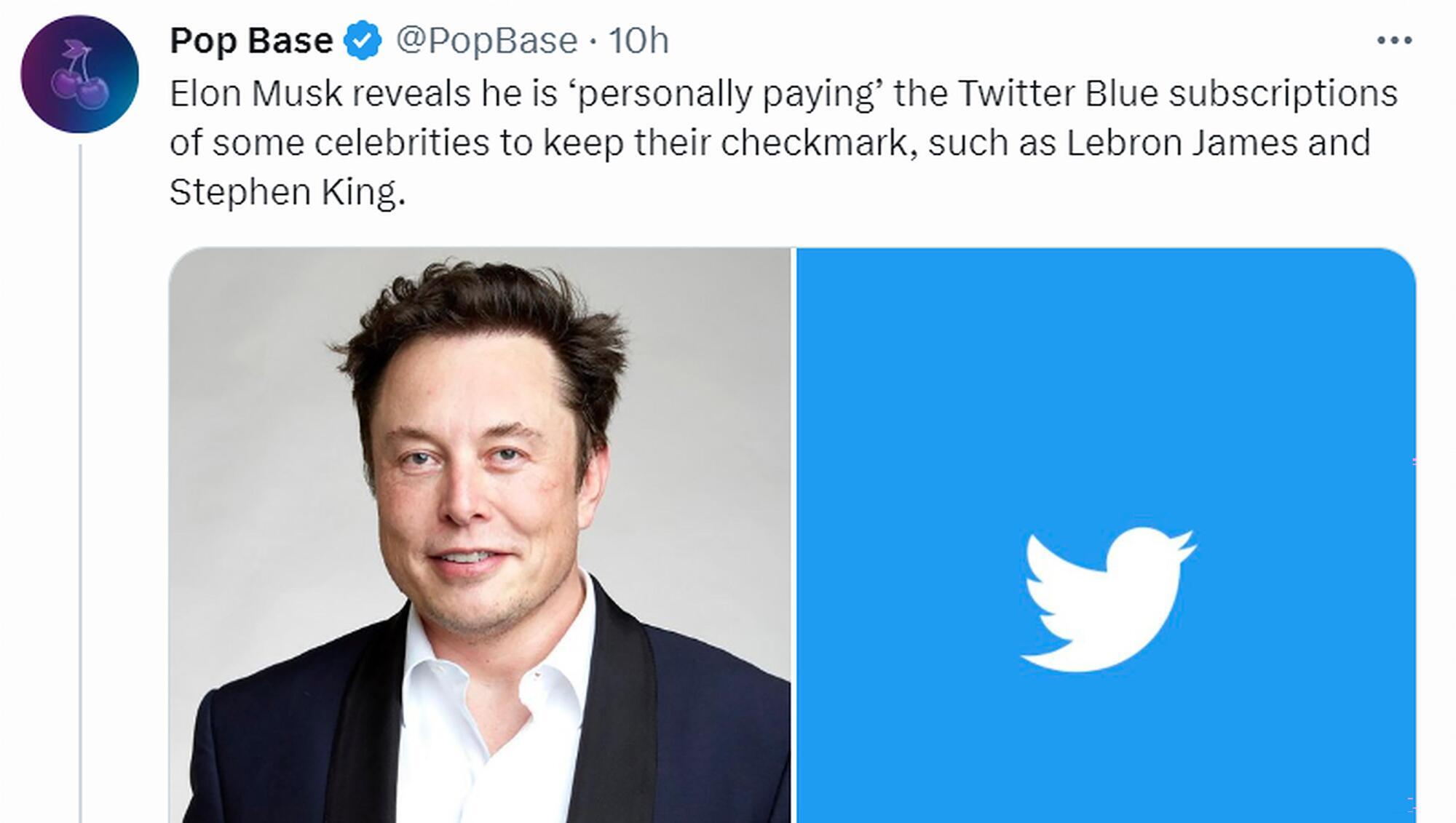
Screengrab from the Twitter feed of PopBase of Elon Musk replying to confirm that he is "personally" paying to keep blue ticks on the accounts of several notable people despite many claiming that they would not pay to keep their verified checkmark.

In , Tahmima Anam’s satirical novel of 2021, a computer scientist named Asha creates an ingenious algorithm, which rapidly becomes a Silicon Valley sensation.
Her brand includes WAI, a socially conscious social network which “brings meaning and humanity to [your] online presence”, and Obit.ly, a service that allows you to give specific instructions for the “management of your death online”.
Perhaps most pleasing of all is EMTI, a service that delivers empty boxes to your home each month. Content-free, with a single small message “taken from ancient philosophical wisdom”, you then use them to place unloved or unwanted objects, which EMTI will then recycle or ecologically dispose of. You can even place memories or feelings in the empty box, which EMTI pledges to remove from your life via “appropriate rituals to bury the past and allow the user to be free of whatever is holding them back”.
If any of the above sound like they could be real apps, it’s because they’re indistinguishable from the sorts of things you hear from the industry press, day in, day out. I try to keep up, because I’m very online and because, if I’m honest, I like the idea of, well, ideas; single thoughts or angles that turn an industry, or a society on its head.
I used to love reading about inventions, like the lightbulb or the television, accompanied by contemporary articles ridiculing them as absurd and useless novelties, never to catch on. But, as a lover of old-timey hucksters and medicine show con men, some part of me also cheers at terrible ideas themselves, and the people who pawn them off.
I love that a startup called Juicero secured $120m in funding in 2017, for a wifi-enabled juicing machine that cost $400 to buy, and necessitated a further monthly subscription to receive bags of their patented unsqueezed fruit to use it with. Within days, Bloomberg reporters deduced that the bags worked just as well if you squeezed them with your bare hands, saving you $400 and the hassle of giving said hands their own internet connection.
Or consider Wag!, the dog-walking startup that raised $300m in funding in 2018, and is mostly notable online for cases in which the company’s dogwalkers made themselves at home in their clients’ houses, or cases of dogs going missing or winding up dead.
It might say something about the current tech landscape that one of those companies dissolved with little fanfare, while the other is currently valued at $350m, and you probably can’t guess which is which, without looking them up.
Therein lies the rub. For every “great idea” that tanks, there’s a “stupid idea” that flourishes.
An outsider would be forgiven for surmising that the industry is wholly sustained by, in layman’s terms, throwing shit at the wall and seeing what sticks. Meanwhile, those startups which succeed are branded “good ideas” retroactively, and their founders heralded as geniuses who can see through the numbers and deep into the burning soul of a hungry public. Eventually, we may come to know these all-seeing mystics by name, and they might even get their faces on the cover of .
In the case of Elizabeth Holmes — whose infamous startup Theranos raised €724m in funding for a blood-testing app she knew did not work — and Sam Bankman-Fried — accused of cheating tens of thousands of crypto investors out of billions of dollars with the FTX trading platform — both managed to get their Forbes covers.
The entire internet is currently in thrall to the increasingly insane decisions of multiple-time Forbes cover star, Elon Musk, undoubtedly the most-anointed startup wizard of his generation, who followed his purchase of Twitter for $44bn last year, with a litany of bizarre moves that have halved his wealth and left his most vociferous detractors scratching their heads in bafflement, and driven his most ardent admirers fizzingly insane.
I will not relitigate these events, which have been covered exhaustively elsewhere, but imagine acquiring a platform on which nearly every single famous person on the planet, from Lebron James to the Pope, was an active user, offering content to billions of eyeballs every day, at no charge to you at all. Then imagine inducing nearly all of those people to definitely broadcast that they would never pay you to do so, because you’d made the brand so toxic in six months.
In a sense, the other superpower of the tech world lies within a second layer of ignorance, that of the public, who rarely understand the value of these seemingly empty boxes, even when they succeed. I’m fairly tech literate and I never really thought about how Twitter makes money, if at all. I flatter myself that I wouldn’t decide to charge its oddest users $8 a month to use it for no verifiable benefit, but I’m mostly glad life has never placed me in the position to make such calls.
Sometimes it’s hard to work out what success even means.
Even the most technophobic commentator would be hard-pressed to say that Uber, Deliveroo, or Airbnb are unsuccessful.
They’re not only ever-present in most major cities, but have also reached that most coveted of milestones; becoming household words. But only one of those companies — Airbnb — has ever posted a full-year profit, and that was two months ago, some 15 years after the company was founded.
As part of the promotion for The Startup Wife, Tahmina Anam created a website for her fictional startups, complete with minimalist design, beautiful logos, and short descriptions of their unlikely functions.
Within weeks, Anam was receiving investment offers for the emptiest of her empty offerings, from firms who believed them to be genuine. “For some reason,” she told last year, “EMTI has been the one people are most interested in investing in.”