Séamas O'Reilly: Masked Gardaí attendance of evictions is worthy of artistic critique

Seamas O'Reilly. Picture: Orfhlaith Whelan

When I was young, I marvelled at Picasso’s Guernica. In libraries or school, or just about anywhere I might find books of 20th Century art, their pages were instantly thrown open to his works, so I could find a big enough picture of it that I could pore over it in rapt fascination. My first level of enjoyment was in the painting itself, its fractured lines and distorted perspectives.
It was my first exposure to Picasso, and stood apart from the formal neatness and grandeur of more representational art, giving the impression of an artist doing things with shape and space that were devious, even illegal. And, if I’m honest, there was also the sense that a whole new avenue had opened up for artists who, like my 10-year-old self, also found it hard to stay inside the lines. There was hope for me yet, I thought, since dear old Pablo appeared to be a man after my own heart; he too possessed paints, a blank page, and a terrible track record of making his paintings resemble whatever it was he’d been looking at to begin with.
Born into an era of convenient, lightweight cameras, and a full century into the supremacy of film and photojournalism, I was still many years from appreciating the hidden glories of the older masters.
The Mona Lisas, Laughing Cavaliers and Whistlejackets of the world must, I arrogantly concluded, owe their reputation to being as close to photography as the Kodak-deprived inhabitants of previous centuries could imagine. “Wow” I imagined them thinking, with their tiny, primitive, uncultured minds, “the best art is the one that really, really looks like that thing”.
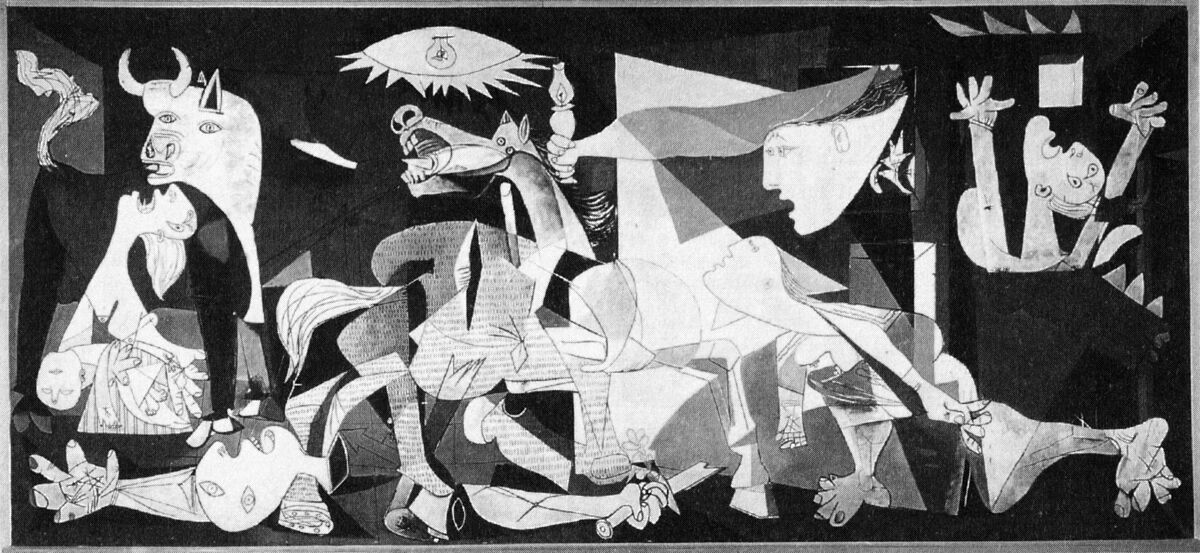
Guernica, by contrast, offered something else; an urgent tumble of dazzling choices left for me to work out, the puzzle box quality of discerning the subjects depicted in its chaotic, blocks of grey-black geometry, of finding the people and animals within its hectic, horrible stew of shapes and blobs, disfigured figures and mutated, bendy bodies.
I quickly grew to learn what Guernica actually represented, and why the decision had been made to render Guernica’s horrors as unreal and perverse on the canvas, as they were in reality. This, one of the defining artworks of the 20th century, was explicitly “politically motivated” art.
“My whole life as an artist” Picasso wrote, “has been nothing more than a continuous struggle against reaction and the death of art… in all my recent works, I clearly express my abhorrence of the military caste which has sunk Spain in an ocean of pain and death.”
Which brings me to the spat between Adam “Spicebag” Doyle and Fionnán Sheahan which dominated this week’s news cycle.
In a testy exchange on Virgin Media’s Tonight show, it became clear that Sheahan is not a fan of “politically motivated pieces of art”, a term he uttered with considerable contempt when discussing Doyle’s collage of Daniel MacDonald’s 1859 painting The Eviction.
In the former’s version, presented on his Instagram - and subsequently shared to great controversy by Sinn Fein TD Eoin Ó Broin - MacDonald’s scene of Famine-era home removal is superimposed with modern-day bailiffs and members of An Garda Siochana.
No words needed (credit Mála Spíosraí) pic.twitter.com/JK6NVcFNeU
— Eoin Ó Broin (@EOBroin) April 1, 2023
Sheahan seemed to view it as outrageous that the modern practice of Gardaí presence at home evictions, could be compared to the practice of bailiffs in 19th century Ireland, seemingly because the law requires police presence during breaches of the peace, a sliver of rhetorical difference that really gets your head scratching at his conception of how, precisely, any citizen can or should criticise the police, government, or laws of their country at all.
For one thing, it was left unsaid whether those Famine-era evictions were themselves legal at the time.
Referencing real scenes of masked Gardaí attending evictions (in this case 2018's Frederick Street eviction, where Gardaí in black balaclavas removed activists from a north Dublin house during rush hour) doesn't strike me as unfair or illegitimate, whether you're a citizen or an artist.
But referencing such imagery in a collage, during a housing crisis directly exacerbated by the current government, seems an uncontroversial choice for any artist covering headier topics than beautiful horses or bowls of photorealistic fruit.
The entire controversy over this artwork appears to be a deliberate, and almost laughably clumsy, attempt to distract from the fact that thousands of people in Ireland are currently facing eviction from their homes, with near total impunity from - and in fact the direct complicity of - a government allowing it to happen for their own political gain. In the face of so much deliberately enacted human misery, it is artistically illiterate to quibble over the aims and motivations of a collage.
Direct comparisons of disparate things can be tricky. You might be worried that this article is comparing Spicebag to Pablo Picasso, or landlords evicting their tenants to the fascist firebombing of Spain, so I want to make it clear: that is precisely what it is doing. Comparison and metaphor do not require one-to-one equivalence, any more than paintings must look like photographs.
If we choose to discount art once we detect the presence of political motivations or editorial license, we don’t just jettison many of the greatest works of art ever created, we allow the artist, and not their work, to be the topic at hand.
We should be vigilant against those dancing on the head of a pin so as to make this issue about anything other than the cruelty being visited on thousands of renters across Ireland. Any choice to obsess, with doglike fascination, at the finger doing the pointing, rather than the thing at which it points, demeans us all.