What the new TB rules mean for farmers at marts
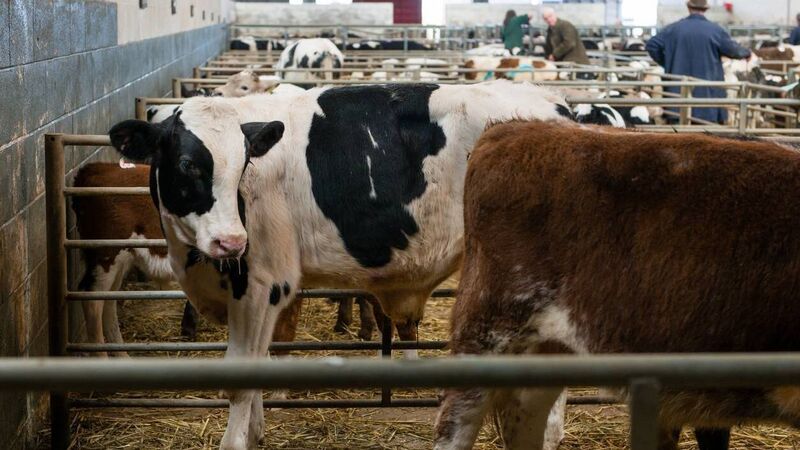
Buyers and sellers will now be assigned to different group statuses depending on testing and enterprise nature.
Updates to the bTB eradication programme will mean you will see changes in how cattle move through livestock marts once the new action plan begins on April 13.
When selling cattle, a farmer’s animal will be assigned one of three groups so that it can be presented at the sale. Animal Identification and Movement (AIM) will notify your mart of your animals' grouping.
Read More
Group 1, or the ‘Open’ group, anyone can by and consists of young stock heifers, non-cow females or males under 36 months that are in test (within the last 12 months). Any cows or males over 36 months if they have a 30-day premovement test, and beef breed cows or males over 36 months on an Animal Health Law (AHL) test, i.e. the animal and the herd it is in were tested within the last six months.
Group 2, the ‘Dry’ group, can only be bought by non-milk-supplying and non-breeding herds and Controlled Finishing Units (CFUs). This group consists of dairy breed cows with an AHL test within the last six months.
Finally, group 3 or the ‘CFU’ group, is the animals that are only allowed to be bought by department-approved CFUs. This group includes cows that were part of an exposed cohort in herds greater than 80 cows that were Gamma Interferon (GIF) tested or any in-test animal, including in-test dairy breed cows not included in Groups 1 and 2.
Farmers will be able to see their animals’ grouping on the animal details screen available on AIM through myAgfood from Monday, 13 April, 2026.
When buying cattle, a buyer's herd will also be assigned to a group. A farmer’s group will determine what animals a farmer is eligible to buy.
Livestock marts will now be required to check with AIM that your herd is an eligible destination for animals you buy at the mart. If AIM notifies the mart that your herd is not an eligible destination, you will not be allowed to purchase those animals.
The groups are named the same as the selling groups. Group 1 (Open) Herds in this group can only buy group 1 animals. This group of herds includes breeding herds and herds with a milk supply contract in place.
Group 2 (Dry) can buy animals with group 1 or 2 assigned groupings. They are non-milk-supplying, non-breeding herds. If you purchase group 2 animals, these can only be subsequently moved directly to slaughter.
Group 3 (CFU) are department-approved CFUs that can buy any animal from any group. Animals can only move from CFUs directly to slaughter.
For farm-to-farm movements, AIM will automatically conduct these checks when a farm-to-farm movement certificate has been applied for.
For further information and updates visit the department website.
Irish Farmers’ Association (IFA) animal health chair, David Hall, said the department restricting the sale of cows in herds that have been locked up prior to the launch of the new Action Plan is “unfair on impacted farmers”.
“IFA is firmly opposed to the retrospective implementation of measures within the TB Action Plan. In particular, the proposed retrospective restriction on the sale of cows from exposed cohorts and the identification at point of sale of females over 18 months,” Mr Hall said.
“These outbreaks have not been managed uniformly to date as envisaged in the TB Action Plan. To now impose restrictions retrospectively on farmers who operated in good faith is completely unfair on those impacted farmers.”
The IFA animal health chair also outlined his disappointment at the lack of meaningful stakeholder engagement by the Department of Agriculture on the implementation of the Bovine TB Action Plan.
Mr Hall also raised serious concerns regarding the implementation of new testing requirements for cull cow sales at marts.
The new rules will require cows entering dairy herds to have a pre-movement test within 30 days. Similar requirements will apply to suckler cows and males over 36 months if they are outside six months of their annual herd test.
Read More
“It was clearly understood that the Animal Identification and Movement system (AIMS) would prevent non-compliant movements and that marts would police these requirements in the interim.
"We have now been informed that this will not be the case and that responsibility will instead fall on individual farmers, with the risk of referral to Regional Veterinary Offices for non-compliance. This is a clear reversal of commitments previously given by the department."
Irish Cattle and Sheep Association (ICSA) animal health and welfare chair John Barron has urged farmers to familiarise themselves with the changes to the TB eradication programme coming into effect from Monday, 13 April.
“These changes form part of the TB Action Plan and will have practical implications for farmers in terms of testing and animal movements. It is important that all farmers take the time now to understand what is required,” he said.
Mr Barron said he would advise farmers to plan ahead when selling stock under the new rules.
“Farmers selling cows or bulls over 36 months should aim to do so within six months of their herd test. Where that is not possible, they should consider a pre-movement test to protect the full market value of their animals. The key is to understand the changes and use them to your best advantage.”
Mr Barron continued highlighting that significant issues surrounding bovine TB remain, particularly in relation to compensation.
“Compensation is always the last thing the department wants to address, but it is a critical part of the TB strategy. Farmers must be paid the true market value for animals removed, alongside proper income support and hardship grants that are fit for purpose. The department now needs to urgently re-engage in meaningful discussions on this issue,” he said.
He said it is also vital that these stronger cattle controls are matched by meaningful action on wildlife.
“The new TB Action Plan includes commitments on the wildlife programme, and farmers expect the department to also act on these from 13 April. This is not a one-sided programme and cattle measures alone will not succeed without a serious and visible effort to tackle wildlife as a source of infection,” he concluded.