Irish farmers receiving 20 cents behind EU average for eggs
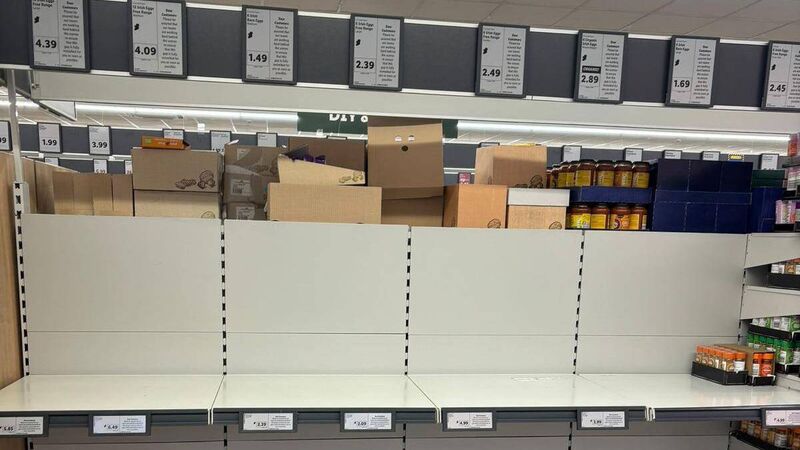
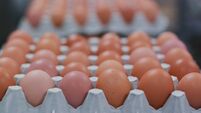
Empty Lidl shelves in Co Monaghan as egg shortages become a reality on retailer shelves.
Irish egg producers are currently receiving “20 cents per dozen behind the EU average”, according to Irish Farmers’ Association (IFA) poultry chair Brendan Soden.
With demand overtaking the supply and farmers not receiving enough for their eggs, a shortage of the household staple on supermarket shelves has become a serious reality.
The egg shortage has been attributed to demand from a growing population, dietary trends, increasing production costs and the high costs of entering the sector and setting up a commercially sustainable egg business.
New entrants into the egg-producing business would need to invest heavily, just to set up a suitable poultry house to house a minimum of 16,000 layers, and to begin production “at a commercial scale, you're talking about €1.2m or €1.4m,” Mr Soden told the .
With low levels of new entrants, “the returns aren’t there, once you’ve made all your repayments, you would be just about our minimum wage”, Mr Soden said.
Even existing poultry farmers are retiring or diversifying and moving away from egg production because the returns and security are not there.
“At the minute, the premium between barn and free range eggs is only around 4c per dozen,” Mr Soden said.
With the extra work and land being tied up in use for the chickens to roam, as well as a higher risk for diseases like the avian flu, the premium associated with free-range eggs for producers has eroded over the last few years, with any new entrants solely looking to set up barn egg enterprises over free range.
Mr Soden, a poultry farmer for 27 years, pivoted from egg production to hatching and raising chicks, then selling them on to layer farms, seeing it as a more secure enterprise.
Despite some egg producers pivoting to different enterprises or retiring, bird numbers have stayed relatively stable, but with the high demand, supply has been unable to keep up.
Lidl, which has seen shortages of supply on the shelves, has now begun sourcing eggs from Poland.
A spokesperson for Lidl has said: “Lidl Ireland is committed to ensuring our customers always have access to high-quality eggs as the Irish poultry sector undergoes a transition from cage to barn egg production.
"To maintain a consistent supply during this industry transition and record customer demand, we are briefly supplementing our stock with eggs from a certified Polish supplier.
"This short-term measure allows us to keep our shelves stocked while our Irish suppliers work hard to increase their output. We remain fully committed to our local farmers and look forward to returning to 100% Irish-sourced eggs as soon as possible.”
In response to Lidl, Mr Soden said: “There have been conversions, they're long done, but at the moment there might be two farmers currently converting, one of which would not supply Lidl, and the number of birds they have would not cause a shortage like we’re seeing.”
Discussing the imports from Poland, he said: “We’re hoping that those eggs meet the same criteria of Bord Bia-approved eggs.”
The IFA is asking for better prices for Irish eggs, “We’ve sought an increase of 2c an egg for free range and organic production and 1c an egg for barn eggs.”
Mr Soden pointed out a similar situation transpired in the UK, and egg producers there were offered contracts that would pay for the cost of production, offering a guaranteed margin. Irish producers do not have these contracts and are “completely exposed on that front”.
The IFA poultry chair said they would be seeking long-term contracts between retailers and the wholesalers the Irish farmers supply, to offer producers security going forward. “A lot of these retailers here operate in the UK, so they're well aware of what they have to do over there too.”
“There's more than enough money within the system… At this point, as farmers, we're receiving the lowest percentage of the retail price that we've ever received. So there's a lot of money there, within the chain to farmers, and we seem to be getting the smallest bit of it, even though we have 90% of the cost on us,” Mr Soden said.