Rule changes to allow biomethane into power grid
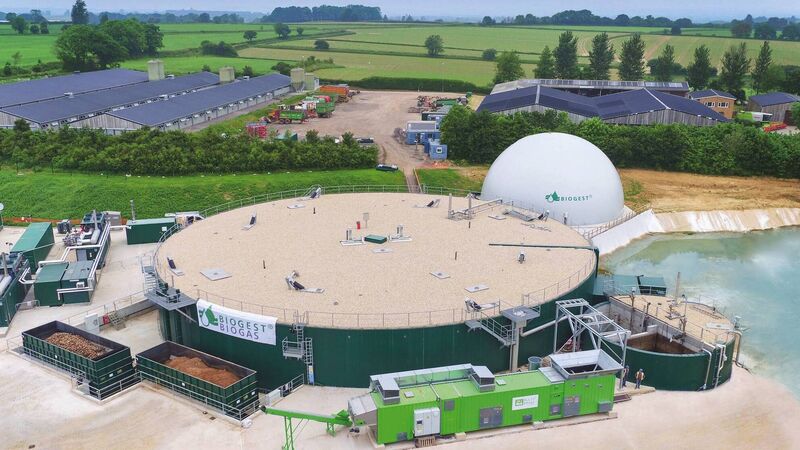
The Frogmary anaerobic digestion plant in the UK. Much of Ireland's projected biomethane supply would come from anaerobic digestion plants processing farm animal by-products or derived products. File picture
Irish energy regulators have boosted the national effort to put up to 200 anaerobic digestion plants in place by 2030.
The Commission for Regulation of Utilities (CRU) has confirmed it will allow reverse compression of biomethane. This will be needed to facilitate injection of biomethane into the gas grid.
Ireland’s National Biomethane Strategy established a target of 5.7 TWh/year of production by 2030. But in 2024, less than 0.1 TWh was being injected annually, from only two facilities, and it is estimated that between 140 and 200 anaerobic digestion (AD) plants will be needed injecting biomethane into the gas grid, to meet the 2030 target.
The CRU intervention will help Ireland's small AD sector (currently about 30 biogas plants, of which about 10 use livestock by-products) to catch up with the rest of Europe, which has more than 20,000 AD plants in operation, a valuable renewable energy source.
Much of Ireland's projected biomethane supply would come from AD plants processing farm animal by-products or derived products.
Across Europe, digesters mainly use manure, agricultural residues, and energy crops, with many plants running solely on livestock manure.
Ireland's 40 million tonnes of livestock waste per year is seen as a huge raw material opportunity for AD.
For farmers, AD can capture additional value from farm waste and provide an on-farm or exported source of energy, while reducing the farm's methane emissions.
It can transform slurry to a more usable fertiliser for enhanced soil, water, and air quality.
Greenhouse gas reduction on farms is seen as a compelling societal reason to support AD.
On a typical Irish dairy farm with 200 milking cows, an AD plant can prevent the release of about 567 kg of CO₂-equivalent per day, thus addressing one of agriculture’s and Ireland's biggest climate challenges.
However, the lack of progress in developing the Irish AD biomethane sector is attributed to prohibitive capital costs, a lack of information, and the uncertainty of government support, according to a recent Oireachtas Joint Committee on Climate, Environment and Energy report on barriers to achieving climate targets.
There are also huge technological barriers to overcome.
One such barrier is local biomethane production exceeding local gas demand in the low-pressure regional distribution networks to which AD plants are expected to connect.
This can be solved by the reverse compression technology now approved by the CRU, which compresses gas from the lower-pressure distribution network, to enable injection into the higher-pressure transmission system, where it can be transported to areas of higher demand.
Reverse compression will facilitate rural sites which would otherwise be prone to network bottlenecks, and having to flare off gas (release it for controlled burning).
Gas Networks Ireland (GNI) has welcomed the CRU's "interim regulatory solution", describing reverse compression as a "key enabler" for growth of Ireland’s biomethane sector.
GNI said it has developed this interim solution to facilitate continued investment in reverse compression infrastructure, and estimates that it may facilitate injection of an additional 437 GWh of biomethane into the national gas grid.
That equates to approximately 7.5% of the National Biomethane Strategy domestic production target of 5.7 TWh by 2030.
GNI head of business development Karen Doyle said: “It allows renewable biomethane gas produced in rural areas to flow efficiently through the national gas network, unlocking new supply, supporting farm diversification and strengthening regional economies".
GNI will assess applications and offer the reverse compression scheme on a first-come, first-served basis. Reverse compression is expected to add a cost of €370,000 for AD developers connecting to the grid.
Separately, Irish company Local Power has agreed a partnership with Vienna-headquartered AD technology experts, Biogest to accelerate the development of agricultural biomethane projects across Ireland.
The first joint project under the partnership, Curragh Biogas in Carnaross, Co. Meath, is a ready-to-build facility, designed for 599 Nm³/h of biomethane production based on a mix of poultry, cattle and pig slurry and grass, maize and rye silage feedstock.
Once operational, the Curragh Biogas project will reduce annual emissions by an estimated 25,000 tonnes of CO2 equivalent.
Pat Smith, managing director of Local Power Ltd, welcomed the collaboration, stating: “Local Power is delighted to work alongside Biogest, a company with an exceptional global record in agricultural anaerobic digestion technology.
"With all major development milestones achieved for our Curragh Biogas project in County Meath, this collaboration brings together the technical strength and project experience needed to deliver a high‑quality biomethane facility for Ireland.
"Biogest's proven technology will provide real confidence to farmers and developers and we see this partnership as an important step towards building a robust and sustainable biomethane industry.”


CLIMATE & SUSTAINABILITY HUB