Siobhan Kavanagh: Don’t wait for autumn — take every chance to get lime out
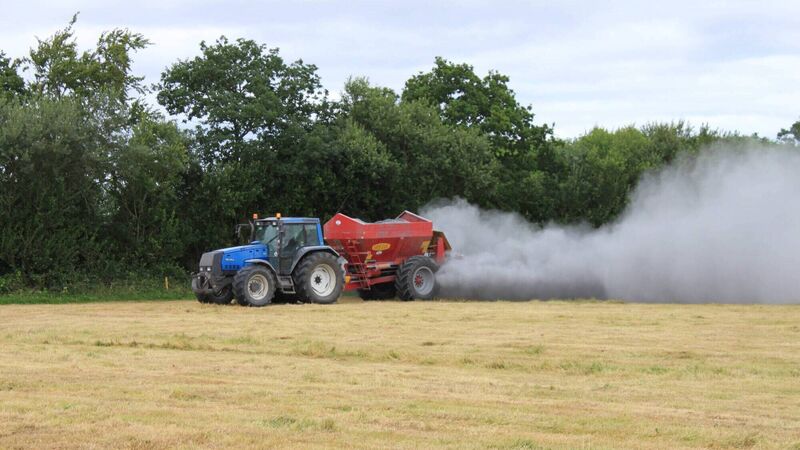
Don't leave liming to the last minute. File picture: Teagasc
You won’t be going out any time soon to apply lime, given the weather and ground conditions, but it's no harm to have a plan in place so you are ready for action when the opportunity does arise.
Traditionally, the back end of the year — October, November and December — was the main period for applying lime. On average, over the last five years, these months have been the wettest, as 30% of our annual rainfall comes at this time of the year.
Waiting until the late season to apply lime will generally result in poorer and less trafficable soil conditions, and the opportunity to apply lime could be missed.
As farmers, we need to be opportunistic about when we apply lime. You might decide to apply lime during longer grazing rotations in spring and autumn, or at reseeding or after a cut of bales.
The point is — don’t leave it all to the autumn, because if we get a bad autumn, as we often do, you won’t get it out and then it's another year gone.
Effective liming begins with regular soil testing, ideally every three to five years, to determine precise lime requirements.
Lime should only be applied based on a recent soil test report, and no more than 7.5 tonnes per hectare should be spread in a single application.
Preparing a farm liming plan helps identify where lime is needed, when it should be applied and at what rate. Making planning essential to take advantage of opportunities.
Many farmers will be in with their local advisor to get a nutrient management plan or derogation plan, or simply your soil analysis results.
When you have their ear, ask them to prepare a liming plan for you. If you have a clear plan for liming, you are far more likely to implement it.
Lime should be applied as recommended in soil test reports. On very acidic soils, it is advisable to apply 50% of the requirement initially and the remaining 50% two years later.
As a general maintenance strategy, applying lime to 20% of the farm annually can help maintain soil pH at optimum levels over time.
Calcium ground limestone is the most commonly used product and is fast-acting, typically adjusting soil pH within three months.
Magnesium, or dolomitic, ground limestone is also available; although somewhat slower to react, it has a higher liming value.
Granulated limes consist of very fine particles, less than 0.1 mm in size, making them highly reactive.
These products are best used as maintenance applications where soil pH is already above 6.0.
Special consideration is required for high molybdenum soils, as increasing soil pH above 6.2 can raise molybdenum availability and potentially lead to copper deficiency in grazing animals.
To minimise this risk, soil pH on such soils should be maintained between 6.0 and 6.2.
When applying slurry, timing is important because the nitrogen it contains is in ammoniacal form and prone to loss on freshly limed soils.
It is recommended to leave seven days between applying slurry and spreading lime, and to wait three months after liming before applying slurry. No interval is required between liming and the use of protected urea.
- Siobhan Kavanagh is Teagasc's Signpost Programme Communications and Engagement Specialist.