'You can understand farmers’ massive upset': Farmers’ anger over Mercosur justified, Heydon says
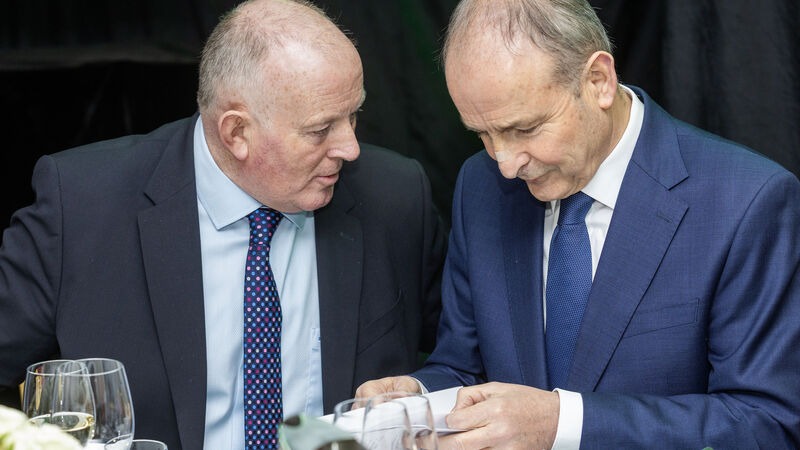
IFA president Francie Gorman speaking with Taoiseach Micheál Martin at the IFA AGM dinner at the Farm Centre in Dublin. Pictures: Finbarr O'Rourke
Speaking at the IFA AGM dinner, Taoiseach Micheál Martin said the Government would continue to advocate strongly on behalf of Irish farmers in relation to the EU-Mercosur trade agreement.
Referring to proposed market safeguards within the deal, the Taoiseach said the trigger for activating safeguards had been significantly lowered.
“The proposed trigger for activating the safeguards, which had already been moved from 10% to 8%, has now been set at a further reduced threshold of 5% of import volume increase, or a 5% price reduction at individual member state level over a three-year average period,” he said.
Despite these changes, Mr Martin said the Government continued to have “significant concerns” about agricultural standards within the agreement, and the potential impact on European farm incomes.
“Ultimately, we concluded that the new and additional commitments, while welcome, were not sufficient to satisfy the concerns of our farmers and our consumers, and so we took the decision to vote against the EU-Mercosur agreement,” he said.
Speaking to journalists, agriculture minister Martin Heydon said he fully understood the level of upset among Irish farmers.
“Farmers have been on a trajectory of improving the sustainability of the food they produce for over 20 years. We have a remarkable level of traceability and some of the highest environmental standards in the world,” he said.
Mr Heydon said farmers were understandably frustrated at being asked to compete with imports that do not meet the same standards.

“You can understand farmers’ massive upset when they see the restrictions placed on their own businesses, while food is allowed into the EU that does not have the same level of traceability or environmental standards,” he said.
“That concern is very clearly at the heart of farmers’ anger, along with the very real fear about the impact on the viability of their business models. The funding proposed under the current mechanisms is not enough, and that is something we have been actively engaged on.”
Mr Heydon said the Government would continue to work with like-minded member states to examine the possibility of forming a blocking minority against the deal.
“At the same time, we are also working on the basis that, if the deal were to come through and a blocking minority did not materialise, how farmers could best be supported,” he said.
“That support would be in two areas. One is through tighter safeguards, and we now have proposals that represent some of the strictest safeguards ever included in a trade deal, should this agreement come to pass.”
Mr Heydon also said he wanted to see an increase in CAP funding.
“The mechanics of how that funding will work, what becomes available to farmers, and what the total budget will be over the seven-year period are still up for discussion,” he said.
“This will be a key part of the CAP negotiations this year, which I will chair in the second half of the year when Ireland assumes the EU presidency from July.”
He said the Government would continue to engage with the European Commission on its concerns.
“Farmers do not want to be in this position. I have been absolutely clear on that throughout my 11 and a half months as minister for agriculture.” Asked whether the deal was now inevitable, Mr Heydon said it was not.
“No. Last Friday was a very significant and pivotal vote, but there is still a role for the European Parliament to play,” he said.