Concentrate timing, not volume, key in Teagasc beef trial
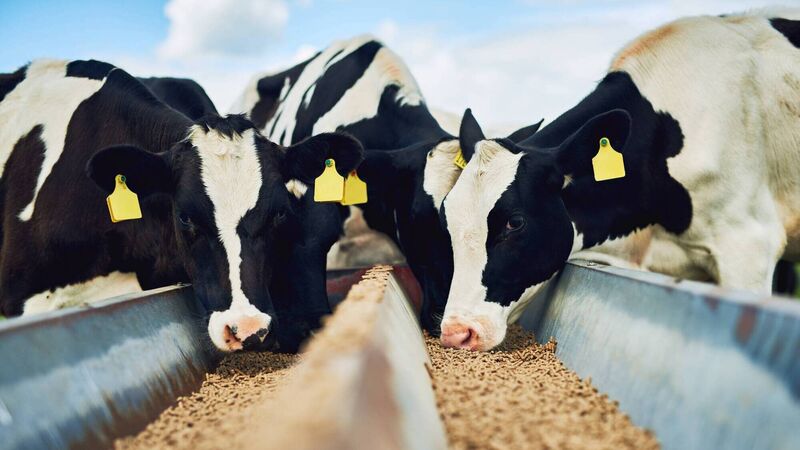
The early results also include variation between different sire breeds within the dairy herd. File picture.
Teagasc has released interesting results from research into finishing beef animals at 19 months with low levels of concentrate fed. The research also includes findings on reducing nitrogen use.
The research is being carried out within the Derrypatrick suckler calf-to-beef herd at Teagasc Grange, and Dr Paul Crosson recently spoke about the results on a Teagasc Beef Edge podcast.
He said: “We’re looking at grass only with 150kg of nitrogen per hectare, or grass clover with 75kg".
“In those two systems, the only concentrate would be fed to the progeny during the first winter. These are weanlings that go into the shed. They'll receive a kilo and a half over the first winter per day, and then, right through to finishing, there'll be no additional concentrates fed. They'd be finished off grass only, or grass clover only.
The aim is to test the pastures.
"If we supplemented the animals at pasture, you would kind of dilute the effect, or mask the effect of the pasture. So, to allow the pasture to be expressed in its fullest, we finish the animals on pasture only."
Dr Crosson said the results definitely depend on the year, to some extent.
But “somewhere between 10kg and 15kg additional carcass on the grass clover system relative to the grass only system, really showing the potential of grass clover systems, with less nitrogen, to support excellent levels of animal performance” has been achieved.
“If we fed the same quantity of concentrate, but fed that earlier in the lifetime, let's say in the first grazing season, and then fed the animals right through to slaughter with grass only, we saw equivalent carcass weight to the animals that were fed grass and concentrate at the end of the second grazing season".
So the feeding pattern of concentrate can be modified, while retaining the same level of carcass output. One full dairy calf-to-beef cycle has been completed at Derrypatrick. Research will continue over three or more cycles.
But the early results also include variation between different sire breeds within the dairy herd. “We have early-maturing, that's Angus and Hereford, and late-maturing Limousin and Belgian Blue,” Dr Crosson said.
The animals are slaughtered at the end of the second grazing period. “What we're finding in terms of carcass weights is around 300kg across those genotypes. For our continental type animals, you know, about 316kg for our Blues, 316kg for our Limousins. So, identical for the two continental or late-maturing breed types.
"For our early-maturing breed types, a little bit lighter. Our Angus are coming in at 308kg and our Hereford at 294kg carcass.” Dr Crosson considers this performance as excellent, given the reasonably young slaughter age.
Calf nutrition is also being researched. “When the animals were still on milk replacement, we've looked at a higher and a moderate milk replacement feeding level, the moderate being our standard 750g of milk powder per day and our high being 1.5kg of milk powder per day.
“Then, immediately post-weaning off milk powder, we've looked at a high and a low concentrate feeding rate, the high being ad-lib concentrate feeding, and the low being 1.5kg of concentrate feeding. That brings us up to turnout to pasture.”
No real advantage, or only a very small advantage, was found from additional milk replacement feeding. “But we did get an advantage of that post-weaning additional meal feeding, something in the order of 16kg of carcass. In other words, when an adequate quantity of milk replacement was fed, and that was 750g per day, increasing above that to 1.5kg gave us no additional advantage.Â
.
Podcast host Catherine Egan said the national finishing age has been reduced by about 1.4 months, and asked if there is scope for farmers to further reduce this without compromising on carcass weight. “I think there is enormous scope there”, Dr Crosson said.
He said the challenge is to assess why earlier slaughter is not achieved on more farms, and this is being investigated in a very large-scale animal and farm study.
Calving age is also being researched at Derrypatrick, said Dr Crosson. “How can we develop strategies that give us a better likelihood of calving first at two years of age? We know that the average age at first calving in the suckler herd [nationally] is around 30–30.5 months.
”The practical reality is in a seasonal calving system where you're spring calving animals and retaining from within the herd, if you miss that window to calve at two years of age, you're potentially looking at, you know, three-year-old calving. So that's potentially a 12-month slippage in terms of calving age. That's animals being managed and fed and so on and so forth for an additional 12 months."
One of the strategies looked at is nutritional supplementation in the first grazing season. Calves are supplemented with an additional 1.5kg, or 1.5kg compared with zero, from four to eight months of age. Will that nutritional strategy result in earlier puberty and calving at two years of age? Results are awaited.