Livestock disease worries haunt farmers across Europe
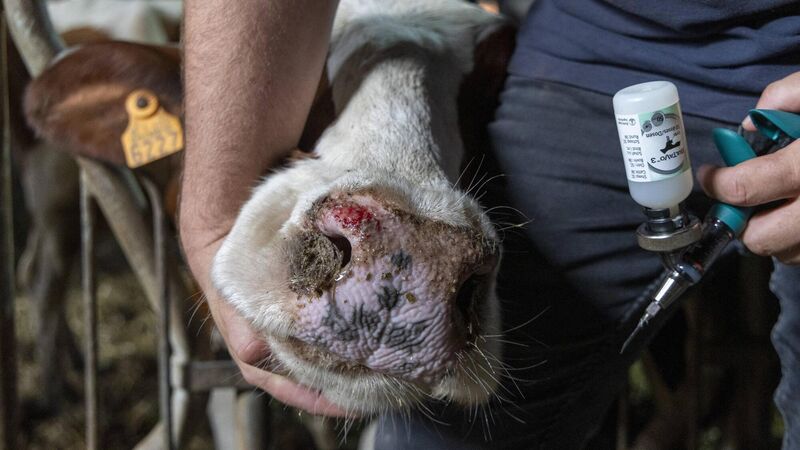
A vet administers a dose of Bultavo 3 vaccine to a cow during a visit of a veterinary to a farm with some cows touched by the virus causing bluetongue disease.
Following a bluetongue outbreak in Co Down, vigilance is critical to prevent the virus becoming established in livestock and midges on the island of Ireland, and to protect the Republic of Ireland’s bluetongue disease free status.
Losing that status could endanger Ireland's valuable live exports, now more lucrative than ever against a background of a global meat scarcity.
That meat scarcity could get even more acute, in one of the worst seasons for bird flu, and after the appearance of African Swine Fever in Spain, the world's second biggest exporter of pork.
The European Centre for Disease Prevention and Control (ECDC) last week issued a guide and tools to help countries detect and respond to possible animal-related influenza threats, including pandemics, following the sharp European increase in the disease in wild birds and poultry, which increases the risk of the virus spilling over to humans.
But the current risk for the European people is low, said the ECDC. No human cases have been reported in Europe.
Meanwhile, the UK got a taste of how bird flu and African Swine Fever could affect the food supply.
Spanish ham products temporarily became unavailable in many stores, after a November 28 UK import ban (which was later downgraded to regional restriction of imports from the area near Barcelona where ASF was detected).
Simultaneously, the spread of bird flu, along with industrial action at the UK’s main frozen turkey provider, tightened the turkey meat supply for British consumers.
Detections of bird flu have surged in Europe.
Between September 6 and November 14, 1,443 detections of highly pathogenic avian influenza were reported in wild birds across 26 European countries, an incidence four times higher than the same period in 2024, and the highest since at least 2016.
There were notable high-mortality outbreaks in common cranes in Germany, France and Spain.
Several Irish poultry farms have been affected.
Across Europe, domestic poultry producers had to adopt high-level biosecurity, including housing of free-range birds.
Nearly nine million poultry birds have been culled worldwide since October, mainly in the US, Canada and in Germany. In the US alone, about eight million birds were culled since September, a slight increase from last year.
African Swine Fever has been equally disruptive. Spain is the latest EU country affected, bringing to 13 the number of member states with ASF in wild boars or domestic pig farms.
Initially, nearly 40 countries closed their borders to Spanish pork and pork products, after ASF was found in wild boars.
China takes 42% of Spanish pork exports outside the EU, which were stopped until Beijing confirmed it would only limit imports from the Barcelona area.
The UK, taking 56,000 tonnes per year, also changed its 100% ban, and allowed imports from unaffected areas.
At stake are Spain's annual exports of 2.7m tonnes of pork, worth about €3.5 billion euros.
Restricted trade flows are inevitable, after Spain's first case of ASF since 1994.
The virus is harmless to humans, but spreads rapidly among pigs and wild boar, for which it can be fatal.
At Bellaterra, northwest of Barcelona, ASF was initially detected in two wild boar. Soon afterwards, seven more infected boars in the same area were found to have died.
Local authorities restricted all leisure activities, including hunting, within a 20-km radius.
A task force of EU vets began work to help contain the outbreak.
Spain called in the military to help identify and control the spread of ASF.
Drones and sniffer dogs were used to hunt down boar carcasses for testing.
Precautions such as testing and quarantining of new animals, perimeter fencing and bird nets, regular disinfections and checks on drinking water, a strict employee dress code, and proper storage of pig semen samples, were also adopted.
Meanwhile, in Ireland, vets will be central in the battle against bluetongue, which has already disrupted livestock markets in 13 European countries.
The 2025 BTV-3 version of the disease has undermined EU livestock productivity, causing 25–40% pregnancy failures in some cattle herds, and 15–20% losses of milk yield in infected dairy farms.
Sheep are even worse affected. In the Netherlands, 90% of sheep are now vaccinated.
Bluetongue poses no threat to public health nor to food safety. It is primarily transmitted through biting midges and affects cattle and sheep as well as goats, deer, llamas and alpacas.
Biting midges are most active from April to November.