Milk prices expected to improve in first half of 2026
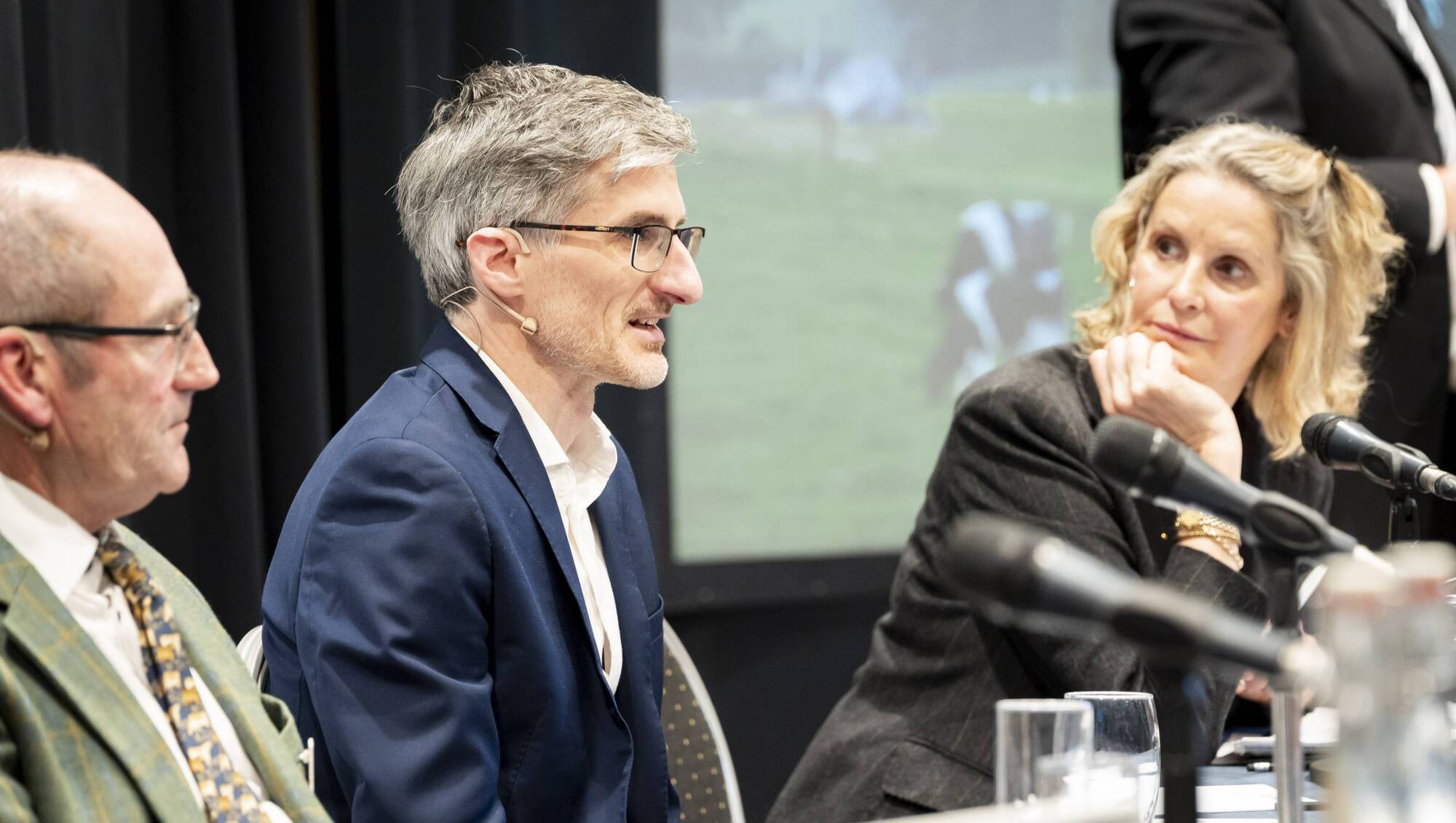
(Left to right): Nick Holt-Martyn of the UK-based 'The Dairy Group'; Ciaran Aylward of Ornua and facilitator Helen Carroll in the Milk Price panel, at the 75th Annual ICMSA AGM. Picture: Don Moloney
Irish milk prices are expected to pick up again in the first half of 2026, according to Ornua’s group economist.
Ciarán Aylward was speaking as part of a panel discussion hosted by the Irish Creamery Milk Suppliers Association (ICMSA).
With co-ops lowering prices on suppliers each month, milk prices were a major topic of discussion at the ICMSA panel discussion during the organisation's 75th AGM, with farmers questioning the panel how the Irish family farm model is expected to survive until the market recovers.
The panel saw presentations and discussion from Laurence Shalloo, head of the Animal and Grassland Research and Innovation programme, Ciarán Aylward, a group economist at Ornua, Nick Holt-Martyn, a principal consultant with The Dairy Group and Liam Fenton, managing director of StoneX Financial Europe S.A.’s Irish branch.
The consensus from the panel was that milk prices would improve with Mr Fenton saying: “It is just a matter of timing.”
Ciarán Aylward took the crowds through the global markets this year, explaining that European dairy commodity prices were expected to fall in June and July, but the timing and rate at which they fell came as a surprise to the market.
Demand began easing towards the end of summer, with the growth of retail sales slowing and food inflation increasing, as well as the cost of living seeing more lower-income consumers eating out less frequently.
In terms of global milk supply, the growth and strength in the US and New Zealand were anticipated by supply forecasts, but “the strength of the European milk flow wasn’t,” explained Mr Aylward, who in June had forecasted a growth of 0.5% in the European milk supply, but the market saw a total increase of over 1%.
“That increase was driven mainly by yield per cow in the likes of Germany, France, the UK and the Netherlands,” Mr Aylward explained, saying that these increases were mainly due to higher margins which encouraged more milk production from farmers as well as favourable weather and disease control such as blue tongue.
This strong supply and modest demand have led to weaker commodity prices in the last few months.
Since June, cheese and butter are back 30% while skimmed milk is back roughly 15%, with Mr Aylward explaining that the market is currently appearing quiet, with buyers still anticipating further price easing by producers to lower stocks before the end of the year.
On the topic of future outlook, Mr Aylward explained that those buyers who are quiet now will need to begin securing product again, with demand expected to pick back up around February and March next year.
He said:
Overall, Mr Aylward explained to the farmers attending the AGM that pricing is expected to remain flat at current levels through Q1 and will hopefully begin to improve in Q2 and Q3 next year.
However, dairy farmers should not expect to see the pricing come back to levels that they saw at the beginning of 2025.
Mr Shalloo warned attendees of the AGM that “you need to get through 2026, it’s not about making a huge amount of money in 2026 but getting through it, that’s the focus point we need to think about”.
He went on to explain that 2026 is not the year to be overstocked or chase production, but to prioritise cost areas in the business and work on reducing them where possible to drive long-term efficiency on the farm.
Mr Shalloo explained that total costs between 2020 and 2024 have increased by €1.36 per kilo of milk solids, roughly 50%.
Direct costs account for 65% of the total increase in production costs, contributing 83c of the €1.36. These direct costs consist mainly of concentrates, which cost roughly 40c per kilo of milk solids, followed by forage and pasture costs, which include fertiliser and contractor inputs.
The second area of increase is in fixed costs. These costs amounted to 53c of the total €1.36, with the main costs coming from energy and fuel and machinery depreciation. Fixed cost amounts to approximately 35% of the total cost increase.
Mr Shalloo put forward actions dairy farmers could take to try and keep costs down by concentrating on cost categories that don’t jeopardise efficiency.
Making small changes, like shopping around and changing energy suppliers, could get farmers better deals for the year. Focusing on maximising grass growth and grazing without cutting productivity costs like soil fertility and lime could help reduce concentrate costs and farmers' reliance on it.
Also, financial planning and forecasting ahead of the year, calculating predicted expenditures and money flow from single farm payments and schemes, as well as calculating fixed costs such as taxes for farmers, could help to get a better view of what they might have to work with throughout the year.
Mr Fenton agreed with Mr Shalloo on farmers trying to manage costs, highlighting that some of the most vulnerable and exposed dairy farmers, as a result of this market price drop, are young or newly entering farmers who have invested or borrowed heavily in an effort to join the sector.
Mr Fenton explained there was no point for farmers to “kick” co-ops or politicians regarding the milk price crisis, as ultimately they don’t control the global market; instead, he suggested the industry look towards the volatility of the market.
He told ICMSA members:
He continued saying: “The industry focus should shift from [milk] price to the margin,” calling for a co-ordinated education effort between farmers, farming organisations, Teagasc, co-ops and media to arm farmers with the right tools to make informed decisions in progressing forward with their business.
Mr Holt-Martyn set out to explain the UK's view at the panel, explaining that the UK is still very much involved in the European dairy market.
European prices affect the UK in the same as they do the Irish pricing. “You get a cold, we get the flu,” he announced to the crowds.
The key driver in the UK market is cheese at 32%. Mr Holt-Martyn said he didn’t hold the same optimism displayed by Mr Aylward, as in October the cheese price dropped below £3,000 per tonne. With Ireland contributing heavily to the UK cheese market, this in turn affected our pricing.
Europe's producing such a high milk supply “spooked” the market in September, resulting in the drop in pricing as previously explained.
Mr Holt-Martyn also added that the UK in October recorded the highest levels of fat and protein the UK has produced in any month at any time, and produced a record 1300 million litres.
He said:
Mr Holt-Martyn explained that for prices to improve, supply must be cut, but the “problem is for you as individual milk producers, cutting your supply, is cutting your paycheque”.
He continued saying the only way a cutback in supply of enough magnitude to drive prices back up would be to have many farmers retiring and exiting the industry, a sentiment that didn’t sit well with those in attendance.
Mirroring the presentation made by Mr Shalloo, Mr Holt-Martyn rounded off his presentation, reminding farmers to go back to basics, “know your cost of production”. He highlighted the importance of good-quality grazing platforms and silage to offset the costs of concentrates.