Trump tariffs to put Irish dairy at "competitive disadvantage" in US
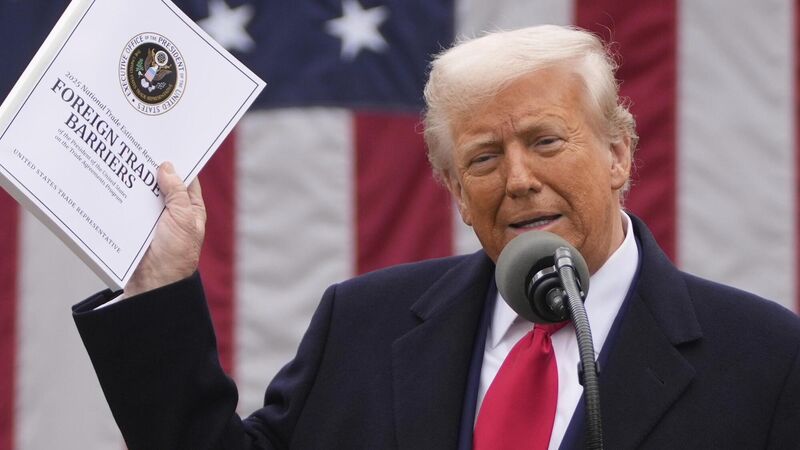
President Donald Trump pictured during the event to announce new tariffs in the Rose Garden at the White House, Wednesday, April 2, 2025, in Washington. Picture: AP Photo/Mark Schiefelbein
Trump’s decision to impose 20% tariffs on EU trade will hamper the competitiveness of some of the US’ best loved Irish products, including Kerrygold, farm orgs have warned.
A spokesperson for the Irish Farmers’ Association said the announcements last night put Ireland at a disadvantage on international markets.

“The fact that New Zealand only has a 10% tariff for dairy products and the UK only has a 10% tariff on drinks, while the EU will have 20% tariffs, will leave us at a competitive disadvantage against some of our biggest competitors in these two sectors,” the spokesperson said.
“Ireland exported circa €1.9bn worth of food and drink products across the Atlantic in 2024. The US market is an important outlet and accounts for circa 11% of our total food and drink exports.
“Within the €1.9bn figure, dairy at €830m and drinks, predominantly whiskey, at €900m account for 91% of what we export. We also export pigmeat (€23m), beef (€8.8m) and seafood (€3.8m).”
Among the biggest names likely to be affected is Kerrygold, which is now the second best-selling butter brand in the US.
“We sent almost €500m worth of [Kerrygold] product in 2024. The market accounts for about 7.5% of our total dairy exports,” the IFA spokesperson said.
A spokesperson for Ornua, which owns the Kerrygold brand, said the body remained “hopeful” that a negotiated solution can be reached between the US and the EU.
“Our products are subject to US import duties and additional tariffs will have a negative impact on our business, on our US consumers, and on the dairy farmers who supply Kerrygold.
“…The US will remain a very important market for Ornua, and we are committed to further investing in our businesses there, and meeting the needs of our wonderful US consumers who love Irish grassfed dairy,” he added.
The move has also been condemned by the European Dairy Association (EDA), which said the “targeting of dairy is unjustified”.
Commenting on the tariffs, EDA Secretary-General Alexander Anton said: “EU dairy exports - most notably cheese - account for less than 2% of total US domestic consumption. These cheeses serve a unique market segment in the US, offering choice and excellence to US consumers, and therefore do not compete directly with American dairy products.
“The newly announced tariffs come as part of the White House’s escalating trade actions, reportedly in response to perceived trade imbalances and the desire to implement ‘reciprocal tariffs’ that match those imposed by other countries on US products.
“Not only have the US and the EU the largest bilateral trade and investment relationship and the most integrated economic relationship in the world, but the overall (goods and services) US-EU trade balance is basically in an equilibrium – this is an ideal basis for a prosperous trade relationship. A trade dispute between the US and the EU, therefore, is clearly in the ‘lose-lose’ category,” he added.
The EDA warns that the US decision risks not only harming EU exporters but also limiting American consumers’ access to the high-quality dairy products they value and trust. With premium European cheeses, creams, and specialty products appreciated by US buyers, the tariffs could significantly restrict choice and drive up prices in the American market.
Mr Anton said that the timing could not be worse: “Our sector is already under enormous pressure from China’s anti-subsidy investigation and ongoing global market challenges. Now, US tariffs risk compounding that crisis. This is a blow to rural economies across Europe - and to the spirit of fair and rules-based trade.” The association, which represents dairy processors across the EU, has called on the European Commission to respond strategically and shield EU dairy from further fallout.
“Trade policy must be smart, not punitive. Dairy is not the problem here; using it as a pawn only creates new problems on both sides of the Atlantic,” Mr Anton added.
Irish Creamery Milk Suppliers’ Association president Denis Drennan said that while there was a “degree of anxiety and concern” around the threat the tariffs present to dairy exports to the US, Irish brands’ “underlying strength” will make them well placed to “ride this out” until the situation becomes clearer and more stable.
Mr Drennan said that the reputation of our cheese and butter, specifically Kerrygold, stood very high amongst top-end US consumers and there was some confidence that premium products like Kerrygold were ‘inelastic’ in terms of demand and not overly subject to price-pressure.
“Tariffs are always a crude economic tool and it’s disappointing because it comes at a point where the excellence of Irish dairy had really ‘cut through’ in the US market. The New York Times only recently declared Kerrygold as the best butter available in the country and the reputation was manifesting itself in healthy sales which were feed backing through Ornua and into the various component Co-ops back to the farmer-suppliers,” he said.
“That demand for butter is principally responsible for the ‘lift’ in milk price that began in the middle of last year after two very hard years and alleviated some of the really serious pressures our dairy farmers were under for the previous period.
“To a degree, the response is out of our hands, but we’d caution the Government against allowing other bigger Member States to ‘fight a trade war’ at our expense.”