This year's National Tree Week has added significance given the devastation storms caused to forests
Events such as plantings, woodland walks, and guided tours will form part of the week, which runs from next Sunday until March 16 
This year's National Tree Week has added significance given the devastation storms caused to forests

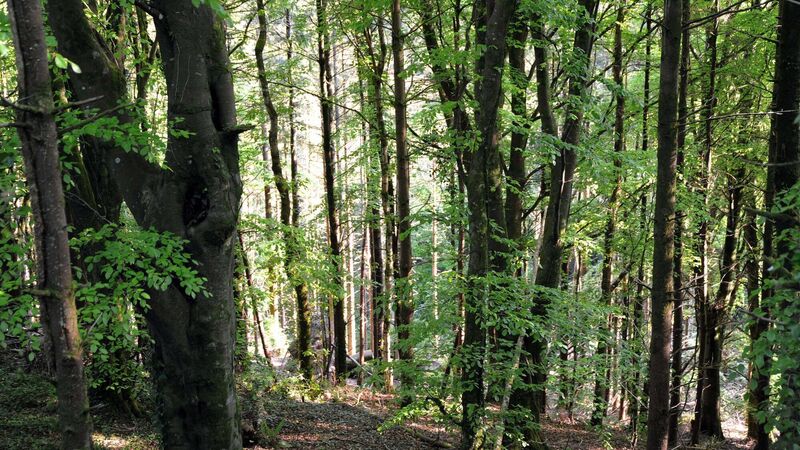
Woodlands are home to a wide variety of plants, animals, and microorganisms. Planting more trees and forests will create and maintain these native species-rich ecosystems. Picture: Denis Minihane

The beauty and crucial importance of Ireland’s trees will be celebrated countywide during National Tree Week, which begins on Sunday, March 9, and continues until March 16.

But this year, the events organised under the umbrella of the Tree Council of Ireland in partnership with Coillte will take place against a background of the devastation caused to forests and other plantations by Storms Darragh and Éowyn.


The first statistically valid satellite assessment available to the Department of Agriculture is that the total area blown down will be nearly 24,000 hectares — more than twice the annual cut.

Forestry minister Michael Healy-Rae said a more detailed analysis was also under way and would give a forest-by-forest assessment with a much greater degree of accuracy.

The initial assessment provides estimated figures at national level and provincial levels. As expected, Connacht is the most affected province. There is roughly an even split between public and private forests.

About 10 million cubic metres of timber is estimated to have been damaged by storms, predominantly in spruce plantations older than 20 years of age.

About 10 million cubic metres of timber is estimated to have been affected, predominantly in spruce plantations older than 20 years of age.

National Tree Week, the country’s largest annual tree celebration, has therefore taken on an added significance as communities and schools across the country come together for various events.

These include plantings, forest and woodland walks, nature trails, guided tours, workshops, webinars, woodturning displays, talks, poetry readings, exhibitions, dramas and competitions.

Coillte and the Tree Council of Ireland have been responsible for planting more than one million native trees in Ireland during National Tree Week since it was first held in 1985. When fully matured, these can absorb 2,500 tonnes of carbon a year, offsetting the emissions of more than 550 cars.

Every year, 150,000 trees are donated to communities. To support this initiative, Coillte is supplying sapling trees to county councils for distribution.

Trees for Cork

Cork County Council, for instance, has helped to plant more than 5,000 trees in the county over the past six years alone. Last year, it allocated more than 1,000 trees to about 100 recipients. This year, it again has more than 1,000 trees on offer in bundles of five or 10.

Apart from their beauty, societal and environmental value, trees also create a sense of identity for communities, as John McLoughlin of the Society of Irish Foresters, explained in the build-up to National Tree Week, which this year has the theme: “Planting Trees, Growing Together”.

Forests act as carbon sinks, sequestering carbon for as long as the trees remain and indeed afterwards if the timber is used for furniture or construction. Therefore, they reduce the concentration of greenhouse gases in the atmosphere.

Trees contribute to the economy through industries such as timber, non-timber forest products, and ecotourism.

Woodlands are also home to a wide variety of plants, animals, and microorganisms. Planting more trees and forests will create and maintain these native species-rich ecosystems.

Trees provide habitat and food for a variety of animal, plant and fungal species, increasing biodiversity. They also filter pollutants from the air, improving its quality.

Trees act as natural filters, preventing run-off during heavy rainstorms by slowing the speed at which the rain hits the ground. This greatly reduces the amount of water and soil lost through run-off. Tree roots also help to prevent soil erosion and contribute to maintaining soil fertility.

Trees contribute to the economy

And they contribute to the economy through industries such as timber, non-timber forest products, and ecotourism. Green spaces and urban trees can enhance the overall quality of life in communities.

Trees in urban areas provide shade, reduce the heat island effect and improve overall comfort. Spending time in green spaces has been linked to reduced stress, improved mental health, and increased physical activity.

It is also estimated that 13,000 townlands, 20%, are named after trees, groves of trees and the uses of trees. Since trees are highly visible in the landscape, many place names have derived from trees and woods.

Launching National Tree Week in Ardee, Co Louth, in 2012, President Michael D Higgins said trees as well as being a feature of our landscapes also hold a significant place in our social history and folklore.

He recalled that 7,000 years ago, almost the entire island was under vast forests of oak, ash, elm and pine, borne out by the ancient tree trunks uncovered in our bogs and by pollen trapped and preserved in peat.

“With the clearance of forests in Ireland over past centuries, the total forest cover dropped to just 1% of land area at the beginning of the 20th century. Following State investment over the last number of decades, however, the level of forest cover has now thankfully been restored to some 11% today,” he said.

President Higgins said investment had helped create a sustainable natural resource that provides the raw material for a strong, export-oriented forest products industry, which in turn makes a significant contribution to the economy and supports many thousands of jobs, of which many are based in rural Ireland.

"It is important for all to recognise, appreciate, and value the many benefits they reap from our forests and woodlands," he said.

x

More in this section

Farming

Newsletter

Keep up-to-date with all the latest developments in Farming with our weekly newsletter.

Cookie Policy Privacy Policy Brand Safety FAQ Help Contact Us Terms and Conditions

© Examiner Echo Group Limited