Farm View: Maintaining public's support is key to farmer protests' success
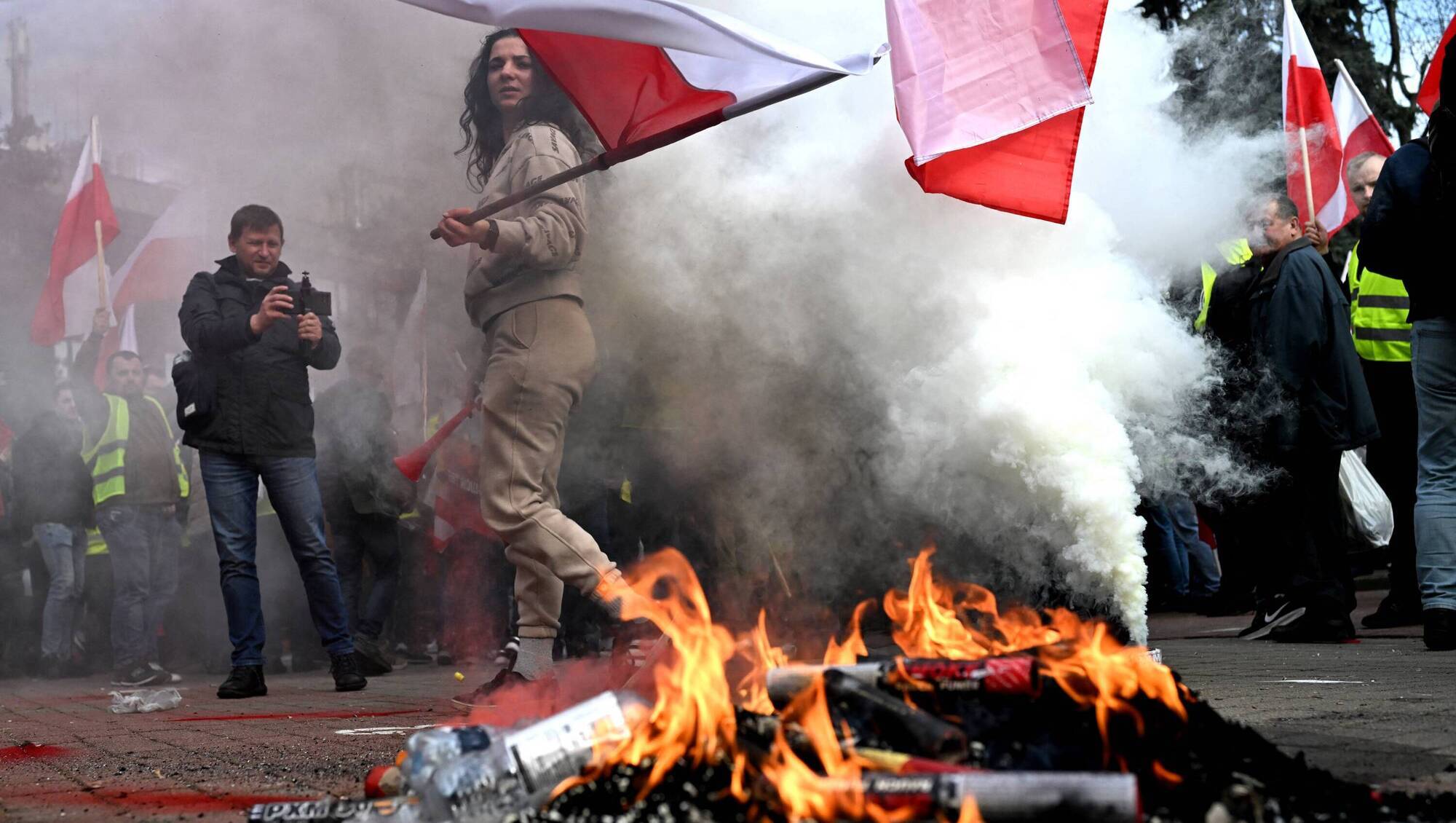
Demonstrators light bottles in front of the Sejm of the Republic of Poland (lower house of the parliament) as they attend a farmers' protest against EU climate measures and Ukrainian imports in Warsaw, Poland on Tuesday, February 27. Picture: Sergei GAPON / AFP via Getty Images.
As farmer protests escalate not only across Europe but now in other countries, including India, there's a fine balance between making an impact and losing the public's respect.
And arguably, in France, where the public support for the farmers has been overwhelming, the greatest wins have been achieved.
But there are signs of fractures between members of the public and farmers in other parts of Europe.
In Brussels, over the last few weeks, protesters have burned tyres, toppled a statue of Belgian-British industrialist John Cockerill, who was one of the pioneers of the steel industry in Belgium, and this week damaged public buildings and injured police officers in clashes.
The organisation's EU advocacy director Raluca Marian said: “Enough is enough. Innocent drivers and transport operators are just trying to do their job, bringing food and other essentials to markets across Europe.
“Everyone has the right to protest but not the right to threaten drivers, attack trucks, and destroy property. And if costly delays, attacks and destruction do happen, someone must pay for it."

From a media perspective, mass dissent offers powerful imagery and demonstrates the palpable anger and frustration felt by farmers, but damaging property can have the opposite effect and can risk alienating the public, who are, at this point, are still largely supportive of the plight of farmers.
Protests in Cork this week were a good example of making accommodations for everyone without jeopardising the message.
Members of the public said the protests were "well-organised" and allowed passengers access to the airport, but it's a fine line and difficult for organisers to retain control when tensions are running high and a crowd begins to enter mob mentality.
A survey carried out by French pollster Elabe showed that the public there was largely supportive of the protesting farmers, with 87% of those surveyed saying they approved of the protests.
However, it should be noted that the survey was carried out at the end of January, not long after the protests had first begun.
Half of those polled said they "support" the farmers, a further 37% had "sympathy" for their cause, while just 5% said they disapproved of the protests.
The key was that the French public have the image of farming as a challenging, strenuous, and passionate profession requiring real skills and character, while being poorly paid.
The French willingness to support the protests despite their impact on the public may be because many there perceive agriculture as an essential sector for our daily lives (96%), a source of French pride (91%), a sector which produces good quality food (90%), which is committed to the environment (75%) and which is modern/innovative (73%) but which is also in difficulty (94%), strongly impacted by the consequences of climate change (91%), which is not internationally competitive (51%).
Meanwhile, in India, 44% of the general public (those not involved in agriculture) who participated said they felt the protests in Punjab were over genuine grievances, compared to 54% of land-owning farmers and 49% of landless labourers, according to polling carried out for India Today, the country's biggest English-language news broadcaster.
When it came to their awareness of the key issues, 68% of non-farmers said they were aware of the demands of farmers, and 61% said they felt the farmers' demands were justified.
However, 43% of non-farming respondents said they felt the inconvenience caused by the protests in India would turn the public against farmers.
As Reuters analysis points out, French unions like the mighty FNSEA have brought some level of discipline to the farmers' protests, so far avoiding the violence seen during the "yellow vest" protests in 2018.
Their more disciplined approach has already won key concessions from the government, but with the protests now continuing for over a month, public support might be getting tested and with that, results might be harder to achieve.