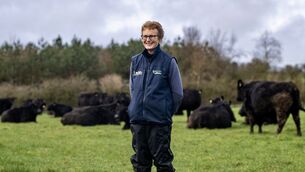
Paula Hynes: The EU may as well tell us "Qu’ils mangent de la brioche"
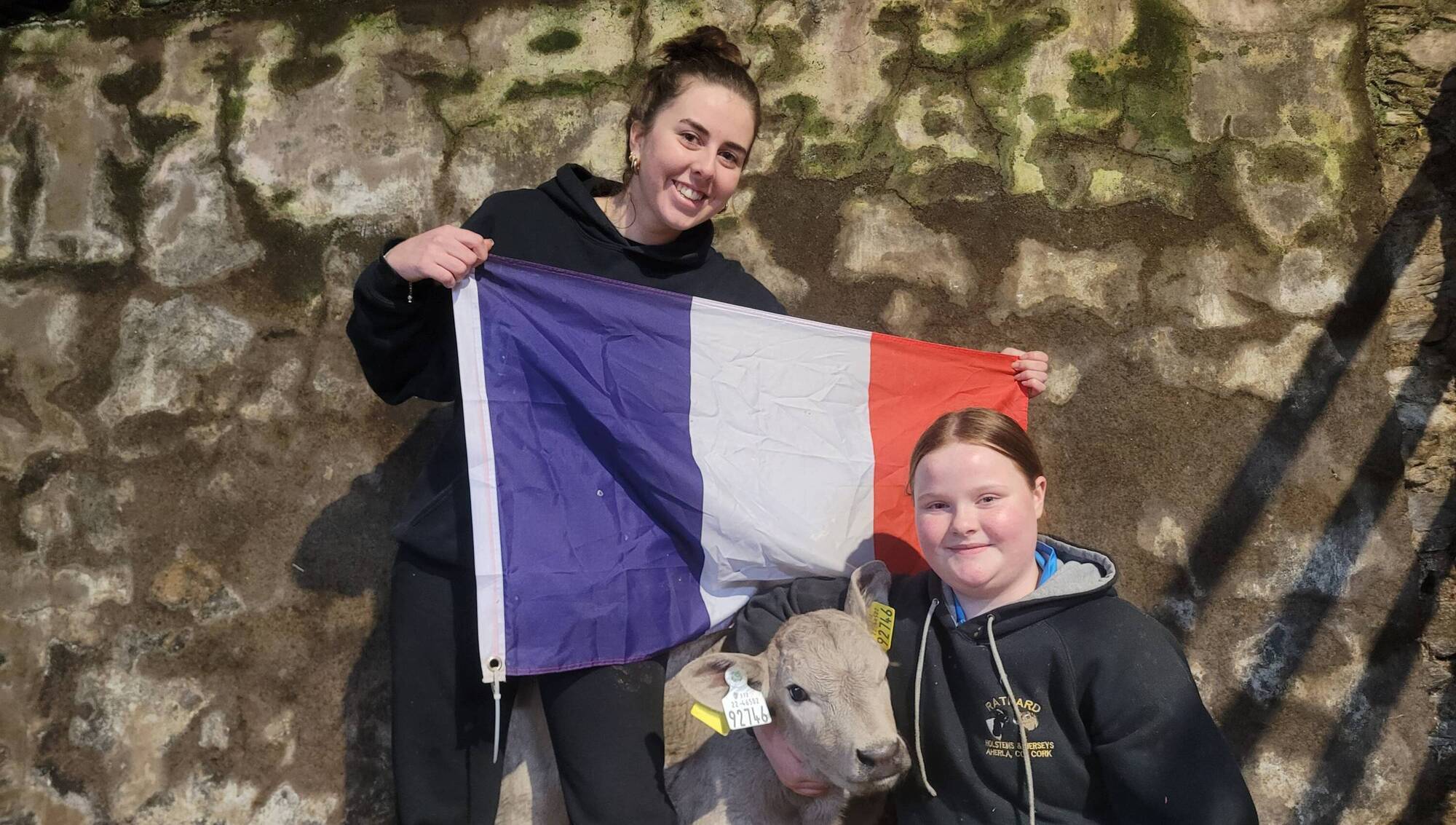
French Veterinary student Valentine Cathala pictured with Georgie Hynes and one of the four Charolais calves born on the family's farm.
Last week seemed like 'French week' here on the farm. Ireland had a big win against France in the Six Nations in Marseille; the farm is busy during the day this time of year, so it’s always nice to have some of the rugby in the evenings.
But most excitingly, our French veterinary student arrived from Bordeaux - she is studying in Portugal and will be with us for four weeks as part of her practical experience. She is not from a farming background, and it is her first time on a dairy farm.
She will get plenty of experience handling cows which are calving; we try not to intervene too much when cows are calving but always allow the students to handle them as it is important that they get as much hands-on experience as they can.
Our student, Valentine, will also be helping a lot with calves so as to be aware of what to look for if a calf is of form but also understand the basics of rearing newborn calves. French farmers also made the news with massive protests, and they united farmers right across the EU to express their frustration towards policymakers.
The French know how to protest, and the farmers have huge public support, with 91% of French people believing farmers do a good job.
The French farmers, like all farmers, are not happy with excessive EU regulations, imports of cheap food which are produced at lower standards are also crippling farmers. France's poultry sector is under huge pressure, especially the smaller farmers. Artic loads of eggs are being imported from the Ukraine, where they are cheaper but have less regulations. The French protests also focused on the Lactalis dairy processor, which has been one of the lowest-paying processors, and like their Irish counterparts, French dairy farmers are struggling to survive.
It was welcoming to see the IFA organize a brief tractor protest in solidarity just as the French farmers started to wind down their two-week protest, but it was also a little disappointing that while the French united farmers across Europe, there is a clear lack of unity amongst Irish farmers. Divided we will fall!
There are so many questions to be asked about Irish agriculture: Why were the other farm organisations not protesting? Could all the farm organizations not stand together for once? I did see a minor protest at the ICSA agm and the online videos continuously mentioned it was not an IFA protest.
There was also some minor tit-for-tat online and in WhatsApp groups amongst farmers. Ridiculous, in my opinion, stand together for God's sake!
One would also wonder why it took the French farmers to generate any sort of decent protest in Ireland, Irish tillage farmers are really struggling, hugely impacted by the weather, land becoming too expensive for them to rent and wheat prices are on a downward spiral. Irish dairy processors have been amongst the lowest payers in Europe over the last 12 months, and Kerry suppliers have been left to paddle their own canoe.
The EU basically said to Irish dairy farmers last year, “Qu’ils mangent de la brioche” [let them eat cake] when they made changes to derogation, and while Ursula Von Der Leyen claims the EU supports farmers with €387.6bn through the common agricultural policy, the reality is enough was enough 12 months ago.
Protests will come and go, but the EU will have to make tactical changes and start to listen to farmers and support them instead of taking them for granted. The fastest way to reduce agricultural emissions and improve water quality is to ensure farmers are making a good living from their farms as farmers are always keen to invest and improve their farms when they can afford to.
It is imperative that the EU regains some unity, it is becoming deeply divided at the moment and as we face into European elections in June of this year, perhaps the new wave of canvassers hoping to become MEP will understand the divisions in order to regain a united Europe, if they don’t grasp that the need a farmer three times a day to feed them then things may not improve for the agricultural sector.
As a friend in France said, “Food is not expensive enough when I see the work that goes into producing what we eat.”
I fully understand the consumer needs cheap food, and the cost of living is a huge issue, but the common agricultural policy was designed back in the 1960s to subsidize farmers to produce cheap food, yet many consumers don’t understand that and believe farmers just get handouts from the EU, now as farmers we are over-regulated with our subsidies getting smaller and food has become even cheaper in the supermarket.
The supply chain says it supports the farmer, but the reality is the farmer carries all the risk, and if global markets weaken, if major weather events occur, if wars break out or if pandemics occur, the farmer is the only part of the supply chain that loses money, and every other cog in the wheel from farm to fork ensures it covers itself financially.
As a person, I love being part of Europe, a common currency, ease of travel between countries, and a strong global voice, but as a farmer, I do have to wonder if my European policymakers love me or simply just take me for granted.
If my week wasn’t French enough, we had four Charolais calves born on the farm today, all of which were arrived 10-12 days before their due date. They are all sired by Lapon, which is a French bull available through Munster Bovine and Progressive Genetics; this was our third season using him.
It is good to get beef calves born in early February, we already have surplus Holstein heifer calves, which is a nice position to be in after the first week of calving.