Officials confident next derogation can be secured
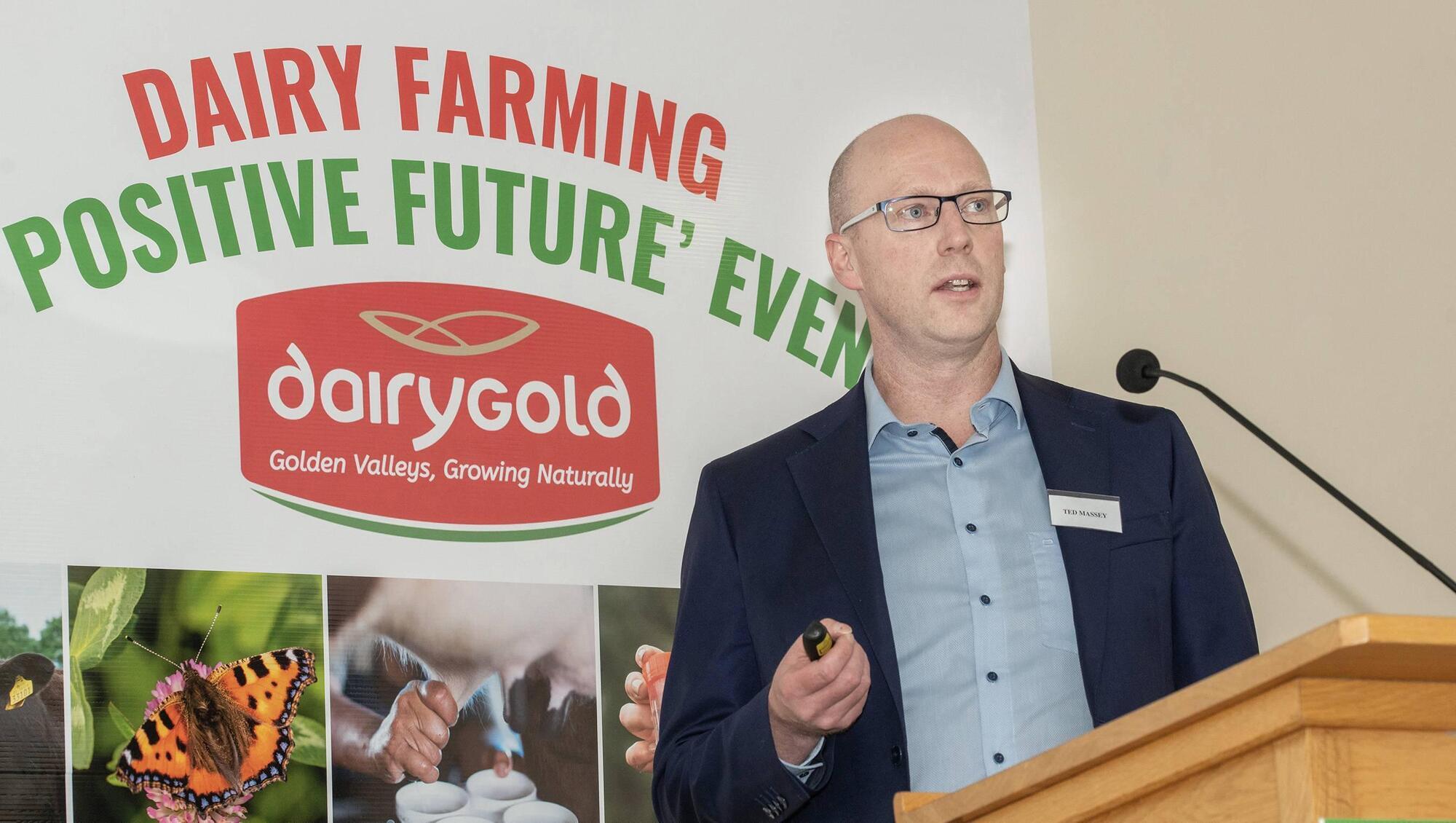
Ted Massey, DAFM chief inspector at the Dairygold Dairy Farming 'A Positive Future' event in Corrin, Fermoy, Co Cork. Picture: O'Gorman Photography
A senior Department of Agriculture official has said he is confident that Ireland will secure another nitrates derogation for post-2025 – but that the big challenge will be to “maintain 220kg and 250kg where we can as maximum stocking rates”.
Senior inspector Ted Massey has said that the Government is “committed to seeking to maintain” the nitrates derogation in Ireland, allowing a higher maximum stocking rate from the 170kg of organic nitrogen per hectare under the rules.
Mr Massey said that later this year, the department “will start to formally engage with the commissioner around the next derogation”.
“We've already started informally in our discussions with the commission,” Mr Massey told a recent Dairygold dairy conference.
“I met the commission nine times last year specifically on the issue of trying to maintain 250kg but also bilaterally, setting the groundwork in place for the next derogation,” he said.
“They will set out what our water quality is like, what our agricultural system is, and what we are doing to justify the derogation.
“Ultimately, we have to convince the commission that they can justify granting us that derogation because it is the commission that will propose an implementing decision for a vote of the member states.”
Firstly, the commission must be “on board”, and when it comes to that vote, it’s a qualified majority vote.
“That means we need at least 15 member states to vote in favour of giving us this exemption and those member states that vote in favour have to represent at least 65% of the EU population,” Mr Massey explained.
“We have to be smart in how we engage with the member states, because there are member states [that] recognise this gives us a competitive advantage.
“So I would be confident if we can get the commission on board, we'll get the member states on board.”
The first Nitrates Action Programme came into operation in 2006, and that was designed to prevent pollution of watercourses caused by agricultural resources, ultimately to protect and improve water quality in line with the directive, Mr Massey told the conference.
“From the outset, we took a national approach covering both nitrogen and phosphorus because they both impact on water quality in Ireland, but they impact in different ways and that differs also by region as well,” he said.
“On our lighter soils of the south and the southeast of the country, we tend to have more of an issue with nitrate because the water drains through the soil, the nitrate is leached through the soil, whereas on our heavier soils where it is more of an issue with runoff, it tends to be more a phosphorous problem.”
In accordance with the directive, the Nitrates Action Programme has to be reviewed every four years.
“It's the very same with the derogation, we can only secure a derogation for four years at a time,” Mr Massey said.
“But we can work to ensure that we will be best placed to maintain our derogation, and that's what we need to do.”
Improving water quality is “not just an issue for derogation farmers”, he said, “these rules apply to all farmers”.
However: “If we look at Irish agriculture, there were significant changes between when the last derogation was secured in late 2017 and the negotiations for our current derogation took place largely in 2021.
“Our dairy herd grew by around 230,000 cows, those cows were becoming increasingly concentrated in the south and the southeast of the country. We were using 30 to 40,000 tonnes more chemical nitrogen per year than we used in 2017.
“Ultimately, our water quality declined.
“That decline, and in particular what happened in 2018, that spike directly led to what we have now at 220kg.”
From the commission’s perspective, it is “under pressure to justify granting a derogation”, Mr Massey said.
“To grant the derogation, they had to be assured that our water quality would improve or that some change would be made,” he said.
“That's why they stipulated those requirements around the water quality review.”
Recommendations of the Agriculture Water Quality Working Group will be finalised shortly, Mr Massey said, and there will be a “very strong focus on awareness raising, improved advisory, and ultimately improving nutrient use efficiency”.
“There is a role for regulation, but of itself, it will not solve our water quality challenges,” he said.
“We have to be aware the water quality in a catchment reflects the accumulative impact of all pressures on that catchment.
“Improvement in water quality is a societal and a consumer demand.
“We have to work to reduce our impact on water quality. The only way we’re going to do that is through us all working together.”
Can Ireland secure the next derogation?
According to Mr Massey: “Yes, I would say most definitely we will secure another derogation – the challenge for us will be to maintain 220kg and 250kg where we can as maximum stocking rates.
“When the commissioner came in November, a few key things came out of that,” Mr Massey said.
“I’m hoping when we go back to Brussels, we will have better water quality data that we can bring there that will show the nitrate concentration is coming down.
“Even if we don’t have that, even if water quality is stable, we will go with that and we will make the point that in Ireland, we have embraced massive change both last year and this year and now the whole of industry is getting behind this issue as well - we’re going to do all the right things.
“We will seek the recognition for that and seek the next derogation on that basis.”
There is a consultation currently open on the Nitrates Directive.
The aim of this consultation, according to the commission, is to “ensure that the public’s interests across the EU are properly reflected in the evaluation of the Nitrates Directive, by gathering stakeholders’ and citizen's views and by collecting feedback”.
The consultation closes on March 8, and welcomes input from “all stakeholders and citizens affected by nutrient losses from agriculture as well as those implementing the Nitrates Directive across the EU”.