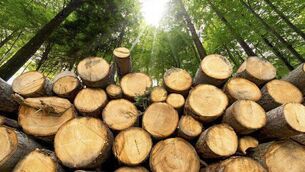
Action plan for ash growers in progress
Minister McConalogue said the Department had initiated actions to eradicate the disease by clearing infected sites and trees that were infected.
A detailed action plan to deal with issues relating to supports for forest owners whose ash plantations were devasted by the dieback disease is being prepared for submission to the Cabinet for approval.
The move by the Department of Agriculture, Food and Marine follows a report by an independent group, which had been tasked by Minister of State Pippa Hackett to review existing supports.

After engaging with relevant stakeholders, the group submitted its report in September, with thirteen recommendations covering a diverse range of issues.
Answering pre-Christmas Dail questions, Agriculture Minister Charlie McConalogue said the plan being prepared will outline comprehensive actions.
Detailed deliberations are taking place to ensure an efficient, appropriate, and proportionate response.
The Minister said there is currently an attractive and enhanced reconstitution scheme for ash dieback open for applications under the new Forestry Programme 2023 - 2027.
It includes a 100% increase in the site clearance grant rate from €1,000 to €2,000 and enhanced replanting grant rates.
A top-up premium equal to the difference between the equivalent forestry type and the existing premium will be paid for those in receipt of farmer rate premium.
Minister McConalogue said this will be calculated for the remaining years left in premium and paid in a single sum.
He said he had stated when the Reconstitution Ash Dieback Scheme opened in July that if a forest owner made an application, they would not be disadvantaged if any changes were made because of the independent review process.
“I want to reiterate that message clearly and encourage ash plantation owners once again to engage with the enhanced reconstitution scheme as the quickest and most effective way to clear and reconstitute affected sites in compliance with the Forestry Act 2014,” he said.
Outlining the action taken to protect ash forests against dieback, he said airborne transmission has resulted in its rapid spread throughout the island of Ireland, where the disease is now widespread.
It is not known when the disease first arrived. The first detections were made in 2012 in both Ireland and Northern Ireland. In the same year it was also first detected in Britain.
The Minister said the Department initiated actions to eradicate the disease by clearing infected sites and trees that were infected.
There is currently a scheme in place for landowners to clear their ash plantations and replace them with another species.
The first such scheme, introduced to slow the spread of the disease and replace infected ash crops with another species of tree was put in place in 2013, he said.
Deputy Joe Flahery said during another Dail debate that virtually every ash tree in the country is rotten. In a lot of estates taken in charge by county councils the tree of choice was ash.
“I have talked to tree surgeons who told me they have never dealt with as many trees in need of removal as they did after the last storm.
“Something needs to be done by the Department in conjunction with the Departments of agriculture and transport. It is going to be a huge issue on our roads as well.
“I suspect a time will come when insurance companies ‘will void’ policies if they detect ash trees along the roadside. Major work needs to be done on this in the new year,” he said.
Senator Victor Boyhan told the Upper House last month that ash dieback is all over the place and must be addressed.
“I would like a debate on forestry with a specific focus on ash dieback and the challenges in terms of insurance,” he said, Meanwhile, Transport Minister Eamon Ryan told the Dail that his Department has no plans to grant-aid the cutting or removal of trees infected with ash dieback.
IFA Farm Forestry Chair Jason Fleming said the report vindicated farmers. The Government’s response, particularly between 2018 to 2023, was ineffective and did not meet the needs of forest owners.
“The speed at which the Government respond on the foot of this report will be critical to rebuilding trust and confidence in forestry and will be fundamental to how farmers judge the attractiveness of forestry as a land-use,” he said.