Calls for National Park plan for the Gearagh
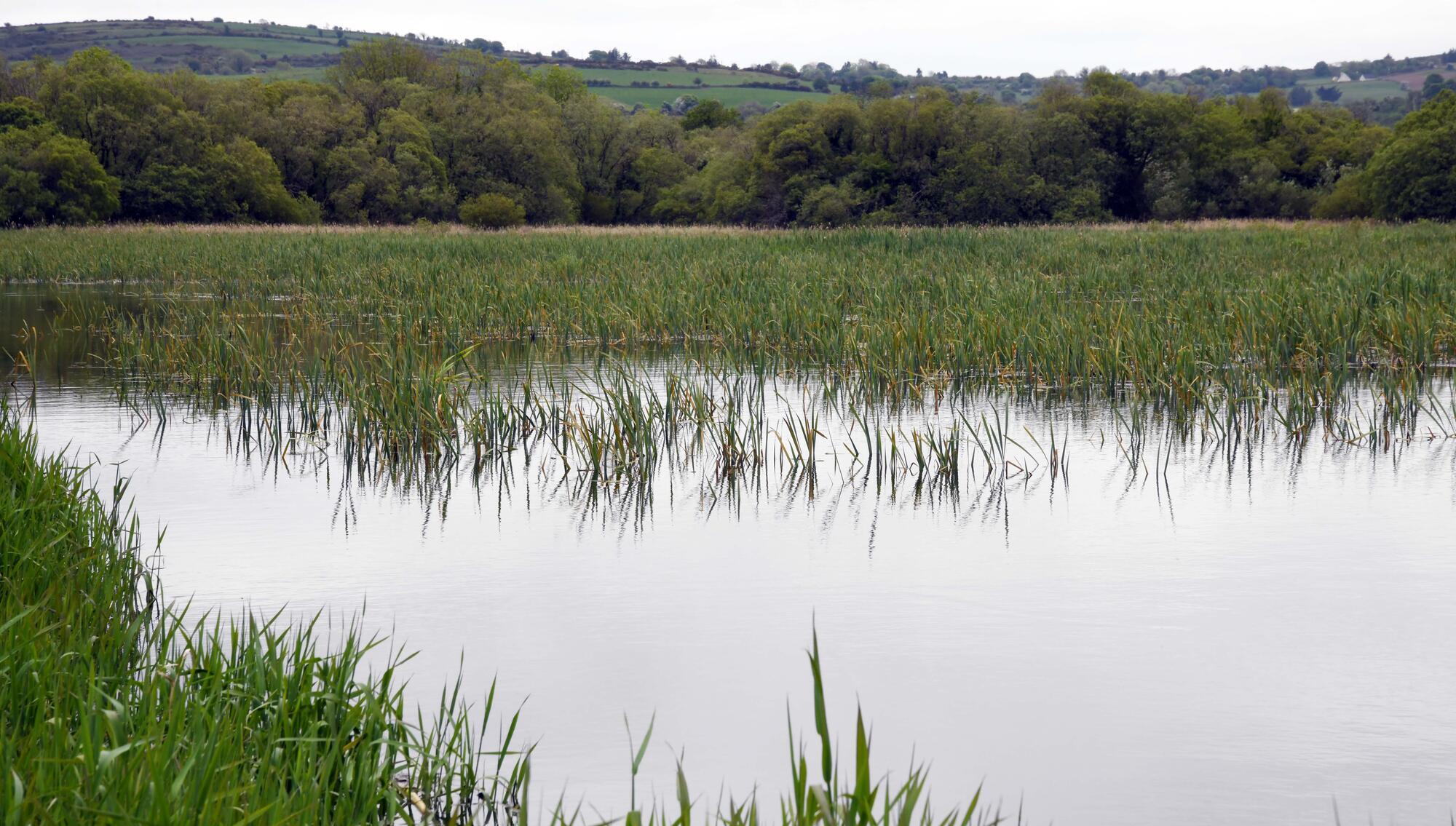
The Gearagh near Macroom, Co Cork.
A draft management plan for The Gearagh, a submerged glacial woodland and nature reserve two kilometres southwest of Macroom, Co Cork, is in the early stages of being compiled by the Electricity Supply Board.
Minister of State Kieran O’Donnell confirmed the move in the Dail, following calls by Deputy Aindreas Moynihan to develop the site into a national park.
Stretching for roughly five kilometres, The Gearagh was previously densely populated with ancient oak trees and the last surviving full oak forest in western Europe.
It was flooded in 1954 to facilitate the building of two hydroelectric dams in Carrigadrohid and Inniscarra, which provide electricity for Cork city.
As that development required the flooding of the region, hundreds of trees were felled, and many people relocated.
Many of the trees were centuries old and had grown since the medieval period. Today, only their stumps survive in flood land, giving the area a ghostly and almost lunar appearance.
The Gearagh comprises wide but shallow water, enclosing a series of small islands separated by mostly flat river streams.
It is an area of outstanding natural beauty, with a diverse ecological system and a wide variety of plants, birds and fish, including freshwater pearl mussels, Atlantic salmon, whooper swans, kingfishers and otters.
Designated as a wetland of international importance, it also enjoys protection as an EU Special Area of Conservation of 558 hectares. Part of it is a nature reserve under the Irish Wildlife Act. A reservoir is a wildfowl sanctuary.
Thought to have been wooded since the end of the last Ice Age, around 8,000 BC, it is Ireland's last primeval river forest.
It was declared a statutory nature reserve in 1987 under the protection of the Wildlife Act, and has not been considered for national park status.
Minister O’Donnell said the Department does not own or manage any part of this special area of conservation (SAC). It is owned largely by ESB.
ESB International undertook a management plan scoping exercise in 2016 and 2017, with the National Parks and Wildlife Service taking part in the stakeholder group that contributed to the report.
The NPWS completed and published detailed site-specific conservation objectives for the Gearagh SAC in September 2016. Monitoring is carried out on a cyclical basis.
It was most recently surveyed during the 2017 and 2018 monitoring period, when the area, structures, functions and future prospects of the habitat in the SAC were all assessed as favourable.
This is in contrast with the national conservation status of alluvial forest habitat in Ireland, which is considered to be bad, and deteriorating.
Minister O’Donnell said the Gearagh SAC is also listed as a habitat of rivers with muddy banks. The results of a 2018 botanical survey which assessed the habitat as "favourable" were also made available to the NPWS by ESB.
Deputy Moynihan noted that the electricity generated over the years at the site has diminished as a proportion of the electricity used in the country.
“The need for the ESB scheme from an electricity point of view has declined. This wonderful park right beside Macroom town draws in wildlife, including migrating birds.
“We had a special visitor again earlier this year, and that, in turn, drew a great many people to the Gearagh.
“This is a double-edged sword because the more that people know about the area, the more who will be attracted to visit it, which creates a threat that it will be damaged.
“A great many people do not know the place, and when they arrive on the site, there is little information provided.
“There is an understanding locally that ESB does not encourage interest in the site, make people aware of it, or put-up signage.
“There is so much that could be done practically on the ground to give people information and promote the place ahead of it securing status as a national park,” he said.
Minister O’Donnell undertook to ask the NPWS to broaden its engagement with ESB on the site with a view to broadening its appeal as regards public use.
Supporting the calls for a National Park plan, Deputy Christopher O'Sullivan said the first penduline tit ever recorded in Ireland landed in the Gearagh last year. An incredibly rare Eurasian bittern was also found there.
Describing the site as a 'Mecca' for rare migrating birds and a perfect habitat for them, he said the water, when it is at a certain level, creates a lovely shore which attracts thousands of wading birds, particularly during the winter.
There are also marshy areas, lagoons and reed beds, and it is perfectly designed because an old road with a few humpback bridges runs right through the middle of it.
“The Gearagh is perfectly designed for visitors to visit and view wildlife and to become a national park and nature reserve. I fully support Deputy Moynihan's call,” he said.