Study indicates area of drained grassland peat soils is 'grossly overestimated'
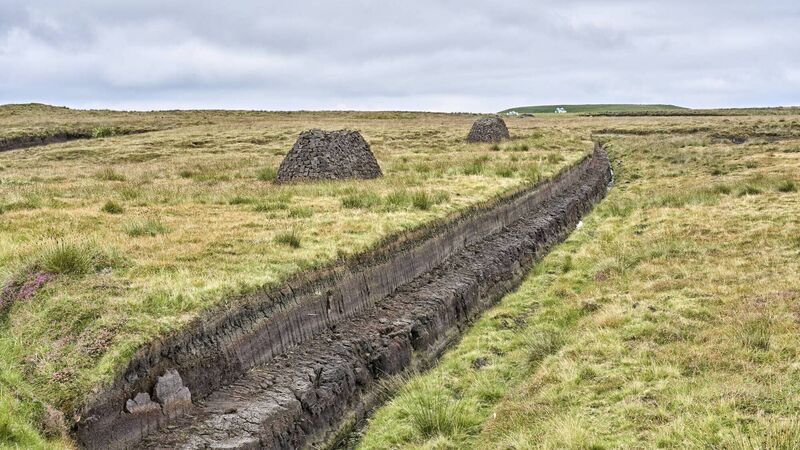
The land-use sector in Ireland is estimated in the national greenhouse gas inventory to be a major source of emissions that are projected to rise to 11.1m tonnes of CO2 equivalent per year by 2030.
A new study has indicated that the area of drained grassland peat soils could be "grossly overestimated" in Ireland.
The land-use sector in Ireland is estimated in the national greenhouse gas inventory to be a major source of emissions that are projected to rise to 11.1m tonnes of CO2 equivalent per year by 2030.
Currently, grassland peat soils are assumed to contribute up to 9m tonnes of CO2 equivalent of this total, due to the assumption that all 335,000 hectares are drained.
According to a new Teagasc study, this estimate is "highly uncertain and relies upon a number of assumptions regarding the drainage status, land classification, areal extent, nutrient status, and the emission factors for agricultural peat soils".
These assumptions are being tested by ongoing research in the National Agricultural Soil Carbon Observatory and other research in the Teagasc Climate Centre to improve the emissions estimates and identify what farmers can do to reduce these emissions.
Results from the study published in the Journal of Environmental Management recently establishes a range of likely scenarios with regard to actual drainage status of peat soils, which estimate emissions in the range of 3.6m – 4.7m tonnes of CO2 equivalent, a saving of up to 60% on current inventory estimates.
These values correspond to a drained area in the range of 90,000 to 120,000 hectares.
The study focuses on the drainage status of agricultural peat soils and combines historical and recent data to offer new insights into the practices of peatland drainage, historical drainage efforts, and likely efficacy at national scale.
Teagasc's Dr Pat Tuohy explained that while large areas of peatland have been transformed from their natural state to grassland agriculture, "there is no evidence to support that effective drainage ever occurred on as much land as previously assumed".
"The drainage status of all grassland peat soils requires further investigation," he said.
Professor Owen Fenton added that this study has proposed these potential emissions savings "by compiling decades of evidence related to drainage status of peat soils".
"We uncovered data in national scientific literature and reports, which enabled a more accurate national figure for drainage status to be proposed," he said.
The application of these findings could impact significantly on the estimated emissions from grassland peat soils and more broadly on the land use, land use change and forestry sector (LULUCF), and this paper could support policy relating to these soils and their management, Teagasc has said.
By accurately quantifying the impact of drainage status on these soils, Ireland can adopt targeted strategies to mitigate CO2 emissions and make informed policy decisions that contribute to a greener future.
While this work offers the potential for positive changes in terms of LULUCF emissions, the refinement of other aspects, yet to be quantified, may result in increased emissions.
The LULUCF sector is a separate sector in the national inventory to the agriculture sector.
A 25% reduction target by 2030 has been set for the agriculture sector, but work is still ongoing to agree a target for the LULUCF sector.