250kg stocking rate under nitrates derogation 'has to be fought for'
A reduction in the maximum stocking rate to 220kg under the nitrates derogation would be “detrimental” for farms.
250kg stocking rate under nitrates derogation 'has to be fought for'

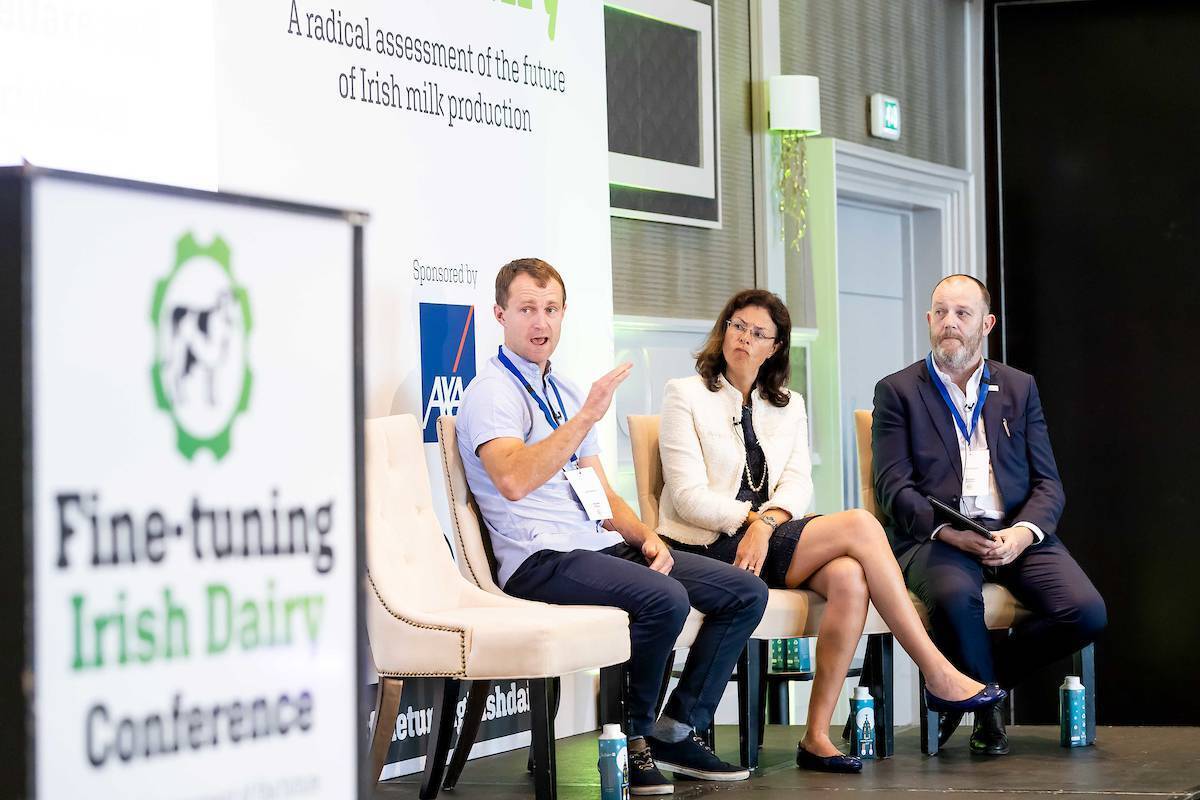
Dairy farmer Joe Deane with National Dairy Council chief executive Zoe Kavanagh and ICOS chief executive TJ Flanagan during a panel discussion on nitrates. Picture: Alison Miles / OSM PHOTO

The 250kg nitrates derogation will have “to be fought for”, farmers stressed at a recent conference in Co Cork.

Speaking at the conference, Cork dairy farmer Joe Deane said farmers feared being “strangled with regulation before new science and technology has the chance to be implemented to combat the challenges facing the industry”.

He said a reduction in the maximum stocking rate to 220kg under the nitrates derogation would be “detrimental” for farms.

Deane urged farm organisations and Government to “fight hard” in Europe for the retention of the nitrates derogation at 250kg, saying that farmers needed “more time” to continue to help to improve water quality.

“There are very big changes this year with nitrates, all that will just take time to come through,” Mr Deane said.

“In fairness, the majority of farmers are adapting and willing to invest and make changes.”

EPA report

The EPA has this week published its data on water quality in 2022, showing, overall, no significant improvement in the biological quality of rivers or lakes.

Nitrogen levels — caused mainly by agricultural use of fertilisers and manures — have increased in rivers and groundwater, and phosphorus levels, mainly from agricultural runoff and wastewater discharges, are generally stable but are still too high in many rivers and lakes.

The agency stressed action needs to be taken by the agriculture sector and Uisce Éireann to reduce the impact of both nutrients on the environment.

Time is the “key piece here”, ICOS chief executive TJ Flanagan told the Fine-Tuning Irish Dairy conference last week.

From talking to co-ops, the amount of chemical fertiliser that has been purchased, and therefore I assume spread, has fallen off a cliff in the last two years,” he said.

“The precision that has been brought to the spreading of slurry has been incredible over the last couple of years.

“There’s been a huge change, but to lock us into a particular point in time [for water quality improvement] and effectively only give us one year to expect the results to manifest themselves, I think it’s crazy.”

New working group

A newly established Agriculture Water Quality Working Group had its first meeting late last month.

Chaired by the Department of Agriculture, the working group includes representatives of the farm organisations, the agri-food industry, Teagasc, private agricultural consultants, local authorities, and officials from the Department of Housing, Local Government and Heritage.

The aim of the working group is to identify and commit to demonstrative actions that will facilitate the agricultural sector to contribute to improved water quality.

Following the meeting, Minister for Agriculture Charlie McConalogue highlighted that over the last decade, water quality has declined.

“Agricultural pressures have contributed to this decline. The collective engagement, ambition, and commitment demonstrated by leading stakeholders from across the agri-food sector on this working group is a pivotal action that we wish to use to facilitate a reverse in recent negative water quality trends with a view to seeking to secure our nitrates derogation in the longer term,” Mr McConalogue said.

Review

An interim review of the current Nitrates Action Programme is required this year.

In awarding Ireland its current nitrates derogation, the European Commission imposed conditionality around water quality trends.

Its implementing decision states that where water quality is poor, or where worsening trends occur over the period 2021-2022, the maximum livestock manure nitrogen per hectare limit must be reduced from 250kg nitrogen per hectare to 220kg nitrogen per hectare from January 2024.

Based on updated water quality data, published this week by the EPA, this review will consider the effectiveness of existing and the requirement for new measures.

The review is led by the Department of Housing, and guided by the Nitrates Expert Steering Group.

Minister McConalogue has made a commitment to preparing a case to reengage and seek flexibility on the timing of this review from the commission, with a view to giving existing measures more time to demonstrate their impact.

However, there is no guarantee that there will be any change to the commission’s decision as it stands.

Impact on other sectors

ICOS chief executive Mr Flanagan also highlighted at the recent conference the impact of a reduced maximum stocking rate on other sectors.

He warned, for example, that it could “decimate the tillage sector”.

“We need the tillage farmer, we need native grains, proteins, straw,” Mr Flanagan said.

“We also need a strong livestock sector as well — who’s going to take our calves to beef?

“The answer can’t be that we force dairy farmers to take more land, drive the price of land; that’s unfortunately what they’re doing at the moment.”

He said that the “nitrates box” that regulators want to tick “has taken over their viewpoint”.

“Forcing dairy farmers to take land that would’ve been probably low-intensity land and then bringing it into the dairy system as well, that’s not good for biodiversity either,” he added.

Time needed

MEP Billy Kelleher told the conference that he believes that Ireland “has to keep the 250kg” derogation.

“If we had additional time to assess the improvements we have made in terms of slurry storage, slurry spreading, and the other mitigating factors that are now part and parcel of obligations under the derogation, then I believe it would show we can farm and that we can also improve water quality,” Mr Kelleher said.

“But we do need time, that is the most important factor.”

He said that concerns about the impact of agriculture on the environment are “now engrained in policymaking decisions” in Europe.

“Traditionally, agricultural policy was looked at through the prism of agriculture first and then amended to try and lessen the impact on the environment,” Mr Kelleher said.

“Most of the flow of legislation and policy is now put through an environmental prism first, and then agriculture is forced into it, and that has been a significant policy shift that has happened in the last 10 years.

“A lot of it for good reason, but a lot of it will cause significant challenges as well.”

More in this section

Farming

Newsletter

Keep up-to-date with all the latest developments in Farming with our weekly newsletter.

Cookie Policy Privacy Policy Brand Safety FAQ Help Contact Us Terms and Conditions

© Examiner Echo Group Limited