Strategy lays our road map for Irish seaweed sector
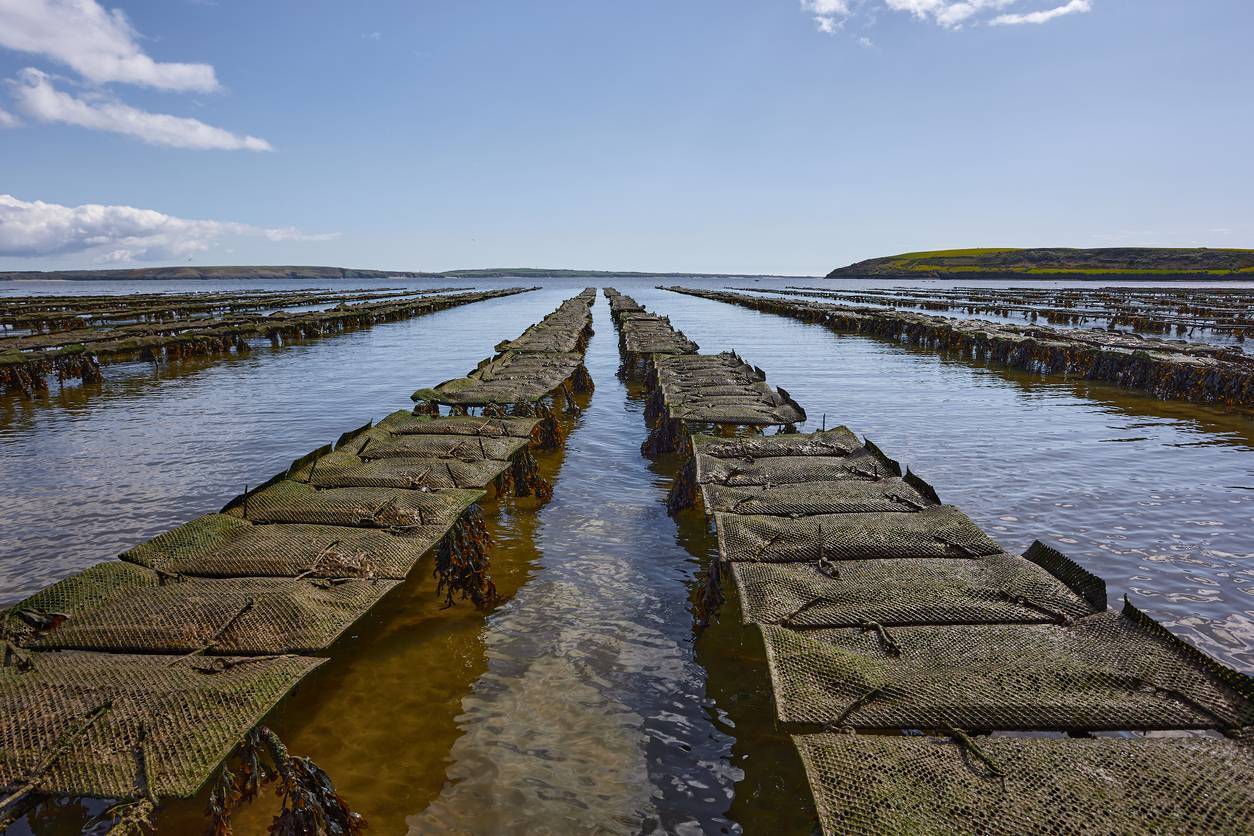
Oyster and seafood growing at Woodstown Beach, Co Waterford.
Generations ago, farmers brought seaweed home over the years to fertilise the land. Others availed of its therapeutic qualities to soothe stiff and painful bones in seaweed baths.
The crop is also used today as an ingredient in cosmetics, pharmaceuticals, fertilisers, organic food, and health supplements. Seaweed farming in Ireland, however, is still a new strategy.
But a road mark to develop it as a sustainable and profitable sector in the aquaculture sector has just been published by Bord Iascaigh Mhara (BIM) – the Irish Fisheries Board.
Annual global output is now in excess of 35 million wet tonnes, 97% of which is cultivated biomass. Most of it is from Asia (China, Indonesia, Republic of Korea and Philippines).
BIM chief executive Caroline Bocquel said that the volume of farmed seaweed must increase to ensure a sustainable and economically profitable aquaculture industry in Ireland.
“Ireland’s long coastline and clean cold waters present the ideal conditions to cultivate seaweed, and to sustainably develop this crop that is highly resource efficient, requiring minimal resource input,” she said.
There are currently 25 licenced seaweed farms in Ireland, located along the north-west, west and south-west coastline. Farmed seaweeds, grown on ropes and nets, are exceptionally fast growing plants.
Michael O’Neill, chief executive at Pure Ocean Algae, a seaweeds biotech company based at Allihies on the Beara Peninsula in West Cork, welcomed the new strategy.
He spoke about the need to unlock the potential of the seaweed sector in Ireland to meet the growing demand for sustainably produced food and claimed the industry has the highest potential for growth in the Irish aquaculture sector.
Currently, an estimated 40,000 tonnes of seaweed are harvested each year in Ireland, the third highest in Europe after Norway and France, with most of this being processed into food products or animal feed.
BIM estimates, however, that only 1% of Ireland’s seaweed is converted into higher-value outputs such as cosmetics and medicinal products, but this amounts to 30% of the total commercial value.
Advances in cultivation technology and processing, leaves Ireland extremely well positioned to become a major player in the international seaweed industry, with the demand for seaweed biomass and seaweed-based products outstripping supply for the foreseeable future.
Mr O’Neill said: “We can grow the most fantastic seaweed in Ireland, and we are looking to develop that into an industry, an industry that is appropriate to our coastal community and our coastal locations.” He added that Pure Ocean Algae looks forward to playing its part in the implementation of the findings in the review.
BIM meanwhile says there is clearly an opportunity for Irish seaweed growers to upscale production, but there seem to be some constraints on the development of the industry.
Of the 11 sites surveyed, only one grower was using their entire licensed area, while another had opted to forego growing seaweed and use their multi-species licence to grow mussels instead.
Only 16% of the overall area licensed to grow seaweed were being utilised. However, most farmers planned to apply for a licence to increase their acreage.
Three currently have applications to do so with Department of Agriculture Food and Marine (DAFM), according to the roadmap, adding that it could be surmised growers were waiting for a market to fulfil their potential.
Ailbhe McGurrin, a PhD Researcher in Marine Biotechnology at UCD, in collaboration with Teagasc and Bantry Marine Research Station, also suggested in an RTÉ Brainstorm article last month that Ireland has the potential to become a global leader in medicines sourced from seaweeds.
An Irish Research Council awardee, she noted that lots of countries across the world have used natural medicines such as seaweed for thousands of years, but only recently has their potential for pharmaceutical medicines been investigated.
It is predicted that over 10 million people will die each year from antimicrobial-resistant infections by 2050 and the World Health Organisation has declared such resistance to be one of the top 10 global public health threats facing humanity.
Due to the harsh environment in the world's seas and oceans, seaweeds produce many different chemicals to protect themselves in their natural habitat, including antimicrobial chemicals or compounds to protect them from bacteria in the sea.
It has been found that seaweeds are full of thousands of these 'bioactive’ compounds, which have health benefits such as antimicrobial and anti-inflammatory properties.
Scientists have begun to explore the natural antimicrobial compounds inside seaweeds to see if they could be used as medicines to cure infections in humans.
Researchers in Teagasc are using new extraction techniques such as ultrasounds and microwaves, which are energy efficient and use non-toxic chemicals (usually water) to extract the bioactive compounds from inside the seaweeds.
McGurrin suggested that seaweed could become an important part of Ireland's marine economy, with a global market value expected to reach $22.13bn by 2024.